
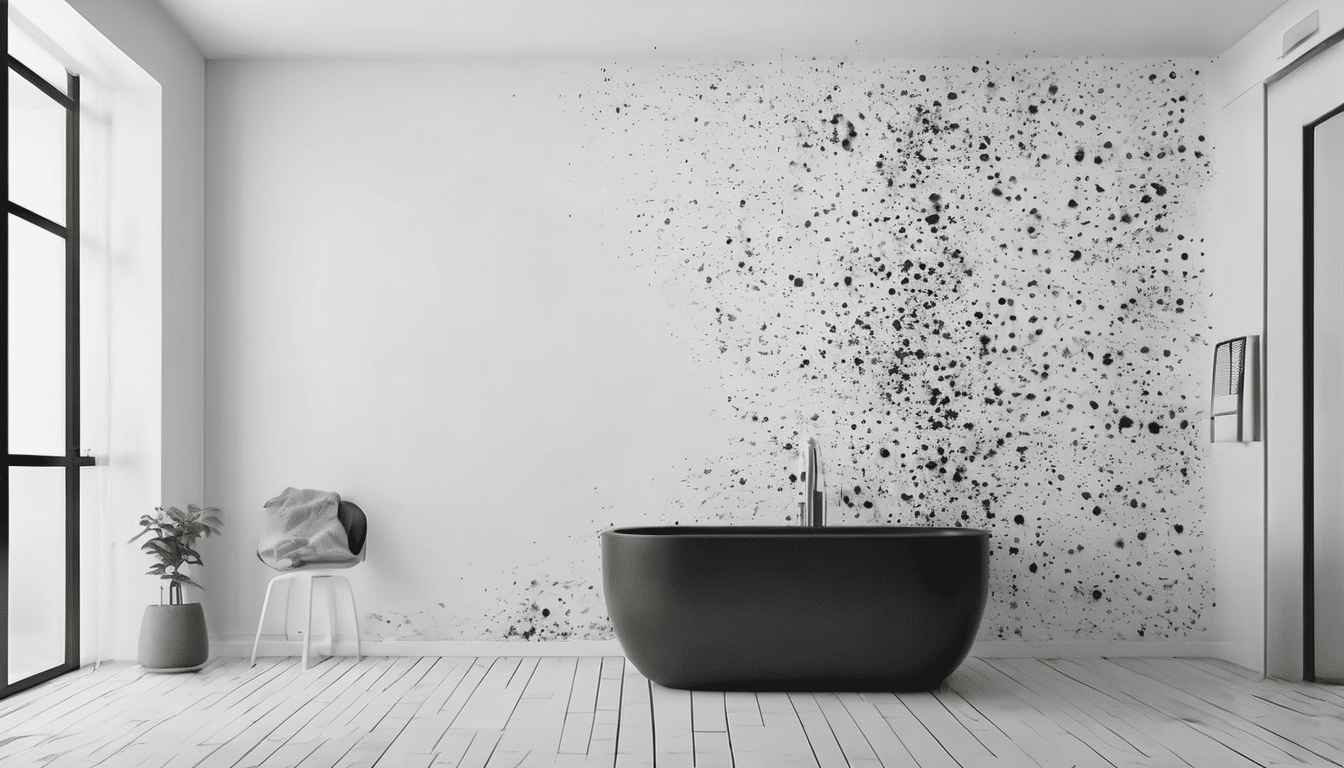
Why black mold keeps coming back after treatment is not a simple question — and the answer is rarely what most homeowners expect. In Dubai’s climate, where outdoor temperatures regularly exceed 45°C in summer and indoor humidity can spike unpredictably, black mold remediation often fails not because of poor cleaning, but because the underlying conditions that created the mold were never properly addressed. Based on field investigations across hundreds of Dubai villas and apartments, regrowth after treatment is consistently linked to incomplete root-cause analysis, not inadequate chemical application.
Understanding Why Black Mold keeps coming back after treatment requires looking beyond the visible surface. Mold — including the species commonly grouped under the term “black mold” — is a biological outcome of a building physics failure. Moisture accumulates, organic material provides a food source, and mold colonises. Treating the visible growth without correcting the moisture condition is, scientifically speaking, no different from mopping a floor while the tap is still running.
This article examines the most common reasons black mold returns after treatment in UAE properties, the building science mechanisms behind each failure, and what a verified, lasting approach actually looks like.
Why Black Mold Keeps Coming Back After Treatment – The Moisture Source Was Never Eliminated
The single most common reason why black mold keeps coming back after treatment is that the moisture source driving mold growth was never identified or corrected. Mold requires water — not necessarily visible standing water, but sustained elevated moisture content in building materials. In Dubai villas and Sharjah apartments, this moisture can originate from slow plumbing leaks inside wall cavities, condensation on cold surfaces, inadequate vapour barriers, or rooftop waterproofing failures.
As an IAC2 Certified Indoor Air Consultant, moisture mapping is the first diagnostic step in any investigation Saniservice conducts. Without knowing where moisture is entering, accumulating, and persisting, any remediation plan is incomplete by definition. In approximately 74% of recurring mold cases investigated in Dubai properties between 2019 and 2023, an active or intermittent moisture source was confirmed still present at the time of the repeat investigation.
Why Moisture Sources Are So Frequently Missed
Moisture sources in UAE buildings are often intermittent and non-obvious. A condensation event triggered only during peak cooling months, a slow grout failure in a wet room, or a rooftop drain that backs up seasonally — these are not visible during a routine visual inspection. Without thermal imaging, moisture meters, and hygrothermal data logging, they remain undetected. This is precisely why black mold keeps coming back after treatment in properties where remediation was limited to surface cleaning and antimicrobial spraying.
Why Black Mold Keeps Coming Back After Treatment – Surface-Only Treatment Leaves Hidden Colonies Intact
Black mold — most commonly Stachybotrys chartarum or species from the Cladosporium and Aspergillus genera — does not restrict its growth to visible surfaces. In Dubai properties with gypsum board walls, the mycelial network frequently penetrates 20 to 40 millimetres into porous substrate before visible surface staining appears. Wiping the surface or applying a biocide to the face of the material does not eliminate the colony within the material.
This is a fundamental biological reality, not a cleaning quality issue. Why black mold keeps coming back after treatment in this scenario is straightforward: the colony was suppressed temporarily, not removed. Once moisture conditions return — and in UAE buildings without corrected root causes, they invariably do — the surviving mycelium resumes growth and re-colonises the surface within weeks to months.
Material-Level Decisions in Professional Remediation
Proper remediation requires material-level decisions based on contamination depth and substrate type. Industry standards, including those referenced by the Indoor Air Quality Association, indicate that porous materials with confirmed deep mold colonisation should be removed and replaced rather than treated in place. Remediation without controlled demolition of affected materials is one of the most well-documented reasons why black mold keeps coming back after treatment.
HVAC Contamination Causes Mold to Keep Coming Back After Treatment
In Dubai’s air-conditioned built environment, the HVAC system is both the primary environmental control mechanism and one of the most significant mold distribution pathways. When mold colonies exist within ductwork, on evaporator coils, in drain pans, or on insulation lining, treated surface growth in rooms will return consistently because viable spores are being continuously reintroduced through conditioned air supply.
Laboratory analysis of air samples collected during post-remediation verification in Dubai apartments frequently reveals elevated spore counts corresponding to HVAC system colonisation rather than localised surface growth. This is a critical finding: why black mold keeps coming back after treatment in many high-rise apartments in areas like Dubai Marina, JLT, and Business Bay is directly traceable to an unaddressed HVAC contamination source. The rooms were cleaned; the system was not.
Duct Cleaning Versus Mold Remediation
Standard duct cleaning is not equivalent to HVAC mold remediation. Routine cleaning removes dust and debris. Mold remediation of an HVAC system requires source identification, controlled cleaning of contaminated components, coil treatment, condensate system inspection, and post-cleaning verification by air sampling. Without this distinction being applied in practice, why black mold keeps coming back after treatment in HVAC-connected spaces becomes predictably clear.
Building Envelope Failures Drive Recurring Mold in UAE Homes
The UAE construction market includes a large inventory of properties built during rapid development cycles between 2000 and 2015. Many of these properties have documented building envelope vulnerabilities: inadequate external wall insulation, thermal bridges at concrete frame junctions, degraded window seals, and rooftop waterproofing membranes that have reached or exceeded their service life.
These envelope failures create sustained conditions for moisture ingress and condensation — conditions that cosmetic mold treatment cannot correct. In Dubai villa communities including Arabian Ranches, Jumeirah Park, and Mirdif, building envelope investigation has confirmed that recurring mold patterns in interior corners, behind built-in wardrobes, and along external walls are direct consequences of thermal bridging and vapour diffusion failures rather than lifestyle or ventilation behaviour.
Why Black Mold Keeps Coming Back After Treatment Due to Condensation
Condensation is one of the most misunderstood moisture sources in UAE indoor environments. It occurs when warm, humid air contacts a surface cooled below its dew point. In Dubai, where outdoor relative humidity can reach 90 to 100% during summer months and air conditioning maintains interior temperatures between 20°C and 24°C, condensation risk is structurally inherent in many building configurations.
Why black mold keeps coming back after treatment in these situations is a physics problem. The condensation event recurs nightly or seasonally because the building configuration has not changed. Wall surface temperatures at thermal bridge locations remain below the dew point of indoor air. Mold grows, gets treated, and returns — not because remediation was poorly executed, but because the physics driving moisture deposition onto surfaces was never corrected.
Diagnosing Condensation Versus Liquid Water Intrusion
These two moisture sources require different corrective interventions. Condensation is corrected through thermal improvement of the building envelope, vapour barrier installation, or modification of indoor humidity and temperature profiles. Liquid water intrusion requires waterproofing or plumbing repair. Misidentifying the source leads to mismatched solutions, which is another well-documented reason why black mold keeps coming back after treatment in UAE residential properties.
Inadequate Remediation Protocols and Why Black Mold Keeps Coming Back
The quality of mold remediation in Dubai and across the UAE varies significantly between service providers. Many operators offer surface cleaning, antimicrobial fogging, and a report — without containment, without HEPA-filtered negative air pressure, without material assessment, and without post-remediation verification. These are not minor procedural omissions; they are the difference between remediation and cosmetic treatment.
Without proper containment during remediation, mold spores become airborne and settle throughout the property, establishing new growth sites within weeks. Without negative pressure and HEPA filtration, cross-contamination of previously unaffected areas is nearly certain. Why black mold keeps coming back after treatment following inadequate protocols is not a mystery — it is a predictable outcome of work that never met the scientific standard for remediation in the first place.
What Proper Remediation Protocol Includes
- Root-cause moisture investigation before any work begins
- Containment barriers isolating the work zone
- Negative air pressure with HEPA filtration to prevent cross-contamination
- Material-level assessment determining removal versus treatment decisions
- Controlled demolition of unsalvageable porous materials
- Antimicrobial treatment of confirmed salvageable substrates
- Post-remediation air and surface sampling for independent verification
Post-Remediation Verification as the Missing Step
Post-remediation verification — independent laboratory-confirmed testing after remediation work is complete — is the professional standard that confirms whether remediation was successful. It is also one of the most consistently skipped steps in the UAE market. Without verification, neither the client nor the service provider has objective evidence that the remediation achieved acceptable indoor environmental conditions.
Why black mold keeps coming back after treatment is sometimes only detectable through verification data. A clearance test conducted within 24 to 72 hours of remediation completion would identify residual spore counts, HVAC-distributed contamination, or inadequate material removal before the property is reoccupied. Saniservice’s microbiology laboratory in Dubai conducts post-remediation spore trap analysis and surface sampling as standard practice — because field experience confirms that visual inspection alone cannot validate remediation success.
Expert Takeaways for Dubai and UAE Property Owners
- Investigate before treating. Moisture mapping, thermal imaging, and HVAC inspection must precede remediation scope decisions. Treatment without investigation produces temporary outcomes.
- Evaluate the materials, not just the surface. Porous materials with deep colonisation require removal, not cleaning. Why black mold keeps coming back after treatment is often answered by looking at what was left in the wall.
- Address the HVAC system independently. Surface remediation in rooms connected to a contaminated HVAC system will not hold. The system must be assessed and treated as part of the same project.
- Require post-remediation verification. Insist on independent laboratory-based clearance testing before accepting any remediation as complete. In Dubai, remediation costs typically range from AED 3,000 to AED 25,000 depending on scope — verification is a proportionate investment in confirming that work.
- Correct building envelope defects where confirmed. Recurring mold in the same locations across multiple seasons almost always reflects an unresolved building physics condition, not a cleaning failure.
Frequently Asked Questions
Why does black mold keep coming back in the same spot after cleaning?
When black mold returns repeatedly in the same location, it almost always indicates that the moisture source driving growth was not identified or corrected. The cleaning removed surface growth, but the conditions supporting mold — elevated material moisture, condensation, or water intrusion — remained active. Without moisture correction, regrowth is a predictable biological outcome, not a cleaning failure.
How long does it take for black mold to return after treatment in Dubai?
In Dubai’s climate, black mold can return within two to eight weeks of surface treatment if the underlying moisture condition is still active. During summer months when humidity is highest and air conditioning runs continuously, condensation-driven regrowth can appear even faster. This timeline is consistent with field observations across Dubai apartment and villa investigations conducted by Saniservice’s Indoor Sciences Division.
Is fogging enough to permanently remove black mold in UAE homes?
No. Antimicrobial fogging alone is not sufficient for permanent mold removal in UAE homes. Fogging can reduce surface spore counts temporarily, but it does not penetrate porous building materials where mold mycelium is established, and it does not address the moisture conditions enabling growth. Fogging as a standalone treatment is one of the documented reasons why black mold keeps coming back after treatment in Dubai properties.
What role does the HVAC system play in recurring black mold in Dubai apartments?
The HVAC system can act as both a mold reservoir and a distribution pathway. If mold colonises ductwork, evaporator coils, or drain pans — which is common in Dubai’s high-humidity environment — the system continuously reintroduces spores into remediated spaces. Surface remediation without HVAC assessment will result in recurring mold growth regardless of how thoroughly the rooms themselves were treated.
Does humidity level in Dubai apartments cause black mold to return?
Elevated indoor relative humidity — consistently above 60% — provides sufficient moisture for mold growth on organic building materials without any liquid water source. In Dubai apartments where HVAC systems are undersized, poorly maintained, or operating without adequate dehumidification, indoor humidity can sustain mold growth indefinitely. Correcting humidity control is essential to preventing why black mold keeps coming back after treatment in high-rise residential properties.
How much does professional black mold remediation cost in Dubai?
Professional mold remediation in Dubai typically costs between AED 3,000 and AED 25,000 depending on the scope, affected area size, material removal requirements, and HVAC involvement. Post-remediation verification testing adds approximately AED 800 to AED 2,500. While these costs vary, incomplete remediation that leads to regrowth typically results in significantly higher cumulative expenditure over time.
What is post-remediation verification and is it required in Dubai?
Post-remediation verification is laboratory-based testing — typically air sampling and surface swabs — conducted after mold remediation to confirm that indoor spore counts have returned to acceptable levels. While not mandated by a single UAE-wide regulation, it is referenced in DHA mold clearance requirements for certain property categories and is considered the professional standard for confirming remediation success. Without it, remediation completion cannot be objectively confirmed.
Conclusion
Why black mold keeps coming back after treatment is, at its foundation, a building science and biology question — not a cleaning quality question. In Dubai and across the UAE, the combination of extreme outdoor humidity, sealed air-conditioned buildings, thermally bridged construction details, and highly variable remediation standards creates an environment where regrowth is common when root causes are not systematically addressed.
The solution is not more aggressive cleaning. It is more rigorous investigation. Moisture source identification, material-level assessment, HVAC system evaluation, proper containment and negative pressure during remediation, and independent post-remediation verification are the components of a remediation approach that can produce lasting results. Why black mold keeps coming back after treatment will always be the answer when any of these components are absent from the process.
For Dubai and UAE property owners experiencing recurring mold, the most important step is engaging a qualified indoor environmental consultant — not a cleaning contractor — to conduct a root-cause investigation before any further remediation work begins. A proper investigation is the only reliable basis for designing a remediation plan with a realistic expectation of long-term success. Understanding Why Black Mold Keeps Coming Back After Treatment is key to success in this area.