
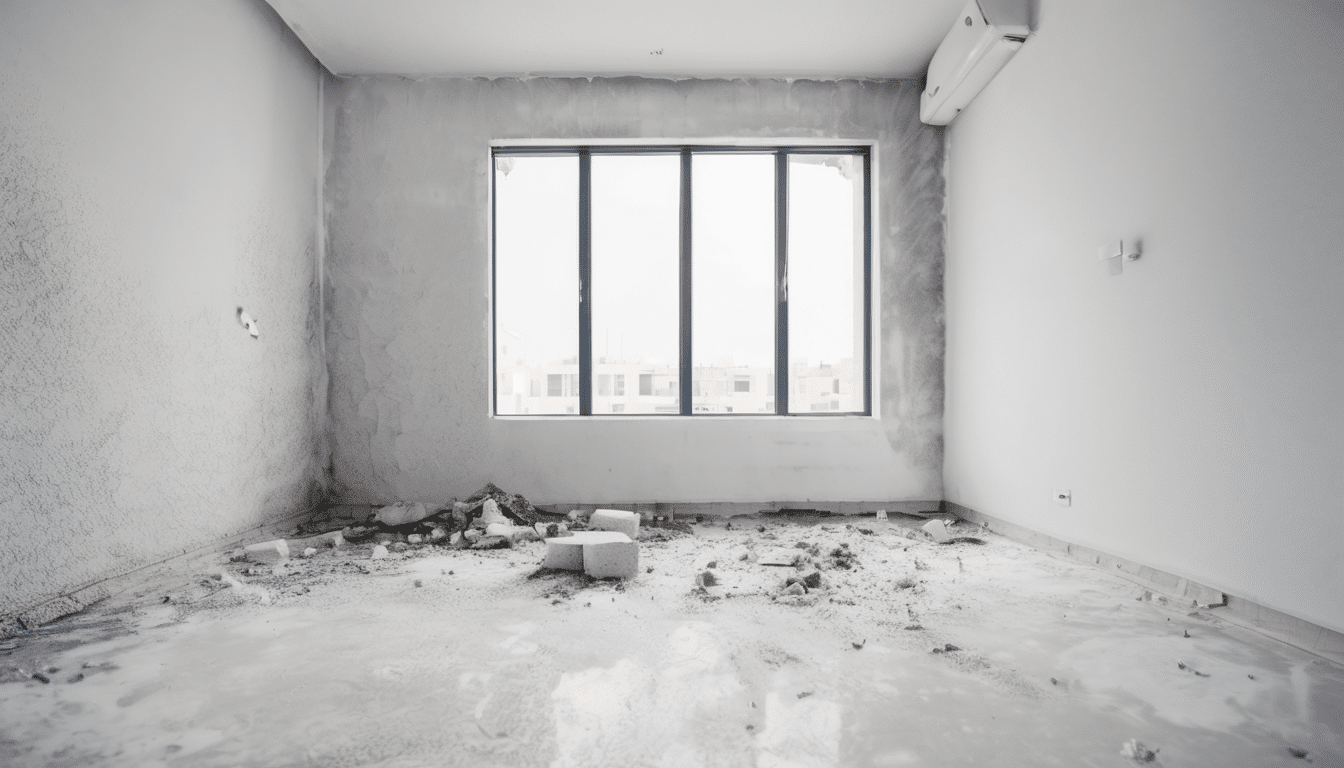
Mold recurrence in Dubai is not random. In more than 20 years of building diagnostics, the pattern is consistent: mold returns because the conditions that produced it were never corrected. Mold Recurrence Dubai: Why Cheap Fixes Cost More is a reality that plays out in Dubai villas, Sharjah apartments, and Abu Dhabi high-rises every season. The mould was cleaned. The surface looked clear. Within weeks or months, the growth returned — sometimes in the same location, sometimes spreading further.
The question worth asking is not “why is the mould back?” It is “what was left unresolved?” In most recurring cases, a surface-level treatment addressed visible contamination without identifying the moisture source, the spore load in the air, or the building system failure that created the environment in the first place. That gap between cosmetic cleaning and verified remediation is precisely where the hidden cost lives. This relates directly to Mold Recurrence Dubai: Why Cheap Fixes Cost More.
This article examines the building science and microbiology behind mould recurrence in Dubai’s climate, explains why cheap mold fixes consistently fail, and outlines what a root-cause approach delivers that surface treatments cannot.
Mold Recurrence Dubai: Why Cheap Fixes Cost More – Why Dubai’s Climate Drives Mold Recurrence
Dubai’s ambient conditions create one of the most persistently mould-favourable environments on the planet. Summer outdoor humidity regularly exceeds 85%, and indoor relative humidity in under-ventilated or poorly insulated spaces frequently sits above 70% — the threshold at which most mould species begin colonising surfaces within 24 to 48 hours. This is not a temporary seasonal challenge. It is a year-round pressure on building envelopes, HVAC systems, and material assemblies.
When outdoor air at 38°C and high humidity meets an over-cooled interior surface — a concrete wall chilled by aggressive air conditioning, for example — condensation forms invisibly. Behind gypsum board, within ceiling cavities, and across the back faces of kitchen cabinetry, this moisture accumulates without any visible indicator until mould growth becomes extensive enough to break through. When considering Mold Recurrence Dubai: Why Cheap Fixes Cost More, this becomes clear.
In Dubai properties built before 2015, vapour barrier installation was inconsistent and envelope detailing was rarely designed for the specific hygrothermal demands of the Gulf climate. Field investigations consistently reveal colonisation in wall cavities, under screed, and within HVAC ductwork that would not be suspected from a visual inspection of living spaces alone.
Understanding Mold Recurrence Dubai: Why Cheap Fixes Cost More
Mold Recurrence Dubai: Why Cheap Fixes Cost More comes down to a fundamental misunderstanding of what mould actually is. Mould is not a stain. It is a living colony embedded within the substrate it inhabits. Surface cleaning removes what is visible. It does not eliminate spores embedded in porous materials, does not address mycelia that have penetrated gypsum or timber, and does not change the moisture conditions that allowed the colony to establish.
A typical cheap mold fix in a Dubai property involves a technician wiping or spraying a visible surface with a biocidal solution. The surface appears clean. No air sampling is performed before or after. No moisture mapping identifies whether the substrate behind the treated surface remains wet. No investigation determines how the moisture arrived. The homeowner pays a modest sum and believes the problem is resolved.
Within 30 to 90 days, growth reappears. Sometimes it is more extensive than before, because disturbance without proper containment has redistributed spores to previously unaffected areas. The second treatment costs at least as much as the first. Often, by the third recurrence, structural materials have deteriorated to the point where replacement — not remediation — is the only option. Mold Recurrence Dubai: Why Cheap Fixes Cost More is therefore not theoretical. The mathematics of repeated cheap treatments consistently exceeds the cost of a single, properly scoped remediation.
Mold Recurrence Dubai: Why Cheap Fixes Cost More – Four Failure Points in Cheap Mold Treatments
No Moisture Source Identification
The single most common failure point in low-cost mould treatments is the absence of moisture investigation. Mould cannot establish without a moisture source. That source may be a slow pipe leak behind a wall, condensation on a cold surface, inadequate waterproofing in a wet area, or HVAC condensate draining incorrectly. Without identifying and correcting this source, any treatment is temporary by definition. The moisture continues. The mould returns.
No Containment During Treatment
Mould spores become airborne during cleaning. Without negative air pressure containment and HEPA filtration, disturbance spreads viable spores throughout the property. Cheap treatments routinely skip containment setup entirely — it adds time and equipment cost. The result is cross-contamination: rooms that were previously clean become colonised after a poorly managed treatment. This is how a localised bathroom problem becomes a property-wide issue. The importance of Mold Recurrence Dubai: Why Cheap Fixes Cost More is evident here.
Inadequate Material Assessment
Porous materials — gypsum board, timber framing, insulation, fabric — cannot be successfully surface-treated when mould has penetrated the substrate. Mycelia extend into the material matrix. Biocidal surface application does not reach embedded growth. Proper remediation requires assessment of whether materials can be cleaned or must be removed. Cheap treatments default to cleaning regardless of substrate condition, leaving active colonisation in place beneath a treated surface.
No Post-Treatment Verification
Verification through air sampling or surface testing after remediation is the only way to confirm the treatment was effective. Low-cost operators do not typically offer or recommend post-remediation testing — partly because it costs additional resource, and partly because the results might reveal that their treatment was insufficient. Without verification, neither the operator nor the homeowner knows whether the environment is actually clear. Understanding Mold Recurrence Dubai: Why Cheap Fixes Cost More helps with this aspect.
Mold Recurrence Dubai: The Hidden Costs That Accumulate
Mold Recurrence Dubai: Why Cheap Fixes Cost More becomes clearest when the cumulative picture is mapped across a typical recurring case. Consider a Dubai apartment where a bathroom mould problem is treated three times over eighteen months with surface-only cleaning. Each treatment costs a modest amount. Each treatment fails within weeks.
By the eighteenth month, the gypsum board behind the tile has deteriorated due to sustained moisture and repeated disturbance. The timber door frame has structural softening. Spores distributed during the first two treatments have established secondary colonies in adjacent bedroom walls. What began as a localised, addressable problem now requires partial demolition, material replacement, and full remediation — at a cost several times higher than a properly scoped initial investigation and treatment would have required. Mold Recurrence Dubai: Why Cheap Fixes Cost More factors into this consideration.
Beyond material costs, there are occupant health impacts. Sustained mould exposure in a living environment affects sleep quality, respiratory comfort, and general wellbeing — particularly for children, elderly occupants, and anyone with atopic conditions. These impacts are real, measurable, and accumulate across the months between ineffective treatments.
Root-Cause Remediation: What It Includes and Why It Works
Root-cause remediation begins before any cleaning occurs. As an IAC2 Certified Indoor Air Consultant, the investigation protocol I apply at Saniservice’s Indoor Sciences Division starts with building envelope analysis, thermal imaging to detect temperature differentials and hidden moisture accumulation, and moisture mapping of affected and adjacent areas. This relates directly to Mold Recurrence Dubai: Why Cheap Fixes Cost More.
Laboratory air sampling establishes a baseline spore count and identifies species present. This matters because species identification informs both the remediation method and the health risk profile. A Cladosporium colony in a bathroom requires a different protocol than Aspergillus or Stachybotrys growth discovered in a wall cavity. Treating both identically is not science — it is guesswork.
Once the investigation is complete, the remediation scope is defined by the data. Materials that cannot be effectively treated are removed under containment. Moisture sources are corrected before any cleaning begins. HEPA-filtered negative air machines run throughout the work. Post-remediation verification through laboratory analysis confirms clearance before containment is removed and the space is returned to use. When considering Mold Recurrence Dubai: Why Cheap Fixes Cost More, this becomes clear.
Mold Recurrence Dubai: Why Cheap Fixes Skip Verification
Mold Recurrence Dubai: Why Cheap Fixes Cost More is perhaps most clearly illustrated by the absence of post-remediation testing in low-cost services. Verification testing is not optional in a science-based remediation framework. It is the only objective measure of whether the remediation succeeded.
Post-remediation air sampling in Dubai properties typically reveals one of three outcomes: clearance within acceptable parameters, elevated spore counts indicating residual contamination, or the presence of new species not found in the initial baseline — a sign of cross-contamination during treatment. Without this data, the homeowner is relying entirely on visual appearance and the operator’s assurance. The importance of Mold Recurrence Dubai: Why Cheap Fixes Cost More is evident here.
A properly conducted post-remediation verification costs a fraction of a repeat treatment. When that verification confirms clearance, the homeowner has documented proof that the environment is clear — something no cheap fix can provide. When verification identifies residual issues, they can be addressed precisely rather than discovered months later when mould reappears on a visible surface.
Post-Remediation Testing as Proof of Success
Laboratory analysis after remediation serves two functions. First, it protects the occupant by confirming that the indoor spore load has returned to acceptable levels relative to outdoor baseline counts. Second, it protects the remediation investment by providing documented evidence that the work was completed to standard — evidence that is increasingly required by Dubai real estate transactions and DHA mould clearance certificate processes. Understanding Mold Recurrence Dubai: Why Cheap Fixes Cost More helps with this aspect.
At Saniservice’s in-house microbiology laboratory — the only laboratory of its kind operated by an indoor environmental services company in the UAE — post-remediation samples are processed with full chain of custody and species-level identification. This is the difference between a signed service report and an evidence-based clearance document.
For Dubai property owners managing rental properties, the clearance document is particularly valuable. It provides tenant-facing evidence of remediation, supports lease compliance, and provides a reference point for future comparisons if conditions change. Mold Recurrence Dubai: Why Cheap Fixes Cost More factors into this consideration.
Mold Recurrence Dubai: Prevention Through Building Science
Mold Recurrence Dubai: Why Cheap Fixes Cost More ultimately resolves when the building itself is corrected, not just the surface. Prevention is a building science outcome, not a cleaning outcome.
In Dubai properties, the most effective prevention measures address HVAC performance, envelope integrity, and ventilation balance. HVAC systems that are undersized for the cooling load create persistent condensation on supply air components and within ductwork. Envelope gaps at window frames, service penetrations, and expansion joints allow humid outdoor air to infiltrate conditioned spaces. Bathrooms and kitchens without adequate exhaust ventilation create localised humidity spikes that accumulate over time. This relates directly to Mold Recurrence Dubai: Why Cheap Fixes Cost More.
Correcting these conditions — with the guidance of a building science assessment — creates an indoor environment where mould colonisation is no longer predictable. This is the final metric: not whether mould is treated, but whether the conditions for mould growth are systematically removed. When that happens, mold recurrence stops.
Expert Takeaways for Dubai Property Owners
- Moisture source first. No remediation is complete until the moisture pathway is identified and corrected. Treating mould without correcting moisture is cleaning, not remediation.
- Demand a scope document. Before any work begins, a proper remediation provider should produce a written scope based on investigation findings, not a verbal quote based on a visual glance.
- Containment is non-negotiable. If the technician arriving does not set up containment and negative air pressure before disturbing any mould growth, the treatment will likely spread contamination rather than remove it.
- Verification closes the loop. Post-remediation testing is the only objective confirmation that the work was effective. Request it. Review the laboratory report, not just the service completion certificate.
- Species matter. Not all mould is equivalent in terms of remediation method or health relevance. Laboratory identification of species guides appropriate treatment decisions.
- Building science prevents recurrence. After remediation is verified, a building science assessment identifies the structural or system conditions that allowed mould to develop — and correcting those is what stops it from returning.
Mold Recurrence Dubai: Why Cheap Fixes Cost More is not a warning designed to alarm. It is a predictable pattern that building science explains clearly and that proper remediation resolves definitively. The evidence from recurring case investigations consistently shows that the least expensive intervention is the one that identifies the root cause correctly the first time.
Frequently Asked Questions
Why does mould keep coming back in Dubai apartments even after treatment?
Mould returns in Dubai apartments because the underlying moisture source was not identified and corrected. Surface cleaning removes visible growth but does not address the humidity pathway, building envelope gap, or HVAC drainage issue that created conditions for mould in the first place. Until the moisture source is resolved, mould recurrence in Dubai is essentially guaranteed regardless of how many times the surface is treated.
What is the difference between a cheap mold fix and professional remediation in Dubai?
A cheap mould fix in Dubai typically involves surface application of a biocidal product without moisture investigation, containment, material assessment, or post-treatment verification. Professional remediation includes a documented investigation, laboratory baseline sampling, contained removal of affected materials where necessary, and post-remediation air sampling to confirm clearance. The difference is the evidence left behind — and whether mould recurrence follows within months. When considering Mold Recurrence Dubai: Why Cheap Fixes Cost More, this becomes clear.
How do I know if my mould treatment actually worked?
The only objective confirmation that a mould treatment worked is post-remediation laboratory testing. Air sampling after remediation compares indoor spore counts against outdoor baseline levels and confirms whether species of concern are still present. A visual inspection or a signed completion certificate from the operator is not equivalent to laboratory verification. Ask for the post-remediation air sampling report before accepting that the work is complete.
Is mould behind walls common in Dubai villas?
Hidden mould behind walls is consistently found in Dubai villas during forensic investigations, particularly in properties built before 2015 where vapour barrier installation was inconsistent. Thermal imaging and borescope investigations at Saniservice have revealed extensive cavity colonisation in properties that appeared visually clean from the interior. In Dubai’s climate, mould behind walls is not unusual — it is a predictable outcome of hygrothermal conditions in buildings with envelope deficiencies. The importance of Mold Recurrence Dubai: Why Cheap Fixes Cost More is evident here.
Does a DHA mould clearance certificate require laboratory testing?
DHA mould clearance certificate processes in Dubai require documented evidence that remediation has been completed and the environment is clear of contamination. Laboratory-supported post-remediation reports produced by certified professionals provide the objective evidence base for clearance documentation. A simple visual inspection or a company-issued completion report is not typically sufficient for formal clearance purposes. Consult your property management or regulatory contact for specific current requirements.
How much does mould recurrence cost compared to proper remediation in Dubai?
While specific figures vary by property size and contamination extent, field cases consistently show that two or three rounds of cheap mould treatment in a Dubai property — each failing and requiring repeat intervention — cost significantly more than a single properly scoped remediation with post-verification. When structural material deterioration is factored in from repeated failed treatments, the cost differential becomes substantial. Remediation done correctly the first time is the more economical outcome. Understanding Mold Recurrence Dubai: Why Cheap Fixes Cost More helps with this aspect.
Can HVAC systems cause mould to recur after treatment?
Yes. HVAC systems are one of the most common drivers of mould recurrence in Dubai properties. Contaminated ductwork, improperly draining condensate trays, and undersized systems that run continuously without adequate dehumidification create persistent conditions for mould growth. If HVAC diagnostics are not included in the remediation investigation, the system will continue delivering mould-favourable humidity levels to the treated space. Addressing mould without assessing the HVAC system is an incomplete remediation by definition. Understanding Mold Recurrence Dubai: Why Cheap Fixes Cost More is key to success in this area.