
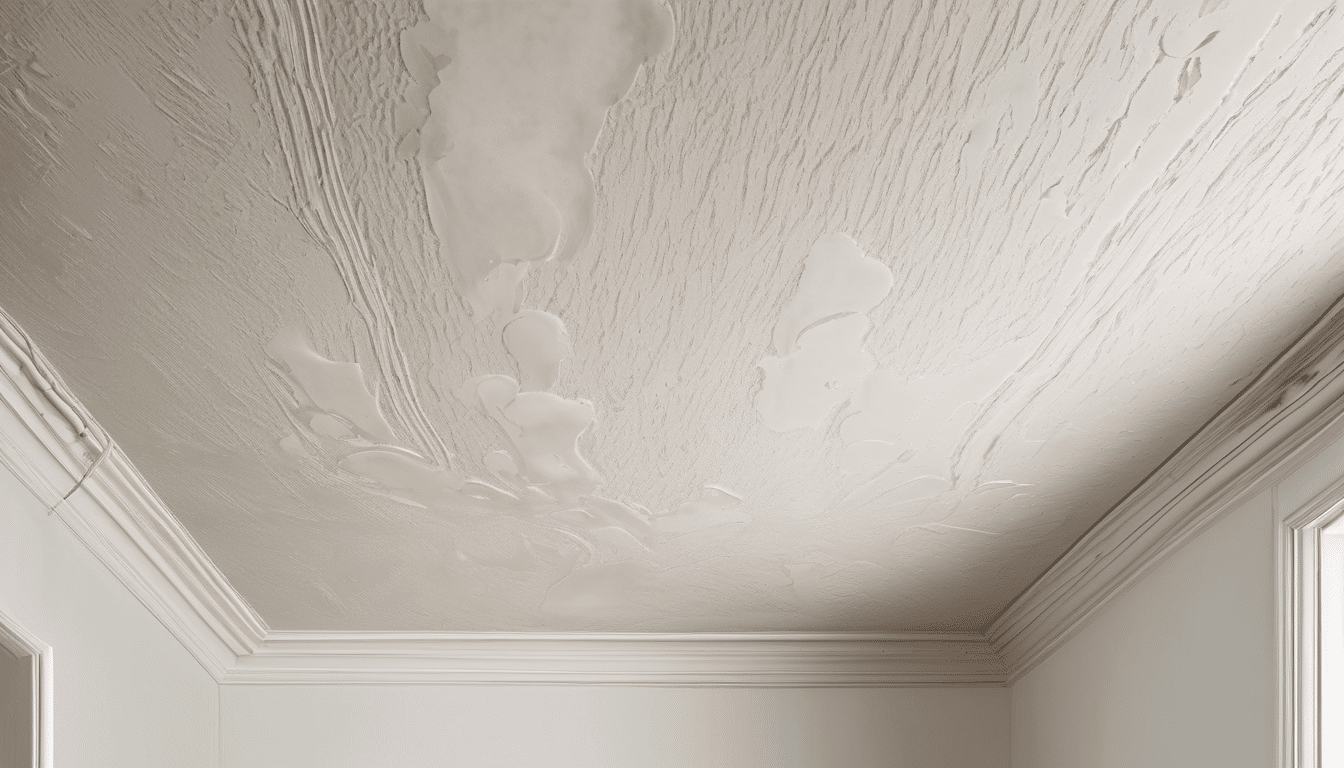
Understanding Ceiling Water Stains and Mould: What They Mean is essential. Ceiling Water Stains and mould — what they mean for your property is rarely as simple as a paint problem. In Dubai and across the UAE, ceiling stains are among the most commonly misread signals in residential buildings. Homeowners repaint, contractors seal, and within weeks the marks return — often darker, often wider, and frequently accompanied by a musty odour that did not exist before. Understanding what these stains are actually communicating is the first step toward resolving them properly.
As an IAC2 Certified Indoor Air Consultant with over 20 years of building investigations across Dubai villas, high-rise apartments, and commercial properties, I can say with confidence: a ceiling stain is not a problem in itself. It is a record. It documents moisture behaviour, building envelope performance, and in many cases, biological activity that has been progressing unseen for weeks or months before the stain became visible. This relates directly to Ceiling Water Stains and Mould: What They Mean.
This guide explains the science behind ceiling water stains and mould, what they signal about your building’s condition, and how professional scope is determined before any remediation work begins. When considering Ceiling Water Stains and Mould: What They Mean, this becomes clear.
Ceiling Water Stains and Mould: What They Mean – What Ceiling Water Stains and Mould Actually Tell You
A ceiling water stain forms when moisture migrates through a building material — typically concrete, gypsum board, or plaster — and evaporates at the surface, leaving behind mineral deposits, dust particles, and in warmer climates, biological matter. The stain itself is a residue. It tells you where moisture arrived at the surface, but not where it originated. The importance of Ceiling Water Stains and Mould: What They Mean is evident here.
Mould appearing alongside or within a ceiling stain is a different signal entirely. Mould growth requires a moisture source sustained over time — typically 48 to 72 hours at relative humidity above 60%, combined with an organic substrate. In Dubai’s climate, where ambient humidity can remain elevated from May through October, this threshold is crossed with far greater regularity than most homeowners expect. Understanding Ceiling Water Stains and Mould: What They Mean helps with this aspect.
What ceiling water stains and mould mean together is that moisture has been present long enough for microbial colonisation to begin. The stain marks the pathway; the mould marks the duration. Both signals deserve investigation, not paint. Ceiling Water Stains and Mould: What They Mean factors into this consideration.
Ceiling Water Stains and Mould: What They Mean – The Most Common Sources Behind Ceiling Stains in UAE Propert
AC Condensate Leaks and Duct Sweating
Across Dubai apartments and villas, the single most frequently identified cause behind ceiling water stains is the air conditioning system. When chilled air circulates through ductwork running through unconditioned ceiling voids, surface condensation forms on the outer duct surface whenever ambient humidity is high. Over time, this condensate drips onto the ceiling board below. The stain that appears is often mistaken for a plumbing leak — but the source is thermal, not hydraulic. This relates directly to Ceiling Water Stains and Mould: What They Mean.
AC condensate tray overflows are equally common. A blocked drain line causes the tray to overflow quietly inside the ceiling void, producing a slowly spreading stain with no visible water above. Professional investigation using thermal imaging and borescope inspection typically locates these sources without the need for unnecessary demolition. When considering Ceiling Water Stains and Mould: What They Mean, this becomes clear.
Plumbing Leaks from the Floor Above
In multi-storey Dubai residential buildings, a slow leak from bathroom plumbing, water heater connections, or washing machine supply lines above will saturate the structural slab and migrate downward. The stain that appears on your ceiling may originate from a floor two storeys above in buildings with complex pipe routing. Tracing the actual source requires moisture mapping rather than visual inspection alone. The importance of Ceiling Water Stains and Mould: What They Mean is evident here.
Roof and Waterproofing Failures
For properties with direct roof exposure — villas, penthouse apartments, and top-floor units — waterproofing degradation is a primary cause. Dubai’s extreme UV exposure and temperature cycling accelerate the deterioration of waterproofing membranes. When the membrane fails, rainwater ingress during seasonal rainfall events creates acute staining. Between rain events, the saturated structure continues to release moisture slowly, sustaining the conditions for mould growth well after the exterior has dried. Understanding Ceiling Water Stains and Mould: What They Mean helps with this aspect.
Condensation on Cold Ceiling Surfaces
A less obvious but frequently encountered source is interstitial condensation. In rooms where the AC is set to very low temperatures — a common pattern in UAE homes — the ceiling surface temperature can fall below the dew point of the warmer air in the adjacent space. Moisture from the air then condenses directly onto the ceiling. This is particularly common in bedrooms with poor airflow and in bathrooms with inadequate exhaust ventilation. Ceiling Water Stains and Mould: What They Mean factors into this consideration.
Ceiling Water Stains and Mould: What They Mean – What Ceiling Water Stains and Mould Mean for Hidden Contamin
The portion of mould growth that is visible on a ceiling surface represents only part of the contamination picture. Gypsum board — the most widely used ceiling material in Dubai residential construction — is highly susceptible to mould colonisation on its paper facing and core. Once moisture has penetrated the board, mould establishes on the rear face, inside the ceiling void, and on any organic material within that void, including insulation, timber battens, and cable jacketing. This relates directly to Ceiling Water Stains and Mould: What They Mean.
Field investigations using borescope cameras routinely reveal significant mould colonies on the concealed surfaces of ceiling boards where the visible stain appeared relatively minor. This is one of the most consistent findings in forensic mould assessments: surface appearance systematically underestimates concealed contamination. When considering Ceiling Water Stains and Mould: What They Mean, this becomes clear.
Ceiling water stains and mould that return within weeks of surface treatment — painting, bleaching, or coating — are almost always the result of unresolved hidden growth and an unaddressed moisture source. The treatment addressed the symptom. The biology and the physics were left intact. The importance of Ceiling Water Stains and Mould: What They Mean is evident here.
Health Implications and When Mould Species Matter
Not every mould species carries equivalent risk, and ceiling water stains and mould what they mean for occupant health depends significantly on the genus and concentration of what is actually growing. Common indoor species associated with chronic moisture problems in UAE properties include Cladosporium, Penicillium, Aspergillus, and in sustained water damage scenarios, Stachybotrys chartarum — a slow-growing species associated with mycotoxin production. Understanding Ceiling Water Stains and Mould: What They Mean helps with this aspect.
Air sampling and surface swab analysis, processed through a certified microbiology laboratory, provide the only reliable basis for species identification and spore concentration measurement. Without laboratory data, any statement about the risk level of a visible ceiling mould problem is speculative. As an evidence-first discipline, IAC2-aligned investigations do not assess risk by visual appearance alone. Ceiling Water Stains and Mould: What They Mean factors into this consideration.
Occupants who report persistent respiratory symptoms, sinus congestion, skin irritation, or unexplained fatigue in rooms with visible ceiling staining should treat the correlation as clinically significant until laboratory results confirm or rule out a biological exposure pathway. This relates directly to Ceiling Water Stains and Mould: What They Mean.
Ceiling Water Stains and Mould — What They Mean for Remediation Scope
Understanding what ceiling water stains and mould mean for remediation scope requires a structured assessment — not a visual estimate. Several property variables determine how extensive the required intervention will be. When considering Ceiling Water Stains and Mould: What They Mean, this becomes clear.
Property Variables That Affect Scope
- Property size and ceiling area: Larger ceiling spans with distributed staining require proportionally greater investigation, containment, and material removal if contamination is confirmed.
- Property age: Older Dubai properties — particularly those built before contemporary waterproofing standards — often present with compounded moisture pathways. A single visible stain may reflect several concurrent failure points.
- Occupancy and sensitivity: Properties housing young children, elderly occupants, or individuals with respiratory conditions require more conservative remediation protocols, including more rigorous containment and post-remediation air quality verification.
- Construction type: Gypsum board ceilings over deep voids, concrete slab ceilings, and insulated suspended ceilings each carry different contamination risks and require different investigation approaches.
Contamination Variables That Affect Scope
- Extent of moisture penetration: Moisture mapping using thermal imaging and pin/pinless meters determines how far saturation has spread beyond the visible stain boundary.
- Laboratory-confirmed species: The presence of mycotoxin-producing species elevates the remediation protocol standard and may require additional air quality monitoring during and after work.
- Duration of moisture exposure: A stain present for three months carries a different biological load than one that appeared three weeks ago. Duration is assessed through building history, occupant records, and moisture readings at depth.
- Material porosity: Gypsum board, insulation, and timber elements within the ceiling void are porous and typically require removal when contaminated. Concrete surfaces are assessed differently.
Certification and Standards Requirements
Professional mould remediation in Dubai properties should align with IICRC S520 remediation standards, with post-remediation verification conducted by a qualified inspector independent of the remediation contractor. Where a DHA Mould Clearance Certificate is required — for healthcare-adjacent properties, schools, or properties subject to regulatory review — post-remediation air sampling must meet defined clearance criteria before the certificate can be issued. The importance of Ceiling Water Stains and Mould: What They Mean is evident here.
A professional assessment determines the scope of work required, certifications applicable to the property type, and the verification methodology appropriate to the contamination level identified. Saniservice specialists conduct site-specific assessments before any remediation scope is defined. Contact the Indoor Sciences division at Saniservice to request a property assessment for your Dubai or UAE property.
What Ceiling Water Stains and Mould Mean for the Remediation Process
A properly scoped ceiling mould remediation in Dubai follows a defined sequence. The moisture source is identified and corrected before remediation begins — without this step, recurrence is predictable. Containment is established to prevent spore dispersal to unaffected areas of the property. Contaminated materials are removed following IICRC-aligned protocols, with HEPA-filtered negative pressure maintained throughout. Surfaces are treated and post-remediation verification sampling is conducted after materials are removed and prior to reinstatement.
Reinstating a ceiling without post-remediation air sampling is not remediation. It is concealment. Post-remediation verification is the standard that separates a documented outcome from an assumption.
Key Takeaways for Dubai Homeowners
- Ceiling water stains record moisture history — they do not define the boundary of the problem.
- Mould alongside a stain indicates sustained moisture, not simply a single event.
- Surface treatment without source correction produces recurrence within weeks.
- Hidden contamination behind gypsum board ceilings consistently exceeds visible surface growth.
- Laboratory identification of mould species is the only reliable basis for risk assessment.
- Remediation scope is determined per property after a site investigation — not from a general estimate.
- Post-remediation verification sampling is required to confirm that remediation has been effective.
Frequently Asked Questions
What do ceiling water stains and mould mean if the stain keeps returning after painting?
Recurring ceiling stains after painting indicate that the moisture source has not been resolved and that mould may be active on concealed surfaces behind the ceiling material. Paint does not seal biological contamination. A professional assessment using moisture mapping and, where indicated, borescope inspection is required to identify what is driving the return.
How do I know if ceiling mould in my Dubai apartment is a health concern?
The health significance of ceiling mould in Dubai apartments depends on the species present and the concentration of airborne spores — not the size of the visible patch. Air sampling analysed by a certified laboratory provides a measurable baseline. Occupants experiencing respiratory symptoms or persistent irritation in the affected room should request a professional indoor air quality assessment before symptoms are attributed to other causes.
Is ceiling mould in Dubai always caused by a leak?
Not always. While plumbing and roof leaks are common causes, condensation on cold ceiling surfaces — driven by very low AC set points and inadequate ventilation — produces ceiling mould without any water leak present. AC duct sweating is another non-leak source frequently identified in Dubai villas and apartments. A professional investigation identifies the actual moisture pathway rather than assuming it.
What is the difference between a ceiling water stain and active mould growth?
A ceiling water stain is a mineral and particulate residue left by evaporated moisture. It may be white, yellow, or brown. Active mould growth is biological — typically appearing as dark green, grey, or black discolouration with a powdery or velvety texture. Both can appear together. Laboratory surface sampling confirms whether visible discolouration is biological growth or mineral staining.
What factors affect the scope and cost of ceiling mould remediation in Dubai?
Factors that affect the quoted scope of ceiling mould remediation include property size, ceiling construction type (gypsum board, concrete, suspended), extent of moisture penetration confirmed by moisture mapping, laboratory-identified mould species, occupancy and sensitivity of residents, and whether post-remediation certification is required. A site assessment by Saniservice specialists determines the scope appropriate to your specific property.
Can I get a mould clearance certificate for ceiling mould in Dubai?
Yes. A DHA Mould Clearance Certificate requires post-remediation air sampling results that meet defined clearance criteria. The certificate is issued after a qualified assessor — independent of the remediation contractor — confirms that spore concentrations in the remediated area have returned to acceptable levels. Saniservice’s Indoor Sciences division provides independent post-remediation verification services across Dubai and the wider UAE.
How long does ceiling mould take to develop after a water leak in Dubai?
Under Dubai’s typical indoor conditions — elevated humidity and temperatures between 22°C and 28°C — mould colonisation on gypsum board can begin within 48 to 72 hours of sustained moisture contact. The visible stain may not appear for several weeks. This gap between the biological onset and the visible signal is why ceiling stains frequently indicate contamination that is older than the stain itself suggests.
The Next Step for Your Property
Ceiling water stains and mould — what they mean for your specific property cannot be determined from a photograph or a general guide. The moisture source, the extent of concealed contamination, the mould species present, and the occupancy context are all variables that shape what a responsible remediation scope looks like. These are determined through site investigation, not assumption.
If you are seeing ceiling stains or mould growth in your Dubai villa, apartment, or commercial property, the most reliable next step is a professional assessment. Saniservice’s Indoor Sciences division conducts evidence-based investigations across Dubai, Abu Dhabi, Sharjah, Ajman, and Ras Al Khaimah. Request a site visit for a property-specific assessment, and receive a documented scope of work grounded in laboratory data — not guesswork. Understanding Ceiling Water Stains and Mould: What They Mean is key to success in this area.