
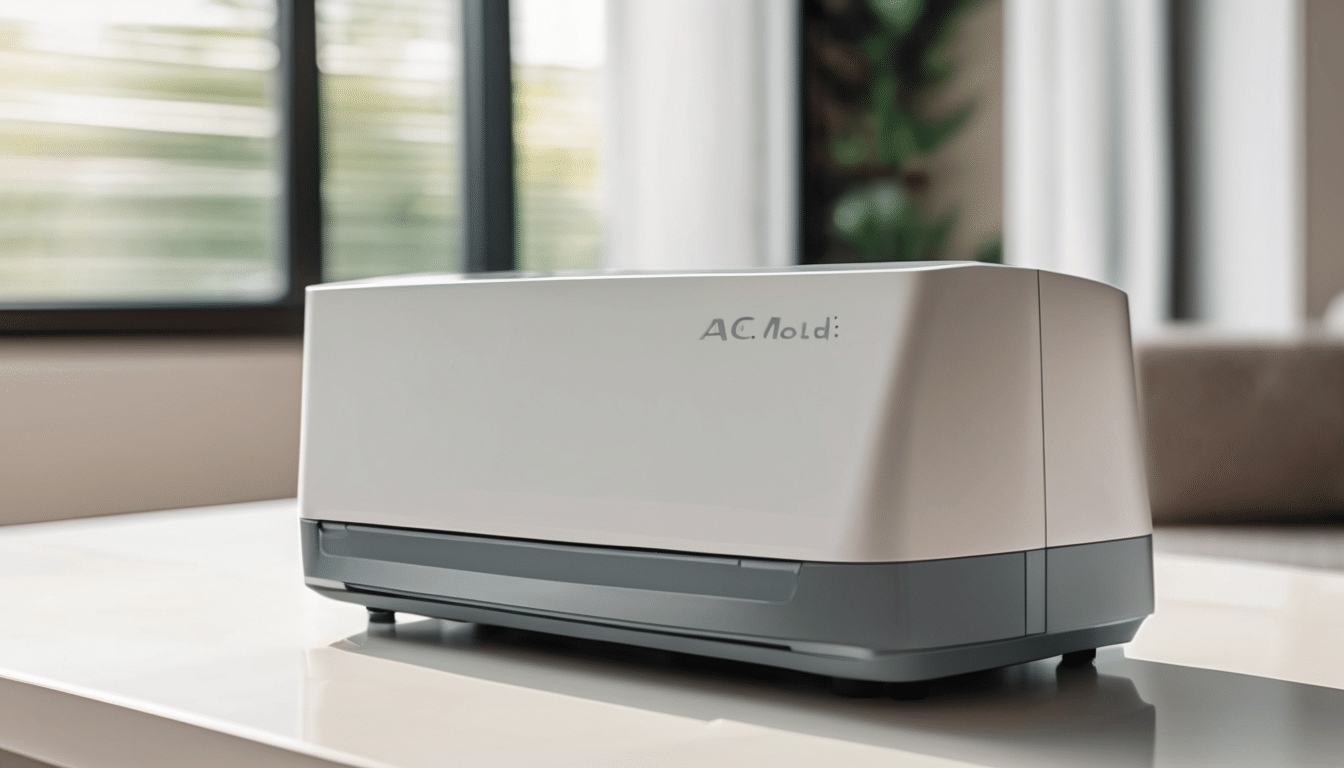
Understanding AC Mold Inspection Dubai: Why HVAC Units Are Tested First is essential. In Dubai’s climate, the HVAC system is consistently the first point of contamination identified during a professional mould investigation. AC mold Inspection Dubai protocols prioritise HVAC testing because the unit links every room in a property through a single air distribution pathway. Understanding why inspectors test the AC first — and what that testing reveals — shapes every remediation decision that follows.
When a homeowner in Jumeirah, Business Bay, or Dubai Hills reports recurring mould on walls or ceilings, the instinct is to investigate the surface. That instinct, while understandable, frequently misses the source. As an IAC2 Certified Indoor Air Consultant, my field investigations consistently show that what appears on a wall is the downstream consequence of what is already living inside the air conditioning system. This is why AC Mold Inspection Dubai protocols do not begin at the wall — they begin at the air handler. This relates directly to AC Mold Inspection Dubai: Why HVAC Units Are Tested First.
This article compares two distinct investigation approaches: surface-first mould inspection versus HVAC-first mould inspection. Both are used in the industry. Only one reliably identifies the root cause in Dubai’s specific building and climate context. When considering AC Mold Inspection Dubai: Why HVAC Units Are Tested First, this becomes clear.
AC Mold Inspection Dubai: Why HVAC Units Are Tested First – Why Dubai’s Climate Makes HVAC the Primary Suspect
Dubai’s outdoor humidity regularly exceeds 80% relative humidity during summer months, with temperatures surpassing 45°C. The moment that warm, humid outdoor air contacts the cold internal surfaces of a running AC unit, condensation occurs. This moisture, combined with accumulated dust, skin cells, and organic debris inside the ductwork, creates precisely the substrate that mould species require to establish and reproduce. The importance of AC Mold Inspection Dubai: Why HVAC Units Are Tested First is evident here.
AC Mold Inspection Dubai investigations frequently reveal that spore counts inside the air handler are significantly elevated compared to ambient room levels — a finding that surface inspection alone would never capture. The HVAC system is not merely a suspect. In a Dubai property with persistent mould problems, it is statistically the most probable source. Understanding AC Mold Inspection Dubai: Why HVAC Units Are Tested First helps with this aspect.
Ductwork in UAE high-rise apartments and villas is often concealed within ceiling cavities and wall chases, running for 10 to 30 metres between the air handler and the furthest outlet. Every metre of that pathway is a potential colonisation zone if condensation, dust loading, or inadequate maintenance has occurred. AC Mold Inspection Dubai: Why HVAC Units Are Tested First factors into this consideration.
AC Mold Inspection Dubai: Why HVAC Units Are Tested First – AC Mold Inspection Dubai vs Surface Mould Inspection — A D
Understanding the difference between these two approaches requires examining what each method actually tests, what it misses, and what its findings enable downstream. This relates directly to AC Mold Inspection Dubai: Why HVAC Units Are Tested First.
Surface-First Mould Inspection
Surface inspection begins with visible assessment — discolouration on walls, grout, or ceilings — followed by surface swab or tape-lift sampling in affected areas. The laboratory then identifies the species present and estimates contamination density on that specific surface. When considering AC Mold Inspection Dubai: Why HVAC Units Are Tested First, this becomes clear.
This approach works well when mould is genuinely confined to a single, clearly defined location such as a bathroom ceiling with a known leak above it. The cause is isolated, the contamination is bounded, and the remediation scope is straightforward. The importance of AC Mold Inspection Dubai: Why HVAC Units Are Tested First is evident here.
However, surface-first inspection carries a significant limitation in the Dubai context. It identifies where mould is growing visibly. It does not identify where spores are originating, how they are being distributed, or whether the HVAC system is actively seeding every room simultaneously. Understanding AC Mold Inspection Dubai: Why HVAC Units Are Tested First helps with this aspect.
HVAC-First Mould Inspection
AC Mold Inspection Dubai protocol, as applied by Saniservice Indoor Sciences investigators, begins with the air handling unit itself. This includes visual inspection of the evaporator coil, drain tray, blower fan, and duct interior — followed by air sampling at the supply outlet and return grille, and where indicated, a borescope examination of concealed ductwork sections. AC Mold Inspection Dubai: Why HVAC Units Are Tested First factors into this consideration.
The advantage is diagnostic completeness. If the HVAC system is contaminated, every room it serves is receiving a continuous dose of spores regardless of what the walls show. Treating wall mould without addressing a contaminated AC system produces predictable results: the mould returns within weeks. This relates directly to AC Mold Inspection Dubai: Why HVAC Units Are Tested First.
HVAC-first inspection is more technically demanding, requires calibrated air sampling equipment, and demands laboratory analysis to interpret spore counts and species distribution meaningfully. It is also the approach that produces a root-cause finding rather than a symptom observation. When considering AC Mold Inspection Dubai: Why HVAC Units Are Tested First, this becomes clear.
AC Mold Inspection Dubai: Why HVAC Units Are Tested First – Comparing the Methods — Pros and Cons
Surface Inspection — Strengths
- Faster to execute in simple, isolated cases
- Lower initial cost for a single-room concern
- Clear visual documentation for property records
- Effective when water ingress source is already confirmed and contained
Surface Inspection — Limitations
- Misses airborne distribution pathways entirely
- Cannot confirm whether visible mould is the source or a symptom
- Does not account for hidden contamination in duct systems
- Frequently leads to remediation failure and recurrence in multi-room properties
- Provides no data on spore load in breathable air
HVAC-First Inspection — Strengths
- Identifies the distribution mechanism before surface investigation begins
- Air sampling quantifies actual occupant exposure in real-time conditions
- Species identification helps match remediation chemistry to confirmed contaminants
- Detects contamination in concealed ductwork invisible to any surface check
- Supports post-remediation verification through comparable baseline data
- Consistent with IAC2 and IICRC field investigation standards
HVAC-First Inspection — Limitations
- Requires specialist equipment and laboratory infrastructure
- Takes longer to complete than a visual surface walk-through
- Laboratory turnaround time adds to overall investigation timeline
- Scope and associated investment are higher than a basic surface assessment
What AC Mold Inspection Dubai Testing Actually Involves
A professional AC Mold Inspection Dubai assessment is not a simple visual check of the air vent grilles. The process, as conducted by Saniservice Indoor Sciences specialists, follows a structured diagnostic sequence. The importance of AC Mold Inspection Dubai: Why HVAC Units Are Tested First is evident here.
Stage One — Air Handler Access and Visual Assessment
The indoor air handling unit is opened and inspected directly. The evaporator coil, a cold wet surface during operation, is examined for visible growth. The drain tray — which collects condensate — is checked for standing water, biofilm, and spore colonies. The blower fan blades, which accumulate dust and organic material, are assessed for surface contamination. Understanding AC Mold Inspection Dubai: Why HVAC Units Are Tested First helps with this aspect.
Stage Two — Air Sampling at Supply and Return Points
Calibrated spore trap cassettes are run at defined flow rates — typically 15 litres per minute — at the supply air outlet and the return air grille. These samples capture the biological content of air actually leaving and entering the HVAC system. Laboratory analysis then produces a spore count per cubic metre and species identification, providing a measurable exposure figure rather than a visual estimate. AC Mold Inspection Dubai: Why HVAC Units Are Tested First factors into this consideration.
Stage Three — Ductwork Borescope Investigation
Where access points allow, a borescope camera is inserted into concealed duct sections to examine internal surfaces. In Dubai villas with long horizontal duct runs, this step frequently reveals contamination zones invisible from any external vantage point. Field investigations have identified mould colonies growing on internal duct liner material — a finding that changes remediation scope entirely. This relates directly to AC Mold Inspection Dubai: Why HVAC Units Are Tested First.
Stage Four — Comparative Room Sampling
Ambient air samples are taken in rooms served by the system, allowing a comparison between HVAC supply air and room air. A significant elevation in supply air spore count relative to outdoor baseline confirms active HVAC distribution. This data forms the diagnostic foundation for any subsequent remediation plan.
When HVAC-First Is Non-Negotiable
AC Mold Inspection Dubai protocol mandates HVAC-first assessment in several specific scenarios commonly encountered across UAE properties.
When mould is present in multiple rooms simultaneously without a single obvious water source, the shared factor is almost always the air conditioning system. When remediation has been performed previously and mould has returned within three to six months, an untested HVAC system is the most probable explanation for the recurrence. When occupants report symptoms — persistent respiratory irritation, nocturnal coughing, or sensitivity reactions — that correlate with time spent indoors rather than outdoors, airborne spore exposure through the HVAC system warrants immediate investigation.
In Dubai high-rise apartments where the air handling unit serves multiple rooms from a single cassette, any contamination within that unit distributes to every connected space simultaneously. Surface treatment of individual rooms, without addressing the HVAC source, is remediation in name only.
The Verdict — Which Approach Produces Better Outcomes
The comparison between surface-first and HVAC-first inspection is not a close contest in Dubai’s building and climate context. AC Mold Inspection Dubai investigations that begin with the HVAC system consistently produce more accurate root-cause findings, more targeted remediation plans, and lower rates of recurrence.
Surface inspection remains appropriate for genuinely isolated cases — a single bathroom ceiling with a confirmed, repaired leak above it, for example. In that specific scenario, a targeted surface assessment is proportionate to the problem.
However, for any multi-room concern, any recurring mould problem, any case involving occupant health symptoms, or any property where the HVAC system has not been professionally maintained within the past twelve months, AC Mold Inspection Dubai protocol demands HVAC-first investigation. The data from that investigation — spore counts, species identification, and distribution mapping — is what makes every subsequent decision defensible rather than speculative.
At Saniservice, the Indoor Sciences Division applies this approach across Dubai, Abu Dhabi, Sharjah, and across the UAE, supported by the region’s only in-house microbiology laboratory operated by an indoor environmental services company. The findings are documented, the methodology is repeatable, and the results are verifiable.
Expert Takeaways for Dubai Property Owners
- Mould on surfaces is frequently a symptom of HVAC contamination, not the cause itself
- AC Mold Inspection Dubai assessments that include air sampling provide measurable exposure data — not estimates
- Recurring mould after previous treatment is a strong indicator that the HVAC system was never tested
- Species identification from laboratory analysis determines appropriate remediation chemistry and containment protocol
- Post-remediation air sampling confirms clearance — without it, remediation success remains unverified
- Dubai’s climate makes annual HVAC inspection a preventive necessity, not an optional maintenance step
Frequently Asked Questions
Why is the AC unit tested first during a mould inspection in Dubai?
The HVAC system distributes air — and any biological contaminants within it — to every room it serves. In Dubai’s humid climate, the evaporator coil and drain tray create persistent moisture conditions that support mould growth. Testing the AC first during an AC Mold Inspection Dubai assessment identifies whether the system is actively distributing spores before surface investigation begins.
What does air sampling during an AC mould inspection actually measure?
Air sampling uses calibrated spore trap cassettes to capture airborne particles at defined flow rates. Laboratory analysis then quantifies spore concentration in units of spores per cubic metre and identifies the genus or species present. This provides a measurable exposure figure for occupants — far more informative than a visual assessment alone.
How long does an AC Mold Inspection Dubai assessment take?
A comprehensive HVAC-first mould inspection, including air handler access, air sampling, and ductwork borescope examination, typically requires two to four hours on site. Laboratory results from air samples are generally available within three to five working days, depending on the laboratory and sample volume.
Can mould grow inside AC ducts in Dubai apartments?
Yes. Concealed ductwork in Dubai apartments is a commonly identified contamination zone during professional investigations. Internal duct liner materials, if wet from condensation or a drain fault, support mould colonisation. Borescope inspection during AC Mold Inspection Dubai assessments frequently reveals growth in sections invisible from any external grille or vent.
What happens if the AC mould inspection reveals contamination in the HVAC system?
A confirmed contamination finding changes the remediation scope. The HVAC system requires professional cleaning and disinfection before or alongside any surface treatment. Proceeding with surface remediation only, while leaving a contaminated AC system running, results in re-contamination of treated surfaces within weeks.
Is HVAC mould testing different from a standard AC service in Dubai?
Yes, they are distinct services. A standard AC service focuses on mechanical performance — filter replacement, coil cleaning, refrigerant levels. AC Mold Inspection Dubai testing is a biological investigation that includes air sampling, laboratory analysis, species identification, and spore count quantification. The objective is health impact assessment, not equipment performance.
Should Dubai villa owners test for mould in the AC even if no mould is visible?
Proactive AC Mold Inspection Dubai assessment is advisable for any Dubai villa where occupants report indoor air quality concerns, where the HVAC system has not been professionally inspected for twelve or more months, or where the property has experienced a water leak or condensate drain fault. Mould in ductwork is frequently invisible from any surface observation point. Understanding AC Mold Inspection Dubai: Why HVAC Units Are Tested First is key to success in this area.