
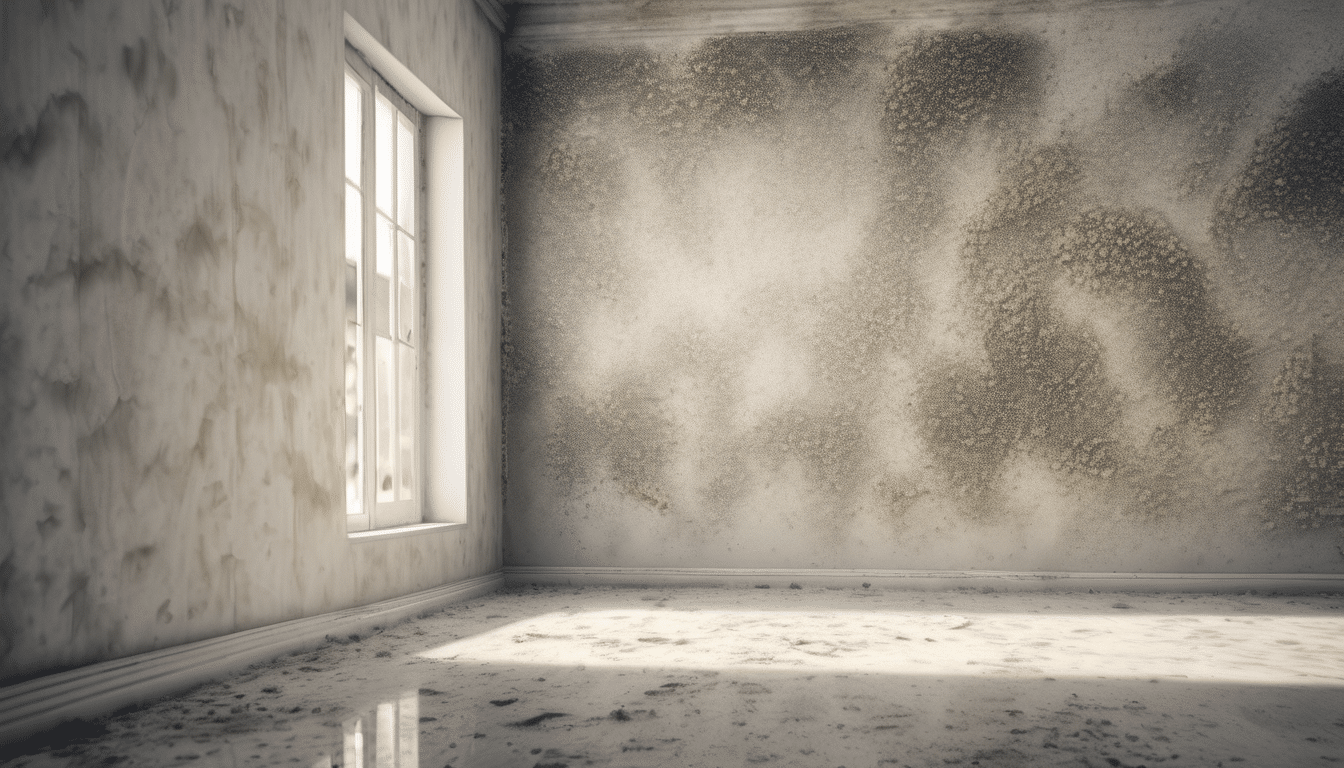
Dubai’s climate is one of the most demanding in the world for building performance. Outdoor humidity routinely reaches 80–95% during summer months, and indoor environments are kept artificially cool by air conditioning systems running continuously. This sharp contrast between indoor and outdoor conditions is precisely what drives How High Humidity causes mold behind walls in Dubai — not through obvious leaks or floods, but through invisible physics that most building occupants never consider.
mold growing behind walls is particularly problematic because it remains hidden long after it has become a serious contamination issue. By the time visible signs appear — staining, odour, or paint bubbling — colonies may already be well-established within wall cavities, behind gypsum board, or inside insulation layers. Understanding how high humidity causes mold behind walls in Dubai means understanding the relationship between moisture, temperature, air movement, and building materials.
This article explains the mechanisms behind hidden mold growth, why Dubai’s specific climate makes it predictable rather than random, and what evidence-based investigation looks like when wall mold is suspected.
How High Humidity Causes Mold Behind Walls In Dubai – Dubai’s Climate and the Hidden Mold Risk
Dubai sits in a hot, arid desert environment for much of the year — yet paradoxically ranks among the most mold-prone environments for indoor buildings. The reason is not the desert heat itself. It is the combination of high ambient humidity from the Arabian Gulf and the extreme cooling demands that keep interior temperatures far below outdoor conditions.
Between May and October, outdoor temperatures regularly exceed 40°C, while indoor environments are maintained between 20°C and 24°C. Outdoor relative humidity during coastal summer months frequently exceeds 85%. This temperature and humidity differential creates the physical conditions for condensation inside walls — and condensation is the primary driver of how high humidity causes mold behind walls in Dubai.
Sharjah, Ajman, and Ras Al Khaimah coastal zones experience similar or more intense humidity events. Fujairah on the east coast encounters additional moisture from the Gulf of Oman. In every case, the building envelope — the walls, floors, ceilings, and roofs — sits between two very different environments and must manage that difference without accumulating moisture.
How High Humidity Causes Mold Behind Walls in Dubai Through Condensation
Condensation occurs when warm, humid air contacts a surface that has cooled below the dew point. The dew point is the temperature at which air becomes fully saturated and can no longer hold moisture in vapour form. In Dubai, with outdoor air at 38°C and 85% relative humidity, the dew point can be as high as 33°C. When that air contacts a wall surface cooled by interior air conditioning to 22°C, condensation is thermodynamically inevitable.
This is not a design flaw unique to poorly built homes. It is a fundamental physics problem that affects buildings of all quality levels when the climate differential is extreme enough. How high humidity causes mold behind walls in Dubai is therefore a physics-first problem before it becomes a biology problem.
Interstitial Condensation — The Hidden Mechanism
What makes wall mold particularly insidious in Dubai is interstitial condensation. This refers to moisture forming not on the visible surface of a wall, but within the wall assembly itself — inside insulation, at the back face of gypsum board, or on structural elements such as metal stud frames. From the interior, the room appears dry. From behind the wall, conditions may be persistently wet. This relates directly to How High Humidity Causes Mold Behind Walls In Dubai.
Metal stud framing, common in UAE apartment construction, conducts temperature efficiently. A cold indoor temperature rapidly reaches the metal studs embedded in the wall, creating a cold bridge at which condensation forms. Gypsum board and mineral wool insulation absorb and retain this moisture. Given sufficient duration — days, not months — mold spore germination begins.
The Moisture Threshold for Mold Growth
Mold species commonly found in UAE buildings, including Cladosporium, Aspergillus, and Penicillium, require a relative humidity above approximately 70% at the material surface and organic substrate to establish growth. Gypsum board paper facing, wallpaper adhesive, and dust accumulation on surfaces all provide adequate organic nutrition. Sustained surface humidity above 75–80% is sufficient for active colony development within 24–72 hours under warm conditions.
How High Humidity Causes Mold Behind Walls In Dubai – Building Materials and Moisture Absorption in UAE Constructi
Standard UAE construction materials respond to moisture in ways that can accelerate hidden mold development. Gypsum board — used almost universally in internal partitions, ceilings, and feature walls across Dubai villas and apartments — is hygroscopic. It absorbs moisture readily from surrounding air and holds it within its paper facing and gypsum core.
Cement render and lightweight block, common in structural walls, also retain moisture. When exterior walls are not adequately waterproofed or when vapour barriers are improperly installed or absent entirely, moisture migrates inward from outdoor air through the wall assembly. This inward vapour drive is a direct consequence of how high humidity causes mold behind walls in Dubai during peak summer months.
Vapour Barriers and Their Frequent Absence
Vapour retarders — membranes that slow the movement of moisture vapour through wall assemblies — are standard components in building envelopes designed for hot, humid climates. In a properly designed hot-humid climate wall, the vapour retarder should be placed on the exterior (warm) side of the insulation, preventing outdoor moisture from reaching cooler interior wall layers.
In many UAE construction projects, vapour barriers are either absent, incorrectly positioned, or improperly sealed at joints and penetrations. This single omission explains a substantial proportion of the hidden mold cases we encounter during forensic investigations. The wall is visually complete and aesthetically finished, yet structurally vulnerable to the climate it sits within.
How AC Systems Contribute to Humidity and Mold Behind Walls
Air conditioning systems are intended to control both temperature and humidity. In practice, many UAE buildings experience dehumidification failure — where the AC system maintains an acceptable temperature but fails to remove sufficient moisture from indoor air. This typically occurs when systems are oversized, improperly maintained, or when supply air is poorly distributed.
An oversized AC unit cools the space rapidly but cycles off before completing adequate dehumidification. Indoor relative humidity may remain at 60–70% even when temperature appears comfortable. Over weeks and months, wall surfaces, especially in corners, behind furniture, and inside built-in wardrobes, accumulate enough sustained humidity to support mold growth. When considering How High Humidity Causes Mold Behind Walls In Dubai, this becomes clear.
How high humidity causes mold behind walls in Dubai is therefore not only a matter of outdoor climate — indoor humidity management failures play an equally significant role. The two factors compound one another in buildings where envelope performance and AC performance are both inadequate.
Recognising the Signs of High Humidity Mold Behind Walls in Dubai Homes
Because mold grows within the wall assembly, visible confirmation is often delayed. By the time staining appears on a painted surface, the underlying colony may already be extensive. Understanding early indicators significantly reduces the likelihood of discovering mold only after it has become a major remediation project.
Physical and Sensory Indicators
- Musty or earthy odour in specific rooms, particularly after the AC has been running for several hours
- Paint bubbling, blistering, or peeling at wall bases, behind furniture, or along external walls
- Efflorescence — white salt deposits appearing on wall surfaces, indicating moisture movement through masonry
- Discolouration or staining that cannot be attributed to direct water leakage
- Warping or soft spots in gypsum board when pressed lightly
- Condensation forming on interior wall surfaces in early morning hours
Health and Symptom Patterns
Occupant health patterns can provide early indicators of hidden mold exposure. Recurring respiratory symptoms — particularly sneezing, nasal congestion, or eye irritation — that improve when occupants leave the building and worsen upon return suggest biological contamination within the indoor environment. These patterns warrant professional investigation rather than assumption.
This does not constitute medical diagnosis. However, in our investigations, symptom correlation with specific rooms or specific building conditions has repeatedly provided the first meaningful evidence pointing toward hidden mold behind walls. The importance of How High Humidity Causes Mold Behind Walls In Dubai is evident here.
Hygrothermal Failure and Why It Makes High Humidity Cause Mold Behind Walls
Hygrothermal analysis is the study of how heat and moisture move simultaneously through building assemblies. When a wall is designed without adequate hygrothermal modelling for its specific climate, it will perform predictably poorly under real conditions — regardless of how well it is constructed. How high humidity causes mold behind walls in Dubai is, in many cases, a hygrothermal failure that was predictable before the building was even occupied.
Common hygrothermal failure scenarios in UAE buildings include:
- Cold bridging through metal framing — creating localised condensation zones within the wall
- Inadequate external insulation — allowing the wall’s interior surface to drop below the indoor dew point
- Air gaps and uncontrolled infiltration — allowing outdoor humid air to enter wall cavities directly
- Missing or reversed vapour retarders — allowing moisture to accumulate at the wrong location within the assembly
Each of these failures creates sustained moisture accumulation at a location within the wall where mold has both the substrate and the humidity conditions it requires. The biology follows the physics.
The Scientific Investigation Approach for Hidden Wall Mold
When hidden mold behind walls is suspected, the investigation process must address building science and microbiology together. Visual inspection alone is insufficient. A wall that appears completely clean externally may conceal extensive contamination within its assembly. Understanding How High Humidity Causes Mold Behind Walls In Dubai helps with this aspect.
Diagnostic Tools and Methods
Thermal imaging identifies cold zones and thermal anomalies within wall surfaces. A section of wall with consistently lower surface temperature than surrounding areas indicates a potential cold bridge or moisture accumulation zone — both risk factors for hidden mold.
Moisture mapping using calibrated pin and pinless meters quantifies moisture content within wall materials. Readings above material-specific thresholds indicate active or recent moisture accumulation. This data guides decisions about where targeted sampling is warranted.
Borescope inspection allows direct visual access to wall cavities through a small drilled hole, typically 10–12 mm in diameter. In our investigations, this method has revealed extensive mold growth on the back faces of gypsum board and on insulation in walls that showed no external signs of contamination whatsoever.
Air sampling and surface sampling provide laboratory-confirmed data on the mold species present and the concentration of airborne spores. These results guide remediation scope and allow post-remediation verification against baseline conditions. How High Humidity Causes Mold Behind Walls In Dubai factors into this consideration.
Laboratory Analysis
Species identification matters because different mold genera carry different health risk profiles and respond differently to remediation methods. Stachybotrys chartarum, for example, requires persistently saturated substrate and produces mycotoxins of clinical significance. Its presence indicates a fundamentally different moisture history than a surface-level Cladosporium finding. Laboratory analysis resolves this distinction in ways that visual inspection cannot.
Expert Takeaways for Dubai Property Owners
Understanding how high humidity causes mold behind walls in Dubai leads directly to a set of practical principles that reduce risk:
- Monitor indoor relative humidity continuously. Maintain indoor RH below 55% to reduce mold risk at wall surfaces. Calibrated digital hygrometers are inexpensive and provide real-time data.
- Service AC systems regularly. Ensure coils are clean and that the system is dehumidifying adequately, not merely cooling. Dirty coils reduce moisture removal efficiency significantly.
- Ensure adequate air circulation. Stagnant air pockets behind large furniture placed against external walls create localised high-humidity zones. Maintain at least 5–10 cm clearance.
- Investigate musty odours promptly. An unexplained musty smell is a laboratory-worthy finding, not a cosmetic concern. Early investigation prevents extensive remediation.
- Engage building science expertise before renovation. Opening walls or applying surface treatments without understanding the underlying moisture source will not resolve the problem and may worsen it.
- Request a post-construction mold inspection for newly occupied UAE properties, particularly in high-humidity coastal zones. Construction moisture and early occupancy conditions create elevated mold risk during the first 12–18 months.
Conclusion
How high humidity causes mold behind walls in Dubai is not a mystery — it is a predictable consequence of climate physics interacting with building assemblies that are frequently under-designed for the UAE’s demanding hygrothermal conditions. The outdoor humidity is intense, the indoor cooling is extreme, and the wall sitting between them must manage that difference without failing. When it does fail, mold is the outcome.
How high humidity causes mold behind walls in Dubai follows a consistent pattern: moisture vapour migrates inward, condenses at cooler wall layers, saturates hygroscopic materials, and provides the sustained wet condition that mold biology requires. The process is invisible, progressive, and almost entirely preventable with correct building science applied at the design, construction, and maintenance stages.
For property owners who suspect hidden wall mold, the correct response is a science-based investigation — thermal imaging, moisture mapping, targeted sampling, and laboratory analysis — not surface treatment or speculation. Understanding the mechanism behind the problem is the only reliable path to resolving it permanently. A proper investigation is required to confirm the scope, identify the root cause, and design a remediation approach that addresses the building failure driving the mold, not merely its visible symptoms. Understanding How High Humidity Causes Mold Behind Walls In Dubai is key to success in this area.