
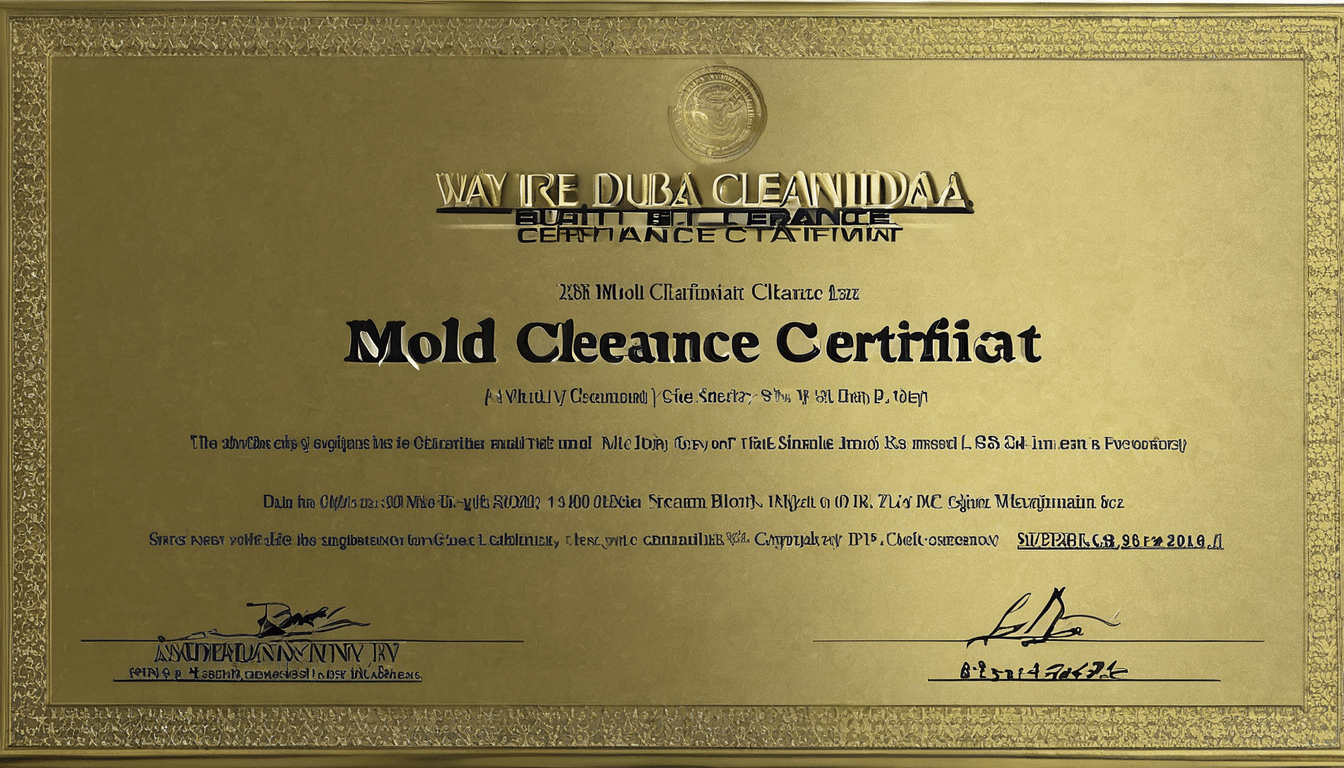
Understanding Mold Clearance Certificate Dubai: What It Means is essential. A Mold Clearance Certificate in Dubai is more than a piece of paper issued at the end of a remediation job. Understanding what a mold clearance certificate Dubai means requires recognising it as a documented, laboratory-verified declaration that the indoor environment has returned to a measurable standard of acceptability — one that can be reviewed, audited, and defended if questioned. In a climate where humidity levels routinely push indoor environments toward biological instability, that verification carries real weight.
Dubai’s built environment presents a particular challenge for indoor environmental science. Temperatures exceeding 45°C outdoors, combined with heavily air-conditioned interiors and buildings that cycle through intensive use, create conditions where moisture intrusion, condensation, and biological contamination can develop quickly and quietly. For property owners, landlords, facility managers, and real estate professionals across Dubai, Abu Dhabi, and Sharjah, knowing what a mold clearance certificate Dubai means — and what it takes to obtain one — is increasingly relevant to property management, occupant wellbeing, and regulatory compliance. This relates directly to Mold Clearance Certificate Dubai: What It Means.
This guide breaks down the process, the science, and the variables that determine the scope and complexity of a mold clearance assessment, so you can approach the process with informed expectations rather than assumptions.
Mold Clearance Certificate Dubai: What It Means – What a Mold Clearance Certificate Dubai Means in Practice
A mold clearance certificate is a formal document issued by a qualified indoor environmental professional or accredited laboratory following post-remediation verification. It states, based on physical inspection and laboratory-confirmed sampling, that the affected area no longer contains mold contamination at levels considered problematic for indoor occupancy.
Critically, a clearance certificate is not issued by the remediation contractor themselves. Issuing and verifying are two different functions, and any credible mold clearance certificate Dubai process separates them. The party that cleaned the property should not be the same party confirming the outcome — that separation is what gives the document its integrity. When considering Mold Clearance Certificate Dubai: What It Means, this becomes clear.
What the certificate typically documents includes:
- The property address and the specific areas assessed
- The date of post-remediation inspection (DD/MM/YYYY format)
- The sampling methodology used (air sampling, surface sampling, or both)
- Laboratory results from an accredited testing facility
- The professional’s interpretation of results against accepted indoor environmental benchmarks
- A conclusion statement confirming clearance or identifying areas requiring further attention
As an IAC2 Certified Indoor Air Consultant, the standard I apply to every clearance assessment is straightforward: the data must support the conclusion. If laboratory results are borderline, the certificate does not get issued until the findings are reconciled. The importance of Mold Clearance Certificate Dubai: What It Means is evident here.
Mold Clearance Certificate Dubai: What It Means – When Is a Mold Clearance Certificate Required in Dubai
Several situations in Dubai and the wider UAE commonly trigger the need for a mold clearance certificate. Property transactions are one of the most frequent drivers. Buyers conducting due diligence on villas in areas like Arabian Ranches, The Springs, or Jumeirah Islands — where older building envelopes can hide years of moisture accumulation — may request a clearance certificate before completing a purchase.
Rental disputes resolved through the Dubai Rental Disputes Centre or RERA-related proceedings can also involve mold clearance documentation, particularly when tenants raise indoor environmental concerns. Facility managers in commercial and hospitality settings may require clearance documentation as part of their health and safety audit trail. Understanding Mold Clearance Certificate Dubai: What It Means helps with this aspect.
Post-renovation mold clearance is another common scenario. Construction work that opens up wall cavities, disturbs existing materials, or introduces moisture through wet trades can release previously contained contamination. A mold clearance certificate Dubai assessment conducted after renovation confirms that materials are clean before new finishes are applied.
Healthcare facilities, nurseries, and childcare centres in the UAE operate under heightened indoor environmental standards, and mold clearance documentation may form part of ongoing regulatory compliance requirements for those settings. Mold Clearance Certificate Dubai: What It Means factors into this consideration.
Mold Clearance Certificate Dubai: What It Means – The Mold Clearance Certificate Dubai Assessment Process Step
Step One: Post-Remediation Stabilisation
Before any clearance sampling begins, the remediated area must be physically stable. Containment barriers used during remediation should be intact or correctly removed, surfaces must be dry, and the HVAC system — if it was part of the affected zone — should be operational at normal settings. Sampling conducted in an environment that is still drying or still disturbed will not yield results that accurately reflect the cleared state.
Step Two: Visual Inspection by a Qualified Professional
A clearance assessment begins with a thorough visual inspection of the remediated area and surrounding zones. This is where building science training becomes important. An assessor who understands hygrothermal dynamics, envelope behaviour, and HVAC interaction will look beyond the remediated surface to identify whether conditions that created the original mold problem have genuinely been resolved. This relates directly to Mold Clearance Certificate Dubai: What It Means.
Moisture readings are taken across structural materials using calibrated instruments. Thermal imaging is frequently used to identify anomalies behind surfaces that cannot be observed directly. If there is any indication that moisture sources remain active, the clearance process pauses until those sources are addressed.
Step Three: Air and Surface Sampling
Sampling is the scientific core of the mold clearance certificate Dubai process. Air samples are typically collected using spore trap cassettes and analysed under microscopy by an accredited laboratory. Surface samples may be collected using tape lifts, swabs, or bulk material analysis depending on the surface type and what the visual inspection indicated. When considering Mold Clearance Certificate Dubai: What It Means, this becomes clear.
Sampling follows a comparative protocol: samples from the remediated area are compared to an outdoor reference sample collected at the same time, and to non-affected control areas within the property. This comparison is how elevated spore counts are distinguished from ambient background levels that are normal in any outdoor-adjacent environment.
Step Four: Laboratory Analysis
At Saniservice, laboratory analysis is conducted in-house — a distinction that matters for turnaround time and interpretive precision. When the laboratory is integrated with the field investigation team, the assessor who collected the samples and the analyst interpreting them can communicate directly about findings that require context. The importance of Mold Clearance Certificate Dubai: What It Means is evident here.
Laboratory analysis identifies mold genera and species present, quantifies spore concentrations, and flags any species of particular note — such as Stachybotrys chartarum or Aspergillus niger — that carry additional significance in the interpretation of results.
Step Five: Report and Certificate Issuance
If laboratory results confirm that spore concentrations in the remediated area are consistent with or below outdoor reference levels, and no elevated surface contamination is detected, the mold clearance certificate is issued. The report accompanying the certificate documents the full methodology, all sample results, and the professional’s conclusions. Understanding Mold Clearance Certificate Dubai: What It Means helps with this aspect.
If results indicate residual contamination, the report specifies which areas require further remediation before clearance can be confirmed. A second assessment is then scheduled following the additional work.
Variables That Affect the Scope of a Mold Clearance Assessment
A professional assessment determines the scope of any mold clearance engagement. There is no meaningful standardised fee structure because the scope varies significantly between properties. Variables that affect the quoted scope include: Mold Clearance Certificate Dubai: What It Means factors into this consideration.
- Property size and type: A studio apartment and a six-bedroom villa in Emirates Hills require fundamentally different assessment approaches. More surface area, more rooms, and more HVAC zones mean more sampling points and more laboratory analysis.
- Age and construction method of the building: Older buildings in Deira, Bur Dubai, or Satwa may have materials and assemblies that hold moisture differently from newer construction. Some older properties have had multiple layers of finishes applied over original surfaces, complicating visual access and sampling.
- Extent of the original contamination: A clearance assessment following a minor bathroom mold remediation differs substantially from one following extensive remediation of an HVAC system and multiple rooms in a large villa.
- Number of sampling locations required: IAC2 and IICRC guidelines suggest minimum sampling locations, but complex properties or extensive remediation projects require more points to achieve representative data.
- Occupancy status: Occupied properties with sensitive individuals — children, elderly occupants, or those with respiratory conditions — may warrant a more comprehensive sampling protocol to achieve a higher degree of certainty.
- Whether HVAC systems were involved in the remediation: HVAC-related mold cases require specific sampling of supply and return air pathways, which adds both field time and laboratory processing to the scope.
Requesting a site visit for an accurate quote is the only way to receive a scope that reflects your specific property conditions. Generic estimates produced without a site assessment are not reliable indicators of what a credible mold clearance certificate Dubai process will actually involve.
What Distinguishes a Credible Mold Clearance Certificate
Not every document labelled a mold clearance certificate carries equal weight. Several markers distinguish a scientifically credible certificate from one that offers limited practical assurance. This relates directly to Mold Clearance Certificate Dubai: What It Means.
A credible certificate is backed by laboratory data from an accredited or in-house laboratory with documented chain of custody for samples. It is issued by a professional with verifiable credentials — IAC2 certification, building science training, or equivalent recognised qualifications. It follows a defined methodology aligned with IICRC S520 or comparable international protocols for mold assessment and remediation.
The report should be auditable — meaning a third party reviewing the same data could reach the same conclusion. If a certificate cannot be supported by its underlying data when examined, it provides no meaningful assurance to the property owner, buyer, or regulatory authority reviewing it. When considering Mold Clearance Certificate Dubai: What It Means, this becomes clear.
The question is not simply whether mold is present — it is what type, at what concentration, and what the laboratory results say. That is the standard a mold clearance certificate Dubai process should meet.
Mold Clearance Certificate Dubai Implications for Property Transactions
For real estate professionals and buyers operating in Dubai’s property market, mold clearance documentation is becoming a more common component of due diligence, particularly for older villa communities and properties that have experienced water damage or HVAC-related issues. The importance of Mold Clearance Certificate Dubai: What It Means is evident here.
A mold clearance certificate does not guarantee a property will remain free of mold indefinitely — that outcome depends on ongoing moisture management, HVAC maintenance, and building envelope integrity. What it does confirm is that at the point of assessment, following remediation conducted to a documented standard, the indoor environment met the clearance criteria established by the assessing professional using laboratory-confirmed data.
For landlords, this documentation also creates a defensible record of environmental condition at a specific date, which carries value in the context of tenancy transitions and any subsequent disputes about property condition. Understanding Mold Clearance Certificate Dubai: What It Means helps with this aspect.
Expert Observations on the Mold Clearance Certificate Dubai Process
Based on field investigations conducted across Dubai, Abu Dhabi, and Sharjah over more than a decade, several patterns recur in clearance assessments that are worth noting.
First, clearance assessments conducted too soon after remediation — before materials have fully dried or before HVAC systems have been returned to normal operation — frequently yield inconclusive results, requiring reassessment and adding time to the process. Allowing adequate stabilisation time is not a delay; it is a necessary condition for reliable data. Mold Clearance Certificate Dubai: What It Means factors into this consideration.
Second, the areas most likely to fail clearance are not always the areas most visibly treated. HVAC return plenums, wall cavities adjacent to remediated surfaces, and areas where moisture sources were incompletely resolved tend to appear in laboratory results more often than the primary remediation zone itself.
Third, properties where the root cause of mold growth was not addressed before remediation consistently fail clearance or experience recurrence. A mold clearance certificate Dubai assessment that uncovers an unresolved moisture source is delivering valuable information, even if it delays the certificate. That finding protects the property owner from a false sense of resolution that leads to re-contamination within months. This relates directly to Mold Clearance Certificate Dubai: What It Means.
Frequently Asked Questions
What exactly does a mold clearance certificate Dubai confirm?
A mold clearance certificate Dubai confirms, based on post-remediation visual inspection and laboratory-analysed air and surface samples, that mold contamination in a specified area has been reduced to levels consistent with acceptable indoor environmental benchmarks. It is a documented, data-supported statement of condition, not simply a sign-off that cleaning was performed.
Who is qualified to issue a mold clearance certificate in Dubai?
A mold clearance certificate should be issued by a qualified indoor environmental professional with verifiable credentials — such as IAC2 certification or equivalent — who operates independently of the remediation contractor. The assessor must have access to an accredited laboratory for sample analysis. Self-certification by the remediation company does not meet the standard of independence required for credible clearance documentation. When considering Mold Clearance Certificate Dubai: What It Means, this becomes clear.
How long does the mold clearance certificate Dubai assessment process take?
The timeline varies by property size and laboratory processing time. Field assessment typically requires several hours for a standard villa or apartment. Laboratory results for air and surface samples generally take between two and five business days. The full process from field visit to certificate issuance commonly falls within one week, assuming the property passes clearance on the first assessment.
Can a mold clearance certificate be required for property sales in Dubai?
While not universally mandated by Dubai Land Department for every transaction, mold clearance certificates are increasingly requested by buyers conducting due diligence, particularly for older villas and properties with documented water damage history. Sellers, agents, and property managers in Dubai should be aware that professional buyers may include environmental clearance as a condition of offer. The importance of Mold Clearance Certificate Dubai: What It Means is evident here.
What happens if my property does not pass mold clearance assessment?
If laboratory results indicate residual mold contamination above clearance thresholds, the assessment report will specify which areas require additional remediation. A second clearance assessment is then conducted after that work is completed. Failing clearance is not a failure of the property — it is the verification process functioning correctly, protecting the owner from incomplete remediation.
Does a mold clearance certificate cover HVAC systems in Dubai properties?
Only if HVAC systems were included in the scope of the remediation and assessment. HVAC-related mold cases in Dubai are common due to high humidity loads and variable maintenance standards. If the HVAC system was involved in the contamination, clearance sampling should include air quality verification from supply registers and, where accessible, assessment of duct interiors. Confirm with the assessing professional that HVAC coverage is explicitly included in the scope. Understanding Mold Clearance Certificate Dubai: What It Means helps with this aspect.
Is there a difference between a mold clearance certificate and an indoor air quality report in Dubai?
Yes. A mold clearance certificate is specifically a post-remediation document confirming that remediation met clearance criteria. An indoor air quality report is a broader assessment of environmental conditions that may or may not relate to a remediation event. Both involve sampling and laboratory analysis, but they serve different purposes and answer different questions about the indoor environment.
Requesting a Mold Clearance Assessment for Your Dubai Property
Understanding what a mold clearance certificate Dubai means is the first step. Connecting that understanding to your specific property situation is where a qualified professional assessment becomes essential. Property variables — size, age, occupancy, construction method, and contamination history — all influence the scope of what an accurate clearance assessment requires. Mold Clearance Certificate Dubai: What It Means factors into this consideration.
Saniservice conducts mold clearance assessments across Dubai, Abu Dhabi, Sharjah, and Ajman, operating from the UAE’s only in-house microbiology laboratory managed by an indoor environmental services company. That integration of field investigation and laboratory analysis means findings are interpreted with full context, and certificates are issued on data that can be examined and verified.
If you are preparing a property for sale, completing a remediation project, managing a facility with indoor environmental obligations, or simply seeking documented assurance about the indoor condition of a space you occupy, a site visit is the appropriate starting point. Professional assessment determines scope. Contact Saniservice to request a property-specific evaluation and understand what the mold clearance certificate Dubai process means for your situation. Understanding Mold Clearance Certificate Dubai: What It Means is key to success in this area.