
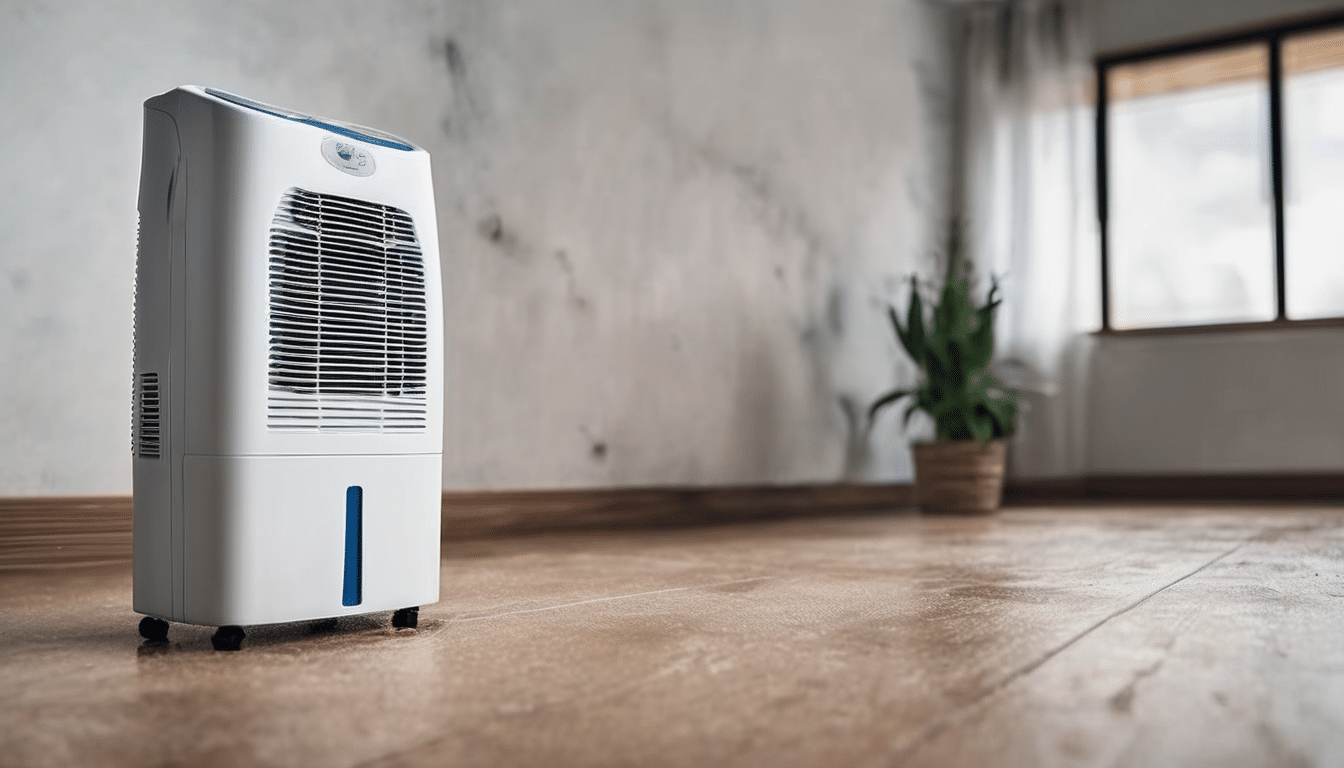
The best dehumidifiers for Dubai basement mold control must handle the UAE’s extreme humidity levels, with refrigerant models rated 50-70 litres per day being most effective for typical basement spaces of 80-120 square metres. Given Dubai’s year-round humidity exceeding 60% and basement temperatures around 24-26°C, selecting appropriate dehumidification equipment becomes critical for preventing mold establishment in these below-grade environments.
Basement mold control in Dubai presents unique challenges that standard dehumidifiers often cannot address effectively. The combination of concrete thermal mass, limited ventilation, and persistent moisture infiltration requires specific dehumidification strategies tailored to the region’s climate conditions. Understanding which dehumidifiers perform optimally in these demanding environments can prevent costly mold remediation projects ranging from AED 8,000 to AED 25,000.
From our investigations across Dubai’s residential and commercial basements, successful mold prevention depends heavily on selecting dehumidifiers with adequate capacity, appropriate technology, and strategic placement within the space. This comprehensive guide examines the most effective options available in the UAE market, based on real-world performance data from challenging basement environments.
Best Dehumidifiers For Dubai Basement Mold Control – Understanding Dubai Basement Humidity Challenges
Dubai’s basement environments face extraordinary moisture challenges that distinguish them from surface-level spaces. Relative humidity levels in below-grade areas frequently exceed 75% during summer months, creating ideal conditions for mold establishment within 48-72 hours of water intrusion events.
The thermal dynamics of basement spaces in Dubai create persistent condensation risks. Concrete foundation walls, typically 15-20°C cooler than ambient air, act as condensation surfaces when humid air contacts these thermal bridges. This phenomenon occurs regardless of visible water leaks, making best dehumidifiers for Dubai basement mold control essential preventive equipment rather than reactive solutions.
Seasonal Humidity Patterns
Our monitoring data reveals distinct seasonal patterns affecting basement humidity control requirements. During Dubai’s peak summer months (June through September), basement relative humidity can spike to 85% or higher, particularly in spaces with inadequate vapour barriers or compromised waterproofing systems.
Winter months present different challenges, with temperature differentials between heated indoor air and cooler basement zones creating persistent condensation conditions. The best dehumidifiers for Dubai basement mold control must accommodate these seasonal variations through adjustable humidity setpoints and consistent operation across temperature ranges of 18-30°C.
Construction-Related Moisture Sources
Dubai’s construction practices significantly influence basement moisture dynamics. Concrete curing moisture, inadequate vapour barriers, and thermal bridging through structural elements contribute ongoing humidity loads that mechanical dehumidification must address continuously.
Post-construction moisture content in concrete foundations can take 12-18 months to reach equilibrium levels. During this period, implementing the best dehumidifiers for Dubai basement mold control becomes critical for preventing mold establishment while building materials complete their drying cycle.
Best Dehumidifiers For Dubai Basement Mold Control – Essential Features for Best Dehumidifiers Dubai Basement Mol
Effective basement dehumidification in Dubai requires specific technical capabilities that standard residential units often lack. The most critical feature is adequate moisture extraction capacity, measured in litres per 24-hour period under standard conditions of 30°C and 80% relative humidity.
Refrigerant-based dehumidifiers demonstrate superior performance in Dubai’s climate conditions compared to desiccant models, which lose efficiency at temperatures above 25°C. The best dehumidifiers for Dubai basement mold control utilise robust refrigeration systems with hot gas defrost capabilities to maintain consistent operation in high-humidity environments.
Humidity Control Precision
Precise humidity control represents another essential capability for basement mold prevention. Target relative humidity levels for mold prevention should remain between 45-55%, requiring dehumidifiers with accurate humidistats and minimal dead-band variation.
Digital control systems with ±2% humidity accuracy enable fine-tuned environmental management that prevents both over-drying (which increases energy costs) and under-drying (which permits mold growth). The best dehumidifiers for Dubai basement mold control incorporate microprocessor-controlled humidity sensing with automatic cycling to maintain setpoint conditions.
Continuous Drainage Systems
Continuous drainage capability eliminates the risk of unit shutdown due to full collection tanks, a common failure mode in high-humidity environments. Gravity drainage to floor drains or pumped drainage to higher elevations ensures uninterrupted operation during peak moisture conditions.
Built-in condensate pumps with lift capabilities of 3-5 metres accommodate typical basement installations where gravity drainage is not feasible. The best dehumidifiers for Dubai basement mold control include reliable pump systems with backup overflow protection to prevent water damage from pump failures.
Best Dehumidifiers For Dubai Basement Mold Control – Top-Rated Dehumidifier Models for Dubai Basements
Based on performance evaluations in Dubai basement environments, several dehumidifier models consistently deliver reliable mold prevention results. The Dri-Eaz LGR 7000XLi represents the premium standard for challenging basement applications, with 133-litre daily capacity and low-grain refrigerant technology optimised for high-humidity conditions.
For residential applications, the Aprilaire 1850 whole-house dehumidifier integrates seamlessly with existing HVAC systems while providing 42-litre daily capacity suitable for basements up to 150 square metres. This model ranks among the best dehumidifiers for Dubai basement mold control due to its robust construction and precise humidity control capabilities.
Commercial-Grade Options
Large basement spaces exceeding 200 square metres require commercial-grade dehumidification systems. The Desert Aire GX series provides scalable solutions with capacities ranging from 95 to 285 litres per day, designed specifically for challenging moisture control applications.
These units incorporate advanced features including variable-speed operation, integrated controls, and remote monitoring capabilities that make them ideal for critical applications where mold prevention is paramount. The best dehumidifiers for Dubai basement mold control in commercial settings often require professional installation and commissioning to ensure optimal performance.
Budget-Conscious Solutions
For smaller basement areas or budget-constrained projects, the Honeywell TP70WKN provides reliable performance at approximately AED 1,200-1,500. While lacking some premium features, this model offers 50-litre daily capacity and automatic humidity control suitable for spaces up to 80 square metres.
The Frigidaire FFAD5033W1 represents another cost-effective option, priced around AED 900-1,200 and capable of handling typical residential basement applications. These models qualify as best dehumidifiers for Dubai basement mold control when properly sized and maintained according to manufacturer specifications.
Capacity Requirements for Best Dehumidifiers Dubai Basement Applications
Determining appropriate dehumidifier capacity for Dubai basements requires careful analysis of space volume, moisture load sources, and target humidity levels. The standard calculation assumes 0.5-0.7 litres per day per square metre for typical basement applications, but Dubai’s extreme humidity conditions often require 20-30% additional capacity.
A typical 100-square-metre basement in Dubai requires dehumidification capacity of 60-80 litres per day to maintain 50% relative humidity consistently. This calculation accounts for concrete moisture emission, air infiltration, and occupancy-related moisture sources that contribute to the overall humidity load.
Load Calculation Methodology
Precise capacity determination involves evaluating multiple moisture sources simultaneously. Concrete moisture emission rates typically range from 2-4 litres per day per 100 square metres of exposed surface area, depending on concrete age and curing conditions.
Air infiltration through basement envelope defects contributes additional moisture loads proportional to outdoor humidity levels and pressure differentials. The best dehumidifiers for Dubai basement mold control must accommodate peak moisture loads during extreme weather events when outdoor dew points exceed 25°C.
Oversizing Considerations
Moderate oversizing of dehumidification capacity provides operational benefits including reduced runtime, improved humidity control precision, and enhanced equipment longevity. However, excessive oversizing can create short-cycling problems that reduce efficiency and increase maintenance requirements.
The optimal approach involves selecting units with 10-20% excess capacity beyond calculated requirements, ensuring adequate performance during peak load conditions while maintaining efficient operation during typical conditions. The best dehumidifiers for Dubai basement mold control incorporate variable-speed operation to accommodate varying moisture loads efficiently.
Placement Strategies for Maximum Effectiveness
Strategic dehumidifier placement significantly influences mold prevention effectiveness in basement environments. Central positioning within the space ensures optimal air circulation patterns, while adequate clearance around the unit prevents airflow restrictions that reduce performance.
The most effective placement locations provide unrestricted air intake and discharge paths, typically requiring 60-90 centimetres of clearance on all sides. Positioning the best dehumidifiers for Dubai basement mold control near the geometric centre of the space maximises coverage area while minimising humidity gradients across the basement.
Air Circulation Optimisation
Basement air circulation patterns directly affect dehumidification effectiveness, particularly in spaces with structural obstacles or compartmentalised layouts. Supplementary circulation fans help distribute conditioned air throughout the space, preventing stagnant zones where humidity can accumulate.
Installing circulation fans to create gentle air movement at 0.5-1.0 metres per second enhances moisture pickup from surfaces and improves overall humidity control uniformity. The best dehumidifiers for Dubai basement mold control work synergistically with properly designed air circulation systems to achieve comprehensive moisture management.
Multiple Unit Configurations
Large or irregularly shaped basements may require multiple dehumidifier installations to achieve uniform humidity control. This approach involves dividing the space into zones based on moisture load characteristics and circulation patterns, with each unit sized for its specific coverage area.
Coordinated operation of multiple units requires careful consideration of air pressure relationships and discharge air paths to prevent short-circuiting between units. The best dehumidifiers for Dubai basement mold control in multi-unit configurations include communication capabilities for integrated operation and monitoring.
Maintenance and Optimization for Best Dehumidifiers Dubai Basement Systems
Preventive maintenance directly impacts dehumidifier performance and longevity, particularly in Dubai’s demanding environmental conditions. Regular filter cleaning or replacement maintains optimal airflow and prevents efficiency degradation that can compromise mold prevention effectiveness.
Air filter maintenance intervals in Dubai basement applications typically range from 4-8 weeks, depending on dust levels and occupancy patterns. Clogged filters reduce airflow by up to 40%, significantly compromising the ability of even the best dehumidifiers for Dubai basement mold control to maintain target humidity levels.
Coil Cleaning Procedures
Evaporator and condenser coil cleaning represents critical maintenance for sustained performance in high-humidity environments. Dust accumulation on coils reduces heat transfer efficiency and can promote microbial growth that affects indoor air quality.
Professional coil cleaning using appropriate chemicals and techniques should occur annually or semi-annually based on operating conditions. The best dehumidifiers for Dubai basement mold control incorporate accessible coil designs that facilitate thorough cleaning without extensive disassembly.
Condensate System Maintenance
Condensate drainage systems require regular inspection and cleaning to prevent blockages that can cause unit shutdown or water damage. Algae and biofilm growth in drainage lines is common in warm, humid conditions, necessitating periodic disinfection treatments.
Monthly inspection of drainage connections, pump operation (if equipped), and overflow protection ensures reliable moisture removal during peak operating periods. The best dehumidifiers for Dubai basement mold control include drainage system monitoring with alarm capabilities to alert users of potential problems.
Cost Considerations and Energy Efficiency
Operating costs for basement dehumidification in Dubai can be substantial, with typical residential units consuming 800-1,200 watts during operation. Annual operating costs range from AED 1,500 to AED 3,500 based on unit size, efficiency, and runtime requirements.
Energy efficiency ratings provide comparative performance data, with Energy Factor (EF) values indicating litres of moisture removed per kilowatt-hour of energy consumed. The best dehumidifiers for Dubai basement mold control typically achieve EF ratings of 2.5-3.5 litres/kWh under standard rating conditions.
Variable-Speed Technology Benefits
Variable-speed compressor and fan systems adapt power consumption to actual moisture load conditions, providing significant energy savings compared to fixed-speed units. These systems can reduce energy consumption by 20-35% while maintaining superior humidity control precision.
The initial premium for variable-speed technology typically ranges from AED 800 to AED 2,000, but operating cost savings recover this investment within 2-3 years in Dubai’s climate. The best dehumidifiers for Dubai basement mold control increasingly incorporate variable-speed operation as a standard feature.
Time-of-Use Optimisation
Dubai’s tiered electricity pricing structure creates opportunities for operating cost optimisation through strategic scheduling of dehumidifier operation. Programming units to operate primarily during off-peak hours can reduce energy costs by 15-25% without compromising mold prevention effectiveness.
Smart controls enable automated optimisation based on time-of-use rates, outdoor conditions, and indoor humidity trends. The best dehumidifiers for Dubai basement mold control include programmable scheduling capabilities that maximise cost-effectiveness while maintaining environmental control objectives.
Integration with HVAC Systems
Integrating basement dehumidification with existing HVAC systems provides operational synergies that enhance overall performance and efficiency. Ducted dehumidifiers can utilise existing air distribution systems to provide whole-building humidity control while addressing specific basement moisture challenges.
The Aprilaire 1850 and similar whole-house units integrate seamlessly with central air systems, providing coordinated temperature and humidity control. This integration approach ranks among the best dehumidifiers for Dubai basement mold control solutions when properly designed and commissioned.
Control System Coordination
Advanced control systems coordinate dehumidifier operation with HVAC equipment to optimise energy consumption and indoor environmental quality. Integrated controls prevent conflicting operation between cooling and dehumidification systems while maintaining precise humidity setpoints.
Smart thermostats with humidity control capabilities enable sophisticated operating strategies that consider outdoor conditions, occupancy patterns, and energy costs. The best dehumidifiers for Dubai basement mold control work seamlessly with building automation systems to provide comprehensive environmental management.
Ventilation Integration
Controlled mechanical ventilation systems work synergistically with dehumidification equipment to manage both humidity and indoor air quality. Heat recovery ventilators (HRVs) can reduce the moisture load on dehumidification systems while providing necessary outdoor air for occupant health.
Properly designed ventilation integration reduces dehumidifier runtime by 15-25% while improving overall indoor environmental quality. The best dehumidifiers for Dubai basement mold control complement rather than conflict with ventilation system operation.
Monitoring and Performance Indicators
Continuous monitoring of humidity levels and dehumidifier performance ensures effective mold prevention and identifies potential problems before they compromise indoor environmental quality. Digital hygrometers with data logging capabilities provide historical trends that inform maintenance and operational decisions.
Target humidity levels for basement mold prevention should remain consistently between 45-55% relative humidity, with daily variations not exceeding ±5%. The best dehumidifiers for Dubai basement mold control include built-in monitoring systems that track performance metrics and alert users to abnormal conditions.
Key Performance Metrics
Critical performance indicators include moisture removal rate, energy consumption, runtime percentage, and humidity setpoint accuracy. Monitoring these parameters helps optimise system operation and identify efficiency degradation that may indicate maintenance requirements.
Monthly moisture removal totals should align with calculated moisture loads, typically ranging from 1,500-2,500 litres per month for average basement applications in Dubai. Significant deviations from expected values may indicate equipment problems or changes in building moisture loads.
Alarm and Alert Systems
Advanced monitoring systems include configurable alarms for high humidity conditions, equipment malfunctions, and maintenance requirements. These systems enable proactive response to problems that could compromise mold prevention effectiveness.
Remote monitoring capabilities allow property managers and homeowners to track basement environmental conditions from anywhere, ensuring continuous protection against mold development. The best dehumidifiers for Dubai basement mold control increasingly incorporate smart connectivity features for enhanced monitoring and control.
Selecting appropriate dehumidification equipment for Dubai basement mold control requires careful consideration of capacity requirements, environmental challenges, and integration opportunities. The most effective solutions combine adequate moisture removal capacity with precise humidity control and reliable operation in demanding conditions.
Success in basement mold prevention depends not only on equipment selection but also on proper installation, maintenance, and monitoring practices that ensure consistent performance over time. The best dehumidifiers for Dubai basement mold control represent a critical component of comprehensive moisture management strategies that protect both building integrity and occupant health in the region’s challenging climate conditions.