
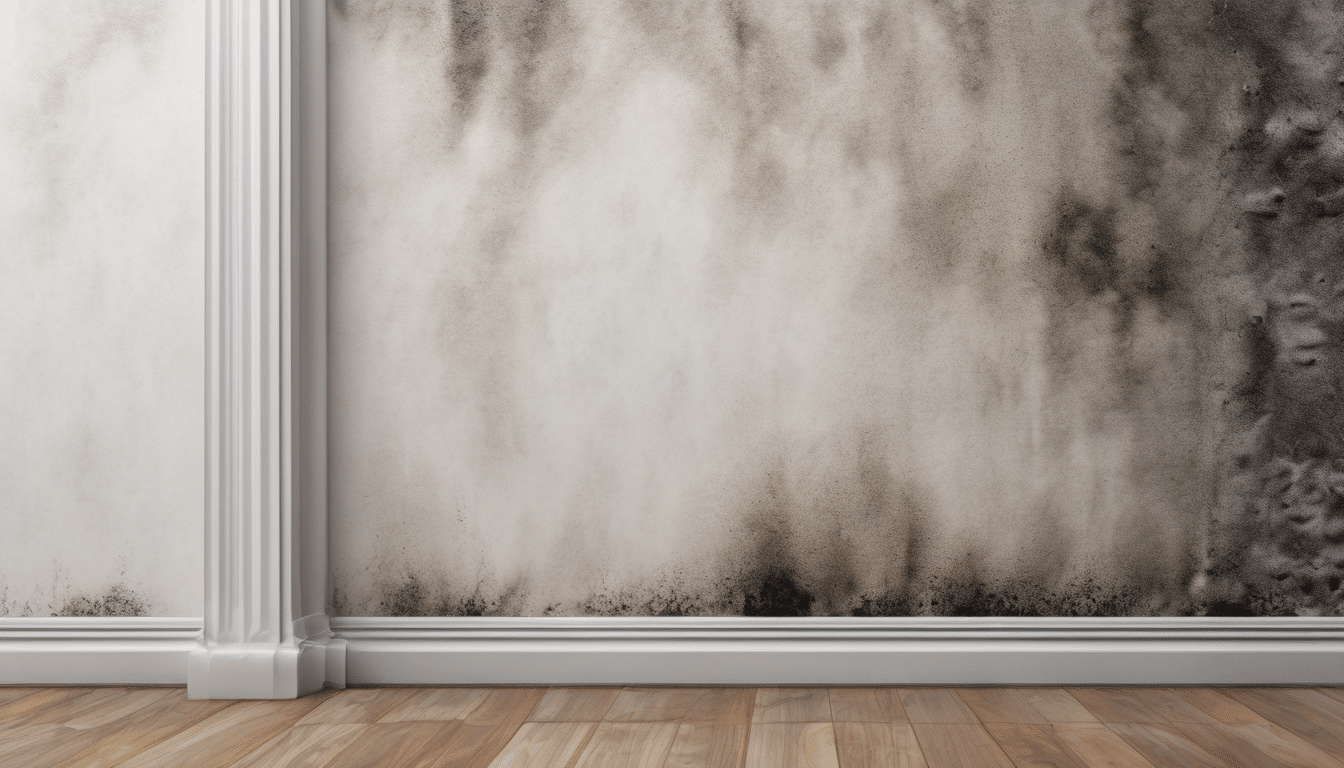
What Causes Mold to grow behind walls in Dubai is one of the most common questions I receive from homeowners and property managers across the UAE. The walls look clean. There is no visible staining. Yet something in the room smells musty, occupants feel unwell, and a post-investigation laboratory report confirms active mold colonies growing in a space no one can see. This scenario is far more common in Dubai than most people realise—and far more predictable than most people expect.
Behind-wall mold in Dubai is not a random event. It is a measurable, traceable outcome of specific conditions that the UAE climate, combined with local construction practices and mechanical cooling systems, reliably creates. Understanding what causes mold to grow behind walls in Dubai requires looking at building physics first, biology second.
This article explains those causes in full—drawing on more than 20 years of indoor environmental investigations across Dubai, Abu Dhabi, Sharjah, and the wider UAE.
What Causes Mold To Grow Behind Walls In Dubai – Why Dubai Walls Are Particularly Mold-Prone
Dubai sits in one of the most challenging climates on earth for building envelope performance. Outdoor temperatures routinely exceed 45°C between June and September, while relative humidity along the coast can climb above 85–90%. This combination—extreme heat and high ambient moisture—creates constant pressure on every external wall surface.
The problem is not humidity alone. It is the interaction between that hot, humid outdoor air and the heavily air-conditioned indoor environment. When these two conditions meet inside a wall cavity, the physics of moisture movement create ideal conditions for mold colonisation. Understanding what causes mold to grow behind walls in Dubai begins with understanding this fundamental thermal and moisture gradient.
Most residents focus on what they can see—surface staining, ceiling patches, grout discolouration. Wall cavities, however, operate invisibly. By the time any odour or surface sign appears, mold colonies inside the wall may have been active for weeks or months.
What Causes Mold To Grow Behind Walls In Dubai – What Causes Mold — The Role of Condensation Inside Walls
Condensation is the primary driver of hidden wall mold in Dubai. It occurs when warm, moisture-laden air contacts a surface that is cool enough to drop below the dew point—the temperature at which water vapour becomes liquid. In a Dubai building, that cool surface is often the interior face of the external wall, chilled by the air conditioning system running continuously at 20–22°C. This relates directly to What Causes Mold To Grow Behind Walls In Dubai.
How Vapour Drives Through the Wall
Outdoor humid air does not stay outside. Vapour pressure differences drive moisture through every gap, joint, crack, and permeable material in the building envelope. As that vapour travels inward from the hot exterior toward the cool interior, it reaches its dew point somewhere within the wall assembly. At that point, it condenses into liquid water—invisible, trapped, and persistent.
This is precisely what causes mold to grow behind walls in Dubai in buildings that appear completely sealed. The water source is not a burst pipe or a leaking roof. It is physics—the same physics that causes a cold glass to collect water droplets in a warm room.
The Dew Point Problem in UAE Climate
In Dubai’s summer months, outdoor dew points regularly reach 28–30°C. With indoor temperatures maintained at 21°C, almost any moisture-carrying air that penetrates the wall assembly will condense before reaching the interior. Gypsum board, insulation batts, timber framing elements, and adhesives all absorb this moisture. Once material moisture content sustains above approximately 17–20%, mold growth becomes viable within 24–72 hours.
What Causes Mold To Grow Behind Walls In Dubai – How AC Systems Directly Cause Mold Behind Walls
Air conditioning is both the solution to Dubai’s heat and a significant contributor to behind-wall mold problems. The relationship is more direct than most building owners realise.
Oversized AC Units and Excessive Cooling
Many Dubai properties—particularly older villas and apartments—have air conditioning units that are incorrectly sized for their spaces. An oversized unit cools the air rapidly but does not run long enough to adequately dehumidify it. This creates air that is cold but still moisture-laden. That cold, humid air then contacts wall surfaces and interior cavities, driving condensation deeper into the building envelope.
Leaking Ductwork Inside Wall Cavities
Concealed ductwork running through wall cavities is a common feature in UAE construction. When those ducts develop leaks—through joint separation, damaged insulation, or improper installation—they release conditioned air directly into wall cavities. The resulting cold air pocket inside a warm wall assembly is a textbook condensation environment. This is a frequently overlooked answer to what causes mold to grow behind walls in Dubai, particularly in high-rise residential buildings.
Condensate Line Failures
AC condensate drain lines that run through or adjacent to wall cavities can develop blockages, cracks, or connection failures. Even a slow, intermittent drip from a damaged condensate line inside a wall cavity provides sufficient sustained moisture for mold colonisation. In our investigations at Saniservice, this cause appears with notable regularity in Dubai apartments where residents report mold but cannot identify any visible water source.
Thermal Bridging in UAE Construction
Thermal bridging occurs where a highly conductive material—typically steel or concrete—creates a direct path through the building envelope, bypassing insulation. In UAE construction, reinforced concrete structural elements, steel columns, and concrete block walls create extensive thermal bridge networks.
These bridges allow cold to penetrate from the interior air conditioning environment into the wall assembly. The result is localised cold spots within the wall—exactly where warm, humid outdoor air condenses. Understanding thermal bridging is central to understanding what causes mold to grow behind walls in Dubai, especially in concrete-framed buildings that dominate the UAE skyline.
Thermal imaging investigations frequently reveal these cold spots as the precise locations of hidden mold colonies. A wall that appears uniform from the outside contains internal temperature variations of 4–8°C—more than sufficient to create differential condensation and selective mold growth.
Concealed Water Leaks and Moisture Intrusion
Not all behind-wall mold originates from vapour movement and condensation. Direct water intrusion is equally significant, and often more damaging due to the volume of moisture involved.
Plumbing Leaks Within Cavities
Supply pipes, waste lines, and chilled water pipes all run through wall cavities in Dubai buildings. A slow leak on any of these—sometimes no more than a weeping joint or a pinhole in copper pipe—can introduce litres of water per day into an enclosed cavity. That moisture is absorbed by gypsum, timber, and insulation, creating the sustained wet environment that mold requires. When considering What Causes Mold To Grow Behind Walls In Dubai, this becomes clear.
Façade and Window Seal Failures
Dubai’s building stock includes a significant proportion of glazed façades and large window systems. When sealants around window frames degrade—accelerated by UV exposure and thermal expansion cycling common in the UAE—rainwater during the brief winter season and condensation from temperature differentials can penetrate behind cladding and into wall assemblies. This is particularly relevant for properties along the coastline in areas such as Dubai Marina, Jumeirah Beach Residence, and Palm Jumeirah.
Trapped Construction Moisture in New Buildings
A frequently underappreciated answer to what causes mold to grow behind walls in Dubai is construction moisture. Concrete, screed, render, and block-work all contain significant quantities of water when first placed. In Dubai’s fast-paced construction environment, buildings are often enclosed, finished, and handed over before the structural materials have fully dried.
When air conditioning is activated in a newly completed property, the cool dry air begins drawing moisture from still-damp concrete and block-work. That moisture migrates through walls, encounters vapour barriers and finishes, and may condense within cavities or at interfaces between materials. Gypsum board fixed over damp block-work is a particularly reliable mold substrate.
This pattern explains why some Dubai properties develop mold problems within the first 12–24 months of occupation—before any plumbing failure or maintenance neglect has occurred. It is a construction science failure, not a behavioural one.
What Causes Mold Through Ventilation and Building Design Failures
Modern Dubai buildings are designed to be airtight. Energy efficiency requirements and the extreme outdoor conditions make this a practical necessity. However, insufficient mechanical ventilation in highly sealed buildings allows moisture generated indoors—from cooking, bathing, respiration, and cleaning—to accumulate within the living environment and eventually migrate into wall assemblies.
Bathroom and Kitchen Extraction Failures
Exhaust fans that vent into ceiling voids or wall cavities rather than to the exterior are a known cause of hidden mold in UAE apartments. Moisture-laden extraction air released inside a wall cavity condenses rapidly and drives mold growth in areas completely inaccessible without demolition. The importance of What Causes Mold To Grow Behind Walls In Dubai is evident here.
Negative Pressure and Air Infiltration
Buildings that operate under negative pressure—where more air is exhausted than is supplied—draw outdoor humid air through every gap in the envelope. This uncontrolled infiltration carries substantial moisture loads directly into wall cavities. Understanding what causes mold to grow behind walls in Dubai often requires a full building pressure and airflow diagnostic, not simply a visual inspection.
What Causes Mold Growth — Wall Materials and Substrate Vulnerability
Biology requires more than moisture to grow mold—it requires an organic food source. Dubai construction materials provide these readily. What causes mold to grow behind walls in Dubai is not moisture alone but moisture acting on the specific materials used in local construction.
- Gypsum board (drywall): The paper facing is a primary mold food source. Once moisture content exceeds threshold, colonisation proceeds rapidly.
- Joint compound and plaster: Contains organic additives that support mold growth under sustained moisture exposure.
- Insulation materials: Fibreglass and mineral wool do not themselves support mold, but trapped dust within these materials provides sufficient organic matter for colonisation.
- Timber elements: Used in cabinetry, door frames, and decorative finishes, timber is highly mold-susceptible under humid conditions.
- Wall adhesives and sealants: Many contain organic compounds that mold species readily metabolise.
Species such as Cladosporium, Aspergillus, Penicillium, and Chaetomium are routinely identified in our laboratory analyses of Dubai wall cavity samples. Stachybotrys chartarum—commonly called black mold—is also encountered where sustained water exposure has occurred on cellulosic substrates.
Expert Takeaways for Dubai Property Owners
After more than a decade of wall cavity investigations across Dubai, Abu Dhabi, and Sharjah, several consistent principles emerge for property owners concerned about hidden mold:
- A musty odour is diagnostic data, not a nuisance. It indicates active mold metabolism and should prompt investigation, not masking with fragrance.
- Visual inspection alone cannot confirm or rule out behind-wall mold. Thermal imaging, moisture mapping, borescope investigation, and air sampling are required for a scientifically defensible assessment.
- New properties are not immune. Construction moisture, commissioning failures, and early envelope defects make first-year mold problems more common than the industry typically acknowledges.
- AC maintenance directly affects mold risk. Annual ductwork inspection, condensate line verification, and filter replacement are preventive measures with measurable impact.
- Remediation without root-cause correction will fail. Cleaning mold without addressing the moisture mechanism guarantees recurrence. This is the single most common reason mold returns after treatment.
Understanding what causes mold to grow behind walls in Dubai is the prerequisite for any effective remediation decision. The building must be understood as a system before any surface treatment is considered.
Conclusion
What causes mold to grow behind walls in Dubai is not one single failure—it is a convergence of climate physics, construction practice, mechanical system behaviour, and material vulnerability. Dubai’s extreme heat-humidity differential creates relentless vapour pressure on every building envelope. Air conditioning systems, while essential, alter temperature profiles in ways that generate condensation within wall cavities. Construction speed, material selection, and ventilation design all contribute to the conditions mold requires.
The consistent finding from our investigations is that what causes mold to grow behind walls in Dubai is almost always traceable to a specific, identifiable mechanism—not bad luck. That means it is also preventable and correctable, provided the right diagnostic approach is applied. Measurement, not assumption. Root cause, not surface treatment. These principles determine whether remediation succeeds long-term or simply delays the next outbreak.
If you suspect hidden mold in your Dubai property, the correct first step is a professional indoor environmental investigation that uses calibrated instruments, laboratory analysis, and building science methodology to identify precisely what is happening inside your walls—and why. Understanding What Causes Mold To Grow Behind Walls In Dubai is key to success in this area.