
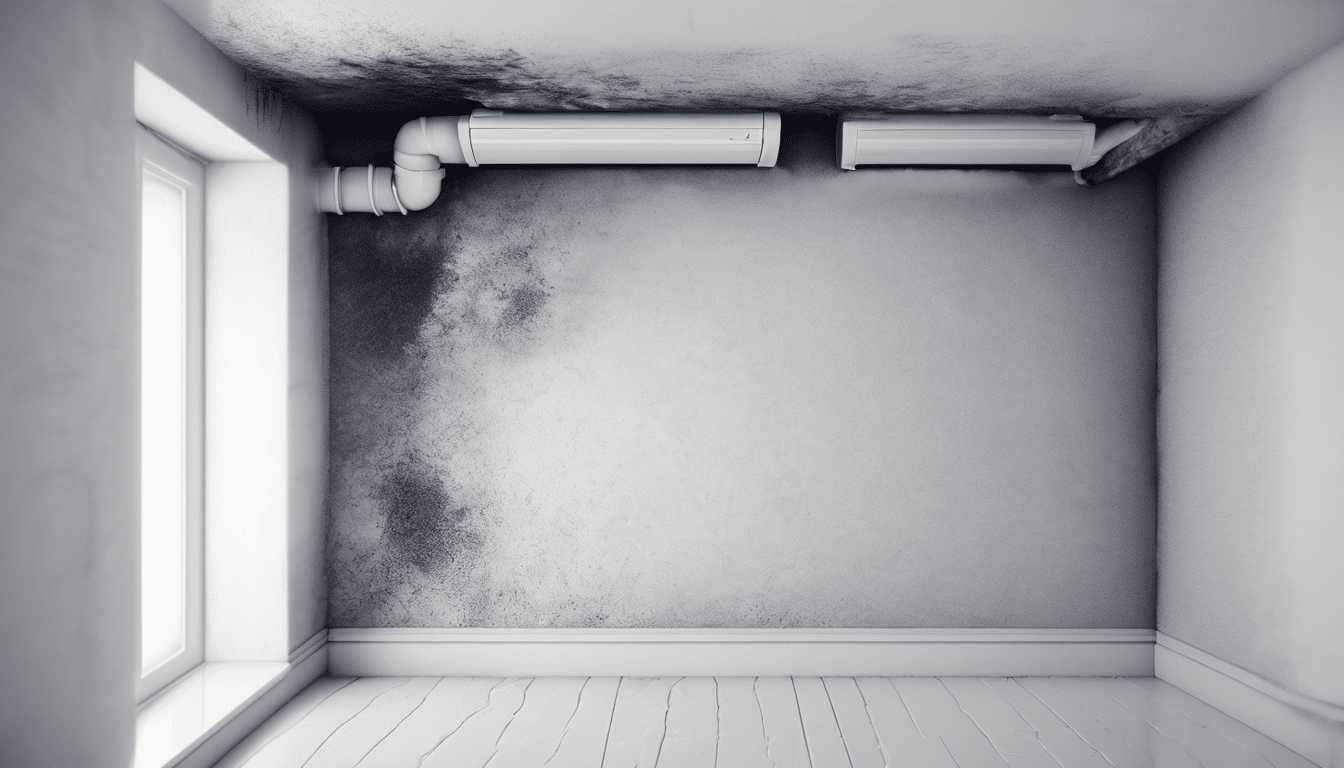
Mold in AC ducts develops when moisture, organic material, and stagnant airflow converge inside your ventilation system — a combination that Dubai’s climate makes remarkably easy to produce. In properties across Dubai, Abu Dhabi, and Sharjah, Mold In AC ducts: causes and warning signs are often dismissed as a minor inconvenience until occupants notice persistent odours, recurring respiratory discomfort, or visible growth at the vent registers. The question is never simply whether mold is present. The question is what type, at what concentration, and what the building system failure is that created the conditions in the first place.
As an IAC2 Certified Indoor Air Consultant with over 20 years of field investigations across the UAE, I have examined hundreds of HVAC systems where the duct network was the primary contamination pathway — not the walls, not the bathroom, not the storage room. The duct system is often the last place homeowners look, yet it is frequently the first place mold establishes itself in Dubai’s indoor environments. Understanding Mold in AC ducts: causes and warning signs is the foundation of any credible remediation plan.
This article addresses the problem directly: what drives mold growth inside ductwork, how to recognise the early and late-stage indicators, and what a science-backed diagnostic process looks like. Whether you are managing a villa in Arabian Ranches, a high-rise apartment in JLT, or a commercial facility in Dubai Investment Park, the building physics are consistent — and so are the solutions.
Mold In Ac Ducts: Causes And Warning Signs – Why Dubai’s Climate Creates Ideal Conditions for Duct Mold
Dubai’s outdoor relative humidity regularly exceeds 80% during the summer months, with ambient temperatures reaching 45°C or above. When warm, moisture-laden outdoor air enters a building envelope cooled to 20–22°C, the resulting condensation creates a reliable moisture source inside ductwork. This is not a building defect in the conventional sense — it is a thermodynamic inevitability when building envelopes are improperly sealed or HVAC systems are undersized.
Mold in AC ducts: causes and warning signs in the UAE are therefore distinct from what a European or North American building scientist would encounter. The moisture source is continuous, the temperatures support rapid fungal proliferation, and many properties — particularly villas built before 2015 — were not designed with adequate vapour barriers or duct insulation standards to manage these extremes.
Based on field investigations conducted across Dubai and Sharjah, properties with poorly insulated flexible ductwork in unconditioned ceiling voids show condensation-related mold growth within 18 to 36 months of occupancy. The duct exterior becomes a condensation surface, and the interior becomes a distribution network for whatever colonises it.
Mold In Ac Ducts: Causes And Warning Signs: Primary Causes of Mold in AC Ducts
Condensation on Duct Surfaces
When flexible ductwork passes through unconditioned spaces — ceiling voids, wall cavities, or service shafts — the temperature differential between the cooled duct surface and the surrounding warm air produces condensation. Over time, this moisture saturates the outer insulation layer and eventually wicks inward. Mold in AC ducts: causes and warning signs almost always trace back to this specific failure point in Dubai villas and low-rise apartment buildings.
Oversized or Undersized HVAC Units
An oversized air conditioning unit cools a space rapidly but does not run long enough to dehumidify the air adequately. Short-cycling leaves residual humidity in the duct system. An undersized unit runs continuously, struggles to maintain set-point temperatures, and creates extended periods of elevated indoor humidity. Both scenarios create the moisture conditions that support mold colonisation inside ductwork.
Dirty or Blocked Evaporator Coils
The evaporator coil removes moisture from the air as part of the cooling process. When the coil is coated in dust, debris, or biological film, its dehumidification efficiency drops. Relative humidity inside the duct system rises, and any organic particulates carried in the airstream — skin cells, dust, fibre — become a nutrient substrate for mold spores that have settled on duct surfaces. This relates directly to Mold In Ac Ducts: Causes And Warning Signs.
Inadequate Duct Sealing and Insulation
Gaps, poorly taped joints, and thin or degraded insulation in ductwork are consistent findings during Saniservice investigations in properties across JVC, Mirdif, and the Palm Jumeirah. Each gap is both a moisture entry point and a location where conditioned air escapes, reducing system efficiency and creating localised cold spots that attract condensation.
Stagnant Zones and Low Airflow Areas
Duct systems with dead-end branches, improperly balanced diffusers, or rooms that remain closed for extended periods develop stagnant air zones. Without consistent airflow to dry surfaces and dilute moisture, these areas become the first locations where mold in AC ducts: causes and warning signs become visible — typically as dark staining around vent registers or a persistent localised odour in a specific room.
Mold In Ac Ducts: Causes And Warning Signs: Warning Signs of Mold in AC Ducts
Musty or Earthy Odour When the AC Runs
The most consistent and earliest indicator of mold in AC ducts is a musty, damp, or earthy smell that appears specifically when the air conditioning is operating. This odour is produced by microbial volatile organic compounds (MVOCs) — metabolic byproducts of active mold growth. If the smell dissipates when the system is off and returns when it starts, the contamination source is almost certainly inside the duct network or at the air handling unit.
Visible Discolouration Around Vent Registers
Dark grey, green, or black staining around supply or return air registers is a visible mold in AC ducts warning sign that homeowners frequently notice. However, surface staining at the register does not confirm the extent of internal contamination. Laboratory analysis — including spore trap air sampling near active registers — is necessary to determine colony density and species composition. When considering Mold In Ac Ducts: Causes And Warning Signs, this becomes clear.
Dust Accumulation That Returns Quickly After Cleaning
When duct systems harbour mold, they also harbour the organic debris that supports it. Rapid re-accumulation of dust or fibrous material on vent covers after cleaning suggests that the internal duct surfaces are shedding particulates continuously. This is a functional warning sign that building scientists use alongside air sampling to prioritise investigation areas.
Inconsistent Room Temperatures or Humidity Levels
Mold colonisation inside ductwork is rarely uniform. In properties where specific rooms feel more humid, warmer, or smell different from adjacent spaces on the same HVAC circuit, the explanation is often differential duct contamination combined with airflow restriction caused by partial blockages of debris and biological growth. The importance of Mold In Ac Ducts: Causes And Warning Signs is evident here.
Seasonal Worsening of Symptoms
In Dubai, the AC season runs approximately from April through October. Properties where mold in AC ducts: causes and warning signs are present will typically show a clear seasonal pattern — symptoms, odours, and air quality complaints intensify when the system runs continuously during summer, and partially resolve during the cooler months when the system cycles less frequently.
How Mold Spreads Through HVAC Systems
Once mold establishes a colony inside ductwork, the air handling unit becomes a distribution mechanism. Spores detach from colonised surfaces during airflow turbulence — particularly at bends, transitions, and diffusers — and are carried into occupied spaces. A single contaminated return air plenum can seed multiple rooms simultaneously. Understanding Mold In Ac Ducts: Causes And Warning Signs helps with this aspect.
Mold in AC ducts: causes and warning signs extend beyond the ductwork itself when contamination reaches the air handling unit. The evaporator coil, drain pan, and blower assembly each provide moisture and organic material that support continued growth. Laboratory analysis of swab samples from these components routinely identifies Cladosporium, Aspergillus, and Penicillium species in Dubai HVAC systems — genera that proliferate readily at the temperatures and humidity levels found inside UAE residential and commercial air handling units.
Cross-contamination between zones is a particular concern in multi-storey villas and commercial properties with shared HVAC infrastructure. Without containment and directional airflow management during remediation, disturbing mold in one section of the duct system can redistribute spores throughout the entire network. Mold In Ac Ducts: Causes And Warning Signs factors into this consideration.
Confirming Mold in AC Ducts Through Diagnostics
Visual inspection alone is insufficient to confirm or rule out mold in AC ductwork. The interior surfaces of insulated flexible ducts, the inner lining of sheet metal ductwork, and the air handling unit components require direct sampling to produce defensible conclusions. As IAC2-certified professionals, the Saniservice Indoor Sciences Division applies a structured diagnostic sequence for every HVAC mold investigation.
Air Sampling at Supply Registers
Spore trap cassettes positioned directly at active supply registers during system operation capture a representative sample of what the duct system is delivering to occupied spaces. Comparing these counts to outdoor baseline samples and to samples taken in areas remote from the HVAC system quantifies the duct system’s contribution to indoor spore load. This relates directly to Mold In Ac Ducts: Causes And Warning Signs.
Surface Swab Sampling Inside Ductwork
Borescope-guided swab samples taken from duct interior surfaces — particularly at elbows, transitions, and within 1–2 metres of the air handling unit — provide direct evidence of colonisation. Laboratory analysis at Saniservice’s in-house microbiology facility identifies species composition and colony density, informing both remediation scope and post-remediation verification benchmarks.
Moisture Mapping with Thermal Imaging
Thermal imaging identifies temperature differentials that indicate condensation zones on duct surfaces within ceiling voids. Combined with pin and pinless moisture meters, this non-invasive technique maps the moisture distribution across the duct network and identifies the failure points that created conditions for mold in AC ducts to develop. Root-cause identification before remediation prevents recurrence. When considering Mold In Ac Ducts: Causes And Warning Signs, this becomes clear.
Health Indicators Linked to AC Duct Mold
Occupants in properties with confirmed mold in AC ductwork commonly report symptoms that correlate with the HVAC operating schedule. These include morning congestion that clears after leaving the property, eye irritation in specific rooms served by contaminated duct branches, and fatigue that worsens during periods of extended indoor time. These patterns are consistent across case histories documented in Dubai villas and apartment buildings investigated by the Saniservice Indoor Sciences team.
Mold in AC ducts: causes and warning signs become a more significant consideration when occupants include young children, elderly residents, or individuals with pre-existing respiratory sensitivities. In these circumstances, air sampling data and species identification from laboratory analysis inform the urgency and scope of the remediation response — not assumptions or visual estimates.
Solutions for Mold in AC Ducts
Professional HVAC Mold Remediation
Effective remediation of mold in AC ducts requires negative pressure containment, HEPA-filtered extraction, mechanical agitation of internal duct surfaces, and application of appropriate antimicrobial treatments verified for HVAC use. NADCA-accredited duct cleaning standards provide the procedural framework. Saniservice’s remediation protocols integrate these standards with laboratory-confirmed clearance testing — the verification step that separates a completed remediation from a cosmetic clean.
Evaporator Coil and Drain Pan Service
Mold remediation of ductwork without addressing a contaminated evaporator coil or drain pan is a predictable path to recurrence. The coil and drain pan must be inspected, sampled, cleaned, and verified as part of every HVAC mold remediation scope. In Dubai properties where the indoor unit sits in a confined ceiling void, access constraints require careful scope planning before work begins. The importance of Mold In Ac Ducts: Causes And Warning Signs is evident here.
Root-Cause Correction
Remediation without root-cause correction produces temporary results. Based on field investigations, the most common correctable failures in Dubai properties are inadequate duct insulation in unconditioned voids, unsealed duct joints, and incorrectly sized condensate drain systems. Addressing these in parallel with the biological remediation is the approach that produces durable outcomes.
Expert Tips for Preventing Duct Mold in UAE Properties
- Maintain indoor relative humidity below 60%. A calibrated hygrometer in the return air zone provides a reliable ongoing measure. Properties consistently above 60% RH during the AC season require HVAC review.
- Schedule evaporator coil inspection annually. In Dubai’s dust environment, coils accumulate debris rapidly. A clean coil dehumidifies efficiently; a fouled coil does not.
- Inspect duct insulation in ceiling voids every three years. Insulation degradation is a slow process that rarely triggers visible symptoms until mold in AC ducts is already established.
- Do not block or redirect supply registers. Altered airflow creates stagnant zones that elevate localised humidity and accelerate biological colonisation on duct surfaces.
- Request laboratory-verified post-service reporting. Any HVAC cleaning or mold remediation service that cannot produce air sampling and surface swab results from before and after the work has not verified its own outcome.
- Address water leaks from the indoor unit immediately. A condensate overflow or blocked drain is a 24–48 hour window before mold colonisation of adjacent materials begins. In Dubai’s ambient temperatures, that timeline is not conservative.
Frequently Asked Questions
How do I know if the smell from my AC is mold or just dust?
A dusty smell from an AC typically occurs at start-up and fades within minutes as the system clears settled particulates. Mold in AC ducts produces a persistent musty or earthy odour that continues throughout system operation and may intensify in specific rooms. Air sampling during system operation is the only method that confirms or rules out biological contamination with certainty. Understanding Mold In Ac Ducts: Causes And Warning Signs helps with this aspect.
Can mold in AC ducts spread to other rooms in a Dubai villa?
Yes. When mold in AC ducts is present, the air handling unit distributes spores through every supply branch the system serves. In a typical Dubai villa with a ducted split or central HVAC system, a single contaminated air handling unit can seed multiple floors. Borescope inspection and air sampling at each supply register maps the distribution accurately before remediation planning begins.
What types of mold are most commonly found in AC ducts in the UAE?
Laboratory analysis of duct swab samples from Dubai and Abu Dhabi properties consistently identifies Cladosporium, Aspergillus, and Penicillium as the dominant genera. Stachybotrys chartarum — often called black mold — requires sustained high moisture and cellulose substrate, making it less common in ductwork than in water-damaged building materials, though it does appear in drain pan areas with persistent moisture accumulation. Mold In Ac Ducts: Causes And Warning Signs factors into this consideration.
How long does it take for mold to grow in AC ducts after a water leak?
Under Dubai’s ambient indoor conditions — typically 22–26°C with moderate humidity — mold colonisation on organic-containing duct surfaces can begin within 24 to 48 hours of a moisture event. A blocked condensate drain that overflows into a ceiling void, for example, creates conditions where mold in AC ducts can establish measurable growth within two to three days if not addressed promptly.
Is visual inspection enough to confirm mold in AC ducts?
No. Visual inspection identifies surface-visible growth and discolouration, but the majority of duct interior surfaces in a typical Dubai property are inaccessible without borescope equipment. More importantly, visual inspection cannot quantify spore concentrations in the airstream or identify species. Laboratory-confirmed air sampling and surface swabs provide the evidence base needed to define remediation scope and verify successful completion. This relates directly to Mold In Ac Ducts: Causes And Warning Signs.
Does NADCA-certified duct cleaning remove mold from AC ducts?
NADCA-accredited duct cleaning addresses accumulated debris and biological contamination on accessible duct surfaces using negative pressure and mechanical agitation. However, mold remediation in AC ducts requires additional steps: containment, antimicrobial treatment verified for HVAC surfaces, evaporator coil service, and post-remediation air sampling. Cleaning without verification does not confirm that mold in AC ducts has been resolved to a measurable standard.
How much does mold investigation in AC ducts cost in Dubai?
Mold investigation costs in Dubai vary based on property size, system configuration, and the number of sampling locations required. A diagnostic investigation for a three-bedroom villa typically involves two to four hours of field work, borescope inspection, air sampling, and laboratory analysis. The value of a science-backed investigation is not in the service fee — it is in the certainty that the remediation scope defined afterwards is proportionate to what the data actually shows. When considering Mold In Ac Ducts: Causes And Warning Signs, this becomes clear.
Mold in AC ducts: causes and warning signs represent a building science problem before they represent a cleaning problem. The moment you notice a persistent odour when your AC runs, or a pattern of symptoms that correlates with time spent indoors, the appropriate response is measurement — not assumption. A laboratory-verified investigation defines what is present, where it originates, and what a proportionate remediation response looks like. That sequence — measure, understand, act, verify — is the only one that produces outcomes worth trusting.