
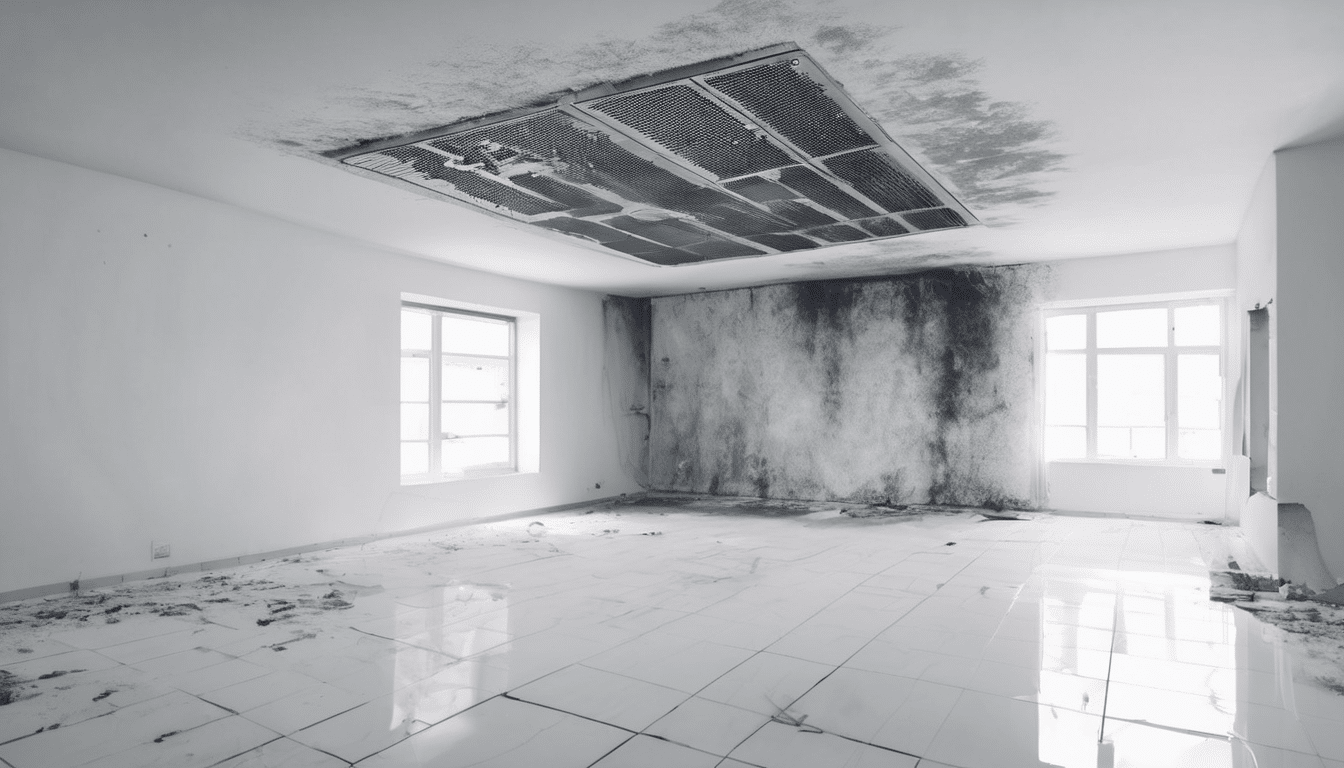
How mold spreads through HVAC systems is one of the most consequential and least understood processes in indoor environmental health — particularly in Dubai, where air conditioning runs continuously for eight to ten months of the year. When mold establishes itself inside a duct network, it does not stay in one place. It travels. Every time the system cycles on, microscopic spores move through supply ducts, cross into living spaces, and settle on surfaces that offer even marginal moisture and organic material. The scale and speed of this process is what separates HVAC mold from surface mold on a bathroom grout line.
In field investigations conducted across Dubai villas and apartments, Saniservice’s Indoor Sciences Division consistently finds that occupants report symptoms for weeks or months before visible mold is ever discovered. That gap — between biological contamination and visible evidence — exists precisely because HVAC systems distribute spores invisibly, continuously, and silently. Understanding the mechanics of that distribution is the first step toward a solution that holds. This relates directly to How Mold Spreads Through Hvac Systems.
This guide breaks down the biology, the building science, the costs, and the remediation process that follows when HVAC mold is confirmed by laboratory analysis. Whether you manage a villa in Emirates Hills or an apartment in Jumeirah Beach Residence, the principles and the risks are structurally the same.
How Mold Starts Inside an HVAC System
Before examining how mold spreads through HVAC systems, it is important to understand where contamination begins. The most common origin point is the evaporator coil — the component responsible for cooling air as it passes through the air handling unit. In Dubai’s humid months, condensation forms on these coils continuously. If drainage is incomplete, if the drain pan is partially blocked, or if relative humidity in the air handler exceeds 70%, the surrounding insulation and coil surface become persistently damp.
Mold spores are always present in ambient air. They require only three conditions to germinate: a surface, moisture, and a food source. Inside an HVAC unit, all three exist simultaneously. Metal surfaces accumulate dust, which provides organic nutrition. Insulated duct liner — common in UAE ducted split systems — retains moisture and supports fungal growth once colonised. From this initial colony, the system’s airflow does the rest.
Primary Origin Points Inside the System
- Evaporator coil surfaces with persistent condensation
- Drain pan with standing water or biological film
- Flexible duct insulation liner (internally lined ducts)
- Fibreglass duct board sections in older installations
- Air filter housing with accumulated organic debris
- Supply and return plenum chambers with humidity exposure
How Mold Spreads Through HVAC Systems: The Mechanics
How mold spreads through HVAC systems follows a predictable biological and physical sequence. Once a colony matures at a primary site — typically the coil or drain pan — it begins producing spores as part of its reproductive cycle. These spores are microscopic, ranging from 2 to 10 microns in diameter, and are designed by biology to travel on air currents. An operating HVAC system provides exactly the airflow required for wide-scale dispersal.
At typical supply air velocities in a residential ducted system — between 2 and 5 metres per second — spores travel the full duct length within seconds. They exit through supply grilles and diffusers into occupied rooms. Heavier spore clusters settle on horizontal surfaces: furniture, bedding, curtains, and carpeting. Lighter individual spores remain airborne and are inhaled directly. This is why occupants in rooms distant from the air handling unit can still experience significant spore exposure.
Secondary Colonisation: How Mold Spreads Beyond the Origin
How mold spreads through HVAC systems does not stop at dispersal. Secondary colonisation occurs when deposited spores find adequate moisture on room surfaces. In Dubai apartments with poor vapour barriers or thermal bridging at walls, surface condensation provides the moisture these spores need. A bathroom adjacent to a bedroom, or a wall facing a cold supply duct, can develop active mold colonies within days of initial spore deposition — even if the surface was previously clean.
This secondary spread is what makes HVAC-origin mold cases fundamentally different from isolated surface mold. The contamination is distributed across multiple rooms simultaneously, and each secondary colony becomes a new spore source that the HVAC system then recirculates. Without stopping the HVAC system’s role in dispersal, surface remediation alone will not resolve the problem.
How Mold Spreads Through HVAC Systems in Dubai’s Climate
Dubai’s climate creates conditions that accelerate every stage of how mold spreads through HVAC systems. Outdoor humidity regularly exceeds 80% from May through September. When warm, humid outdoor air infiltrates the building envelope — through gaps around ducts, electrical penetrations, or poorly sealed windows — it contacts cold surfaces created by air conditioning and immediately condenses. This condensation is invisible until mold growth makes it visible.
Dubai’s year-round air conditioning use also means systems rarely experience the drying cycles that interrupt mold growth in temperate climates. In London or Toronto, a system shut down for winter allows duct surfaces to dry and reset. In Dubai, the system runs continuously, maintaining the persistent damp conditions that support colonial expansion. Based on field investigations in Dubai villas built before 2015, Saniservice has documented active HVAC mold contamination in systems that had not been professionally serviced in 18 months or longer.
Building Types Most at Risk in the UAE
- Older villas in Mirdif, Jumeirah, and Deira with original duct installations
- High-rise apartments in JBR and Marina with centralised AHUs
- Townhouses in Reem Island and Al Reef with known condensation issues
- Properties that have undergone water leaks or flooding without verified drying
- Buildings with fibreglass duct liner that has aged beyond ten years
Warning Signs of HVAC Mold Contamination
Recognising how mold spreads through HVAC systems requires knowing what to observe both physically and symptomatically. Many cases are identified not by visible mold but by occupant reports and air quality data. The following warning signs indicate that laboratory investigation is warranted.
- Musty odour that appears or intensifies when the AC turns on
- Visible discolouration around supply grilles or diffusers
- Recurrent surface mold in rooms with no obvious moisture source
- Increased respiratory symptoms or nasal irritation indoors versus outdoors
- Dust that reappears within days of cleaning in multiple rooms simultaneously
- Visible slime or discolouration inside the air handling unit drain pan
None of these signs alone confirms HVAC mold. Confirmation requires air sampling, surface sampling from within duct components, and laboratory spore identification — a process that distinguishes between background environmental fungi and elevated colonisation indicative of an active indoor source.
HVAC Mold Remediation Costs in Dubai
Understanding how mold spreads through HVAC systems directly influences remediation scope and, therefore, cost. A single isolated coil contamination addressed early carries a very different cost profile from a full duct network colonisation discovered after years of undetected growth. The following table reflects realistic cost ranges for professional HVAC mold remediation in Dubai, based on scope and property type.
| Remediation Scope | Property Type | Estimated Cost Range (AED) | Typical Timeframe |
|---|---|---|---|
| Coil and drain pan cleaning with antimicrobial treatment | 1–2 bedroom apartment | AED 800 – AED 1,800 | Half day |
| Air handler unit full remediation (coil, liner, plenum) | 3–4 bedroom villa | AED 2,500 – AED 5,000 | 1–2 days |
| Full duct network cleaning and antimicrobial treatment | 3–5 bedroom villa | AED 4,000 – AED 9,000 | 2–3 days |
| Duct liner replacement (internally lined duct sections) | Large villa or commercial | AED 8,000 – AED 20,000+ | 3–5 days |
| Full remediation with post-clearance air sampling | Any residential type | AED 6,000 – AED 15,000 | 3–5 days |
| Laboratory investigation (air and surface sampling) | Any property | AED 1,200 – AED 3,500 | 1 day + lab turnaround |
These ranges reflect professional, laboratory-verified remediation and should not be compared with basic AC cleaning services, which do not address biological contamination at the level required when mold is confirmed. What separates a professional remediation from a commodity service is the evidence it leaves behind — pre- and post-sampling results that verify the contamination has been resolved, not simply disturbed. When considering How Mold Spreads Through Hvac Systems, this becomes clear.
Factors That Affect Remediation Cost
- Extent of duct liner colonisation: Internally lined ducts require liner removal and replacement, which is material- and labour-intensive.
- Number of air handling units: Large villas in Dubai Hills or Arabian Ranches may have two to four separate HVAC systems, each requiring independent assessment.
- Secondary room contamination: If how mold spreads through HVAC systems has resulted in active colonies on walls or ceilings, room remediation is added to the scope.
- Post-clearance testing: Laboratory-confirmed clearance is an additional cost but is essential for occupant safety and insurance documentation.
- Access difficulty: Concealed ducts in concrete slab ceilings or raised floors increase labour time and may require borescope inspection prior to treatment.
How Mold Spreads Through HVAC Systems Is Confirmed by Lab Testing
As an IAC2 Certified Indoor Air Consultant, my standard protocol when investigating suspected HVAC mold begins with measurement, not assumption. How mold spreads through HVAC systems cannot be fully understood — or effectively remediated — without identifying what species are present, at what concentration, and whether indoor counts exceed outdoor baseline levels.
Air sampling using spore trap cassettes (RCS impaction or Zefon Air-O-Cell equivalent) is conducted at supply grilles, return air vents, and in the breathing zone of affected rooms. These samples are processed by Saniservice’s in-house microbiology laboratory — the only such facility operated by an indoor environmental services company in the UAE. Results typically show elevated Cladosporium, Aspergillus, or Penicillium counts indoors relative to outdoor controls when HVAC colonisation is present.
Surface swab and tape-lift samples from inside the air handler confirm the species profile. This laboratory data determines which remediation methods are appropriate, whether HEPA air scrubbing is required during the process, and what post-remediation spore counts must be achieved to confirm clearance.
The Remediation Process: Step by Step
Once laboratory results confirm how mold spreads through HVAC systems in a given property, remediation follows a structured sequence. Skipping steps — particularly containment and post-verification — is the most common reason for remediation failure and mold recurrence.
Phase 1: Containment and System Isolation
The HVAC system is shut down and sealed at all grilles and returns to prevent cross-contamination during remediation work. Negative pressure is established in the work area using HEPA-filtered air scrubbers. This prevents spores disturbed during cleaning from migrating to unaffected zones.
Phase 2: Mechanical Cleaning and Antimicrobial Treatment
Duct interiors are cleaned using NADCA-approved mechanical agitation methods — rotary brushing and contact vacuum with HEPA filtration. The coil, drain pan, and plenum surfaces receive EPA-registered antimicrobial treatment. Where liner material is visibly colonised and cannot be effectively cleaned, it is removed and replaced rather than treated in place.
Phase 3: Post-Clearance Air Sampling
After remediation is complete and the system is recommissioned, post-clearance air sampling is conducted using the same laboratory methodology as the initial investigation. Indoor spore counts must return to levels consistent with or below outdoor baseline before clearance is confirmed. This result is documented in a formal post-remediation report — the evidence standard required for DHA mold clearance certification and insurance documentation in Dubai. The importance of How Mold Spreads Through Hvac Systems is evident here.
How Mold Spreads Through HVAC Systems After Remediation: Prevention
Understanding how mold spreads through HVAC systems is also the foundation of prevention. Remediation resolves current contamination. Building system corrections prevent recurrence. Without addressing the underlying moisture conditions, how mold spreads through HVAC systems will repeat on a predictable timeline — typically 12 to 24 months in Dubai’s climate if root causes are unresolved.
- Maintain indoor relative humidity below 60% — ideally 50% — year-round
- Inspect and clear drain pans every three months during peak cooling season
- Replace air filters on schedule and upgrade to MERV 8 or higher where compatible
- Seal all duct penetrations through building envelope with vapour-appropriate materials
- Commission an annual indoor air quality assessment to monitor spore counts before visible growth appears
- Ensure fresh air intake dampers are correctly sized and positioned to prevent uncontrolled humid air infiltration
Expert Takeaways
Based on more than 20 years of building investigations across Dubai and the wider UAE, and on the laboratory data processed through Saniservice’s in-house microbiology facility, these are the most important conclusions about how mold spreads through HVAC systems in the local context.
- HVAC systems are the primary dispersal mechanism for indoor mold in Dubai properties — not the only origin, but the most consequential pathway.
- How mold spreads through HVAC systems is a physics and biology problem simultaneously. Fixing one without addressing the other produces temporary results.
- The question is never simply whether mold is present — it is what species, at what concentration, and what the post-remediation laboratory data confirms.
- In the UAE, remediation without laboratory post-clearance verification is incomplete work, regardless of what the surface looks like after treatment.
- Costs rise significantly when investigation is delayed. Early laboratory confirmation of HVAC contamination consistently results in lower remediation scope and expense.
Frequently Asked Questions
How does mold spread through HVAC systems in Dubai apartments?
In Dubai apartments, mold spreads through HVAC systems when spores from a colonised evaporator coil or drain pan are carried by conditioned air through the duct network and distributed via supply grilles into occupied rooms. Dubai’s high ambient humidity accelerates this process significantly, particularly in apartments with inadequate fresh air ventilation or poorly maintained drain pans.
How quickly does mold spread through an HVAC system?
Mold can spread through an HVAC system within two to four weeks of initial colonisation under high-humidity conditions. In Dubai’s summer months — when outdoor humidity exceeds 80% — spore dispersal through a running ducted system can result in measurable indoor air contamination across multiple rooms within days of the colony reaching reproductive maturity.
What does it cost to remediate HVAC mold in a Dubai villa?
Professional HVAC mold remediation for a Dubai villa typically ranges from AED 4,000 to AED 15,000 depending on the number of air handling units, extent of duct liner colonisation, and whether post-clearance laboratory sampling is included. Full duct liner replacement in large villas can exceed AED 20,000. Investigation and testing alone typically costs AED 1,200 to AED 3,500.
Can I clean HVAC mold myself?
DIY cleaning of HVAC mold is not recommended. Without HEPA-filtered containment, mechanical agitation of mold inside ducts will disperse significantly elevated spore counts into occupied spaces. Additionally, without laboratory identification of the mold species and post-treatment air sampling, there is no verifiable confirmation that remediation has been effective. Professional, lab-verified work is the standard in UAE properties.
How do I know if my AC is spreading mold through my Dubai home?
The most reliable indicators are: a musty odour that intensifies when the system turns on, recurrent surface mold in multiple rooms simultaneously, and respiratory symptoms that improve when occupants leave the property for several days. Laboratory air sampling at supply grilles compared to an outdoor baseline provides definitive confirmation. Saniservice’s Indoor Sciences Division conducts this investigation in Dubai and across the UAE. Understanding How Mold Spreads Through Hvac Systems helps with this aspect.
What mold species are most commonly found in Dubai HVAC systems?
Based on laboratory analysis from Saniservice’s in-house microbiology facility, the most commonly identified species in Dubai HVAC systems are Cladosporium, Aspergillus, and Penicillium. These genera are adapted to the indoor environments created by air conditioning systems and are capable of producing mycotoxins under certain growth conditions. Species identification is essential to determining appropriate remediation methods and health risk context.
Is a DHA mold clearance certificate required after HVAC mold remediation in Dubai?
DHA mold clearance certification is required in specific Dubai healthcare and institutional facility contexts, and is increasingly requested by property management companies and landlords following remediation in residential properties. The certificate is issued based on post-remediation laboratory air sampling results confirming that indoor spore counts have returned to acceptable levels. Saniservice provides this documentation as part of its verified remediation service in Dubai and the UAE. Understanding How Mold Spreads Through Hvac Systems is key to success in this area.