
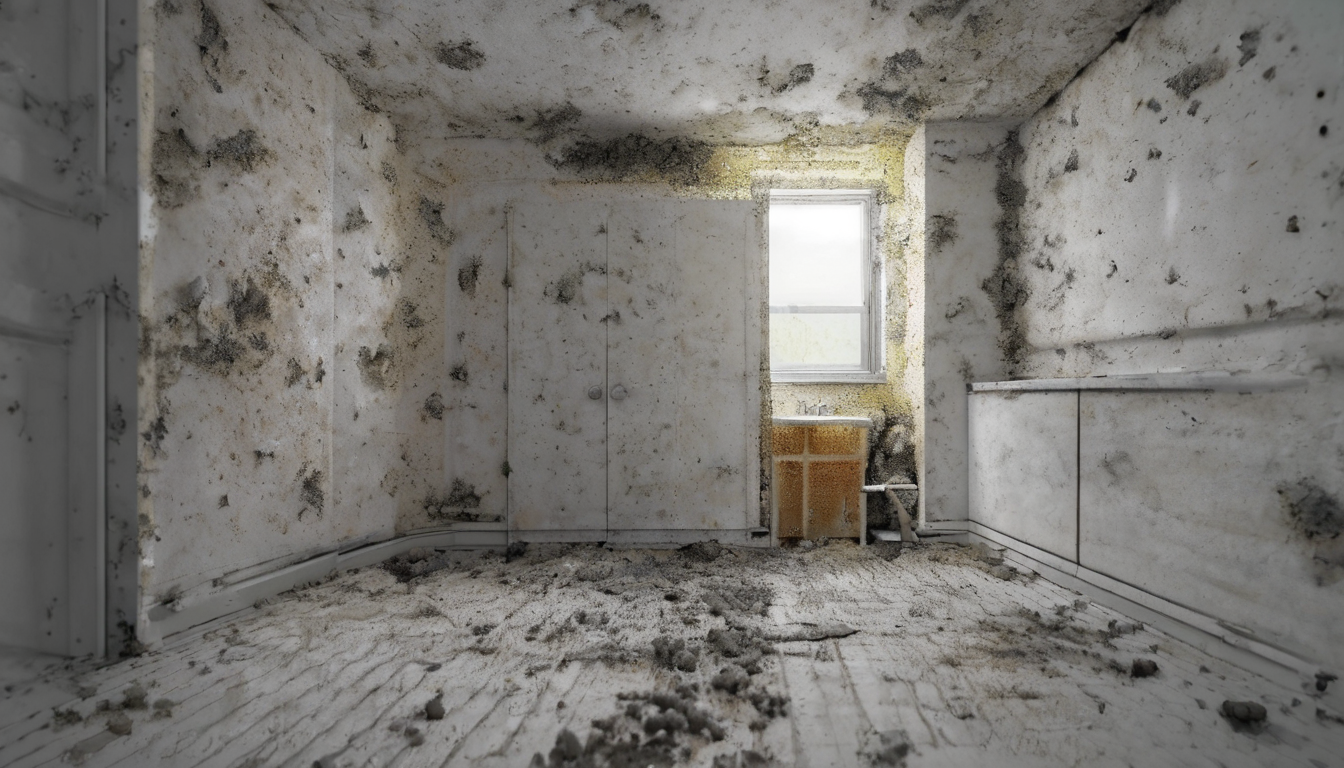
Understanding Hidden Mold Behind Walls: Detection Methods That Work is essential. Hidden mold behind walls is one of the most consistently misunderstood problems in Dubai’s residential properties. Occupants notice symptoms — persistent fatigue, a faint musty quality in the air, unexplained upper respiratory irritation — but visual inspection reveals nothing. The walls look clean. The ceiling appears dry. Yet laboratory results, when properly collected, tell a different story. In Dubai’s climate, where indoor humidity frequently operates under pressure from both the external environment and over-cooled interior air, Hidden Mold Behind walls develops along predictable pathways. The question is never simply whether mold is present. The question is what type, at what concentration, and what the building science reveals about why it formed there.
This case study documents an investigation conducted by Saniservice’s Indoor Sciences Division at a large villa in a residential community near Dubai’s Jumeirah corridor. The property had been occupied for approximately six years. The owners had noticed intermittent musty odours, particularly in the master bedroom and adjacent corridor, for almost eighteen months. Two previous cleaning companies had assessed the property and found nothing of significance. Detection methods that work require more than a visual walk-through — and this investigation illustrated precisely why. This relates directly to Hidden Mold Behind Walls: Detection Methods That Work.
Hidden Mold Behind Walls: Detection Methods That Work – The Challenge: Symptoms Without a Visible Source
The family’s primary concern was the quality of the air in the master bedroom wing. One adult occupant had been experiencing persistent sinus congestion and disrupted sleep patterns for over a year. A child in the adjacent room had been experiencing recurring skin irritation. The family’s general practitioner had ruled out food and contact allergies. No one had yet considered the indoor environment as the variable. When considering Hidden Mold Behind Walls: Detection Methods That Work, this becomes clear.
When the Saniservice investigation team arrived, the first phase was not equipment — it was a structured interview. Understanding the building’s history of water events, renovation work, and HVAC changes is foundational to any investigation where hidden mold behind walls is suspected. The family confirmed that approximately two years prior, a concealed pipe fitting in the master bathroom had dripped for an unknown period before being repaired by a plumber. The repair had been visual only. No moisture mapping had been conducted. No drying protocol had followed. The importance of Hidden Mold Behind Walls: Detection Methods That Work is evident here.
That single detail reframed the entire investigation.
Hidden Mold Behind Walls: Detection Methods That Work – Why Dubai Buildings Are Particularly Vulnerable to Hidden Mo
Dubai’s built environment creates specific conditions that make hidden mold behind walls more likely than in many other climates. Internal wall cavities in villas typically contain gypsum board over steel stud framing, with insulation batts that are highly moisture-retentive. When a water intrusion event occurs — whether from a pipe leak, condensation on cold surfaces, or water ingress at window frames — the cavity retains moisture long after the surface appears dry. Understanding Hidden Mold Behind Walls: Detection Methods That Work helps with this aspect.
The external heat combined with heavily air-conditioned interiors creates steep temperature differentials across wall assemblies. In poorly balanced HVAC systems, wall surfaces in certain zones can drop below the dew point of the indoor air, sustaining condensation on concealed surfaces throughout the year. This is not a seasonal problem in Dubai. It is a persistent one. Hidden Mold Behind Walls: Detection Methods That Work factors into this consideration.
Mold species that colonise these cavities — commonly Cladosporium, Aspergillus, and Penicillium in UAE investigations — do not require visible surface moisture to sustain growth. Relative humidity above 70% within the wall cavity is sufficient. The surface temperature of gypsum board on the room-facing side can feel entirely dry to the touch while the paper backing supports active colony development. This relates directly to Hidden Mold Behind Walls: Detection Methods That Work.
Hidden Mold Behind Walls: Detection Methods That Work – Hidden Mold Behind Walls Detection Methods That Work: Phase
The investigation began with a full thermal imaging sweep of the master bedroom, en-suite bathroom, and corridor walls. Using a calibrated infrared camera, the Saniservice team mapped surface temperature differentials across all wall assemblies. Thermal imaging does not detect mold directly. What it detects is moisture — and moisture is the precondition for hidden mold behind walls in any building. When considering Hidden Mold Behind Walls: Detection Methods That Work, this becomes clear.
Three areas produced anomalous readings. The wall shared between the master bathroom and the bedroom showed a distinct cold zone approximately 40 centimetres wide and 90 centimetres tall, beginning at approximately 30 centimetres above floor level. A secondary cold zone appeared at the base of the corridor wall adjacent to the bathroom. A third, smaller anomaly appeared at a wall junction behind a built-in wardrobe that had obscured the area from any previous inspection. The importance of Hidden Mold Behind Walls: Detection Methods That Work is evident here.
Thermal imaging findings do not confirm mold. They confirm the presence of conditions consistent with potential hidden mold behind walls. The next phase was designed to verify. Understanding Hidden Mold Behind Walls: Detection Methods That Work helps with this aspect.
Hidden Mold Behind Walls Detection Methods That Work: Phase Two — Moisture Mapping
A pin-type and non-invasive moisture metre was deployed across all flagged zones. Readings in the anomalous thermal areas ranged from 28% to 41% moisture content in the wall substrate — well above the threshold at which mold growth is known to initiate on gypsum-backed materials. Readings in control areas of the same room were consistently below 14%. Hidden Mold Behind Walls: Detection Methods That Work factors into this consideration.
Moisture mapping with multiple instrument types provides data integrity that a single reading cannot. Pin metres confirm actual substrate moisture at depth. Non-invasive metres confirm moisture presence without breaching the surface. The combination allows the investigation team to build a spatial map of where hidden mold behind walls is most probable before any physical intrusion is made. This relates directly to Hidden Mold Behind Walls: Detection Methods That Work.
At this point, the investigation had confirmed elevated moisture in three locations correlated with the historical pipe event. The next step was to determine whether mold colonisation had in fact occurred — and if so, what species and at what concentration. When considering Hidden Mold Behind Walls: Detection Methods That Work, this becomes clear.
Hidden Mold Behind Walls Detection Methods That Work: Phase Three — Air Sampling and Borescope Inspection
Air sampling was conducted using calibrated spore trap cassettes at two locations in the master bedroom, one in the corridor, and one exterior sample as a control baseline. Samples were analysed at Saniservice’s in-house microbiology laboratory — the only in-house indoor microbiology laboratory operated by an indoor environmental services company in the UAE. The importance of Hidden Mold Behind Walls: Detection Methods That Work is evident here.
Results were indicative. The master bedroom samples showed elevated Aspergillus/Penicillium spore concentrations at levels meaningfully above the outdoor control. The corridor sample showed moderate elevation. This pattern — elevated indoor counts with a known moisture event history and thermal anomalies — met the threshold for borescope investigation. Understanding Hidden Mold Behind Walls: Detection Methods That Work helps with this aspect.
Borescope Access Without Demolition
A small access point, approximately 20 millimetres in diameter, was created in the lowest thermal anomaly zone. A flexible borescope camera was inserted into the wall cavity. The findings were unambiguous. The paper facing of the gypsum board on the interior of the cavity showed visible dark colony growth across an area estimated at 0.6 square metres. The insulation batt directly behind the plumbing repair point showed staining consistent with historic wetting and biological growth. Hidden Mold Behind Walls: Detection Methods That Work factors into this consideration.
A surface swab sample was collected through the borescope access point and submitted for laboratory speciation. Results confirmed a mixed Aspergillus and Penicillium population, with trace Stachybotrys present at the lower batt material. This was the first confirmed identification of Stachybotrys in this property — a finding that had been entirely invisible to every previous inspection. This relates directly to Hidden Mold Behind Walls: Detection Methods That Work.
Connecting Detection to Remediation Scope
The detection findings directly defined the remediation scope. Hidden mold behind walls, when confirmed through this multi-method protocol, cannot be remediated by surface treatment. The affected gypsum board sections, insulation batts, and any contaminated framing members require controlled removal under containment — with HEPA filtration and negative pressure to prevent spore dispersal to clean areas of the property. When considering Hidden Mold Behind Walls: Detection Methods That Work, this becomes clear.
Saniservice designed a containment protocol that isolated the master bedroom wing while the family temporarily relocated. The remediation sequence followed IICRC S520 principles: containment establishment, material removal, HEPA vacuuming of all exposed structural surfaces, application of an antimicrobial treatment to framing members, and a drying phase with dehumidification to bring residual moisture to below 14% before reconstruction. The importance of Hidden Mold Behind Walls: Detection Methods That Work is evident here.
As an IAC2 Certified Indoor Air Consultant, I have seen cases where remediation was begun without confirmed detection findings. Without knowing the precise extent of contamination, scope is either under-designed — leaving contamination behind — or over-designed, causing unnecessary demolition. Detection methods that work protect both the occupants and the integrity of the remediation. Understanding Hidden Mold Behind Walls: Detection Methods That Work helps with this aspect.
Post-Remediation Verification: The Step That Completes the Process
Hidden mold behind walls detection methods that work are incomplete without post-remediation verification. Following reconstruction and a 48-hour stabilisation period, Saniservice conducted clearance air sampling using the same methodology as the baseline investigation. Indoor spore counts returned to parity with outdoor control samples. Surface sampling of reconstructed wall areas showed no mold presence.
A formal clearance report was issued, providing the family with documented evidence that the contamination had been resolved to measurable standards. This documentation is the type of record required for a mold clearance certificate in Dubai — a formal confirmation that remediation has achieved a verified indoor environmental standard.
The family’s occupant health symptoms resolved within six weeks of returning to the property. The adult occupant reported significantly improved sleep quality. The child’s skin irritation cleared without further medical intervention.
Key Takeaways for Dubai Homeowners and Property Managers
- Visual inspection alone cannot confirm or exclude hidden mold behind walls in Dubai properties.
- Thermal imaging identifies moisture anomalies — not mold directly — but is an essential first-phase tool.
- Moisture mapping with calibrated instruments builds a spatial picture of contamination probability.
- Air sampling, when analysed by an accredited laboratory, provides concentration data that guides decision-making.
- Borescope inspection allows cavity-level visual confirmation and sample collection without unnecessary demolition.
- Detection must precede remediation scope design — not follow it.
- Post-remediation verification with laboratory clearance is the only way to confirm that hidden mold behind walls has been resolved to a measurable standard.
- Any history of pipe leaks, water intrusion, or HVAC condensation issues in a Dubai property should prompt a structured investigation rather than a visual-only assessment.
Conclusion: When Detection Methods Work, Remediation Works
Hidden mold behind walls, detection methods that work, and science-backed remediation are inseparable. The Jumeirah villa case documented here illustrates what is commonly observed during professional assessment in Dubai: contamination that is invisible to the eye, measurable through multi-instrument diagnostics, and resolvable through structured remediation — but only when the investigation reaches the cavity level.
Saniservice’s approach to hidden mold behind walls investigation integrates thermal imaging, moisture mapping, spore trap air sampling, borescope inspection, and in-house laboratory analysis into a single, evidence-led workflow. The result is not a guess about what might be behind a wall. It is a lab-confirmed answer about what is there, at what concentration, and what it will take to resolve it.
If your Dubai property has a history of water events, persistent odours, or occupant symptoms that remain unexplained after clinical evaluation, a structured indoor environmental investigation is the appropriate next step. Detection methods that work begin with a professional assessment — not an assumption.
Frequently Asked Questions
How do I know if there is hidden mold behind walls in my Dubai villa?
Common indicators include a persistent musty odour, occupant symptoms such as sinus congestion or skin irritation, a documented history of pipe leaks or water intrusion, and thermal anomalies identified by infrared imaging. In Dubai’s climate, these signs warrant a structured multi-method investigation rather than a visual inspection alone. A professional assessment determines whether detection methods are warranted and what scope is appropriate.
What detection methods actually work for hidden mold behind walls?
Hidden mold behind walls is most reliably identified through a combination of thermal imaging, calibrated moisture mapping, spore trap air sampling analysed by a microbiology laboratory, and borescope inspection of wall cavities. No single method provides a complete picture. The multi-method approach, as used by IAC2-certified professionals, is the standard that laboratory-confirmed investigations are built upon.
Can mold grow behind walls even if the surface looks and feels dry?
Yes. In Dubai properties, the paper backing of gypsum board within a wall cavity can sustain mold colony development at relative humidity levels above 70%, even when the room-facing surface feels dry to the touch. Aspergillus and Penicillium species — frequently identified in UAE investigations — do not require visible surface moisture to maintain active growth.
Is thermal imaging enough to confirm mold behind walls in a Dubai property?
Thermal imaging identifies surface temperature differentials that indicate moisture presence — it does not confirm mold directly. It is an essential first-phase tool because it maps anomaly zones without surface intrusion. Confirmation requires moisture mapping, air sampling, and where indicated, borescope inspection with laboratory-analysed surface samples. Thermal imaging alone does not constitute a mold investigation.
How long does a hidden mold investigation take for a Dubai villa?
A structured multi-phase investigation — covering thermal imaging, moisture mapping, air sampling, borescope inspection where indicated, and laboratory analysis — typically spans several days from site investigation to laboratory results. The timeline depends on property size and the number of suspect zones identified. Laboratory turnaround time for spore trap and surface samples is a key variable. A professional assessment will outline the expected process for your specific property.
What is a mold clearance certificate in Dubai and when is it issued?
A mold clearance certificate in Dubai is a formal document issued following post-remediation verification testing. It confirms that indoor spore concentrations have returned to levels consistent with or below outdoor baseline readings, and that surface sampling of remediated areas shows no mold presence. It is issued only after laboratory-confirmed clearance — not upon completion of the physical remediation work alone.
Does Saniservice conduct hidden mold investigations in Abu Dhabi and Sharjah as well as Dubai?
Yes. Saniservice’s Indoor Sciences Division conducts structured mold investigations, including hidden mold behind walls detection, across Dubai, Abu Dhabi, Sharjah, Ajman, and the broader UAE. The same IAC2-certified protocol — thermal imaging, moisture mapping, air sampling, borescope inspection, and in-house laboratory analysis — is applied across all locations. Property-specific assessment determines scope and recommended approach. Understanding Hidden Mold Behind Walls: Detection Methods That Work is key to success in this area.