
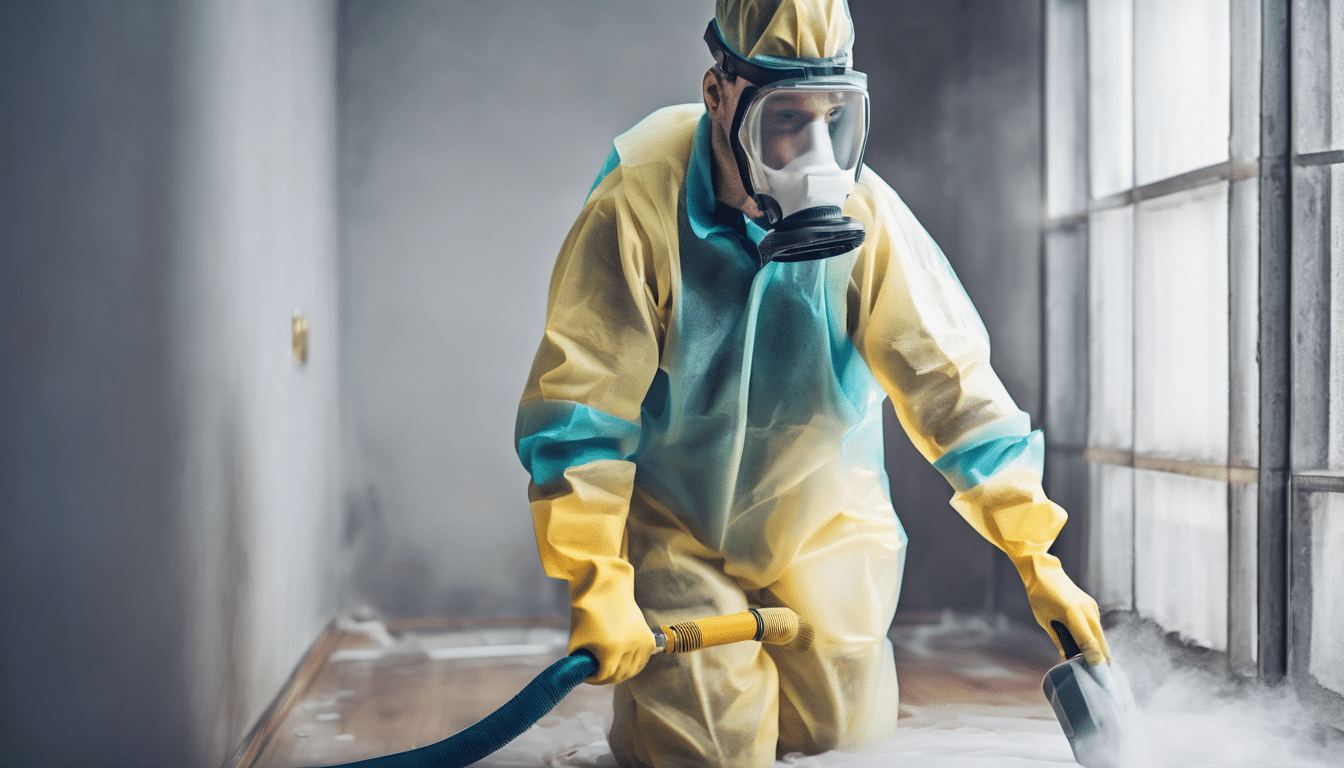
How HEPA Containment protects workers during mold removal is not simply a matter of hanging plastic sheeting and switching on a machine. It is a precise, engineered response to a biological hazard — one that demands understanding of airflow, particle physics, building science, and human health risk. When containment fails, the consequences extend well beyond the work zone.
In the UAE, where mold remediation often occurs inside occupied high-rise apartments, luxury villas, and actively running commercial facilities in Dubai, Abu Dhabi, and Sharjah, the stakes are considerably higher. Ambient temperatures exceeding 45°C outside push workers and residents indoors year-round. Air-conditioned, sealed buildings create unique pressure dynamics that affect how mold spores travel. Understanding how HEPA containment protects workers during mold removal requires examining these local conditions alongside international remediation science.
This article compares the primary containment approaches used in professional mold remediation — full negative pressure containment with HEPA filtration versus partial or informal containment — examining the strengths, limitations, and appropriate applications of each. The goal is not to sell a particular method, but to help property managers, facility teams, and health-conscious homeowners understand what responsible worker protection actually involves.
How Hepa Containment Protects Workers During Mold Removal – What HEPA Containment Actually Means in Mold Remediation
HEPA stands for High Efficiency Particulate Air. A true HEPA filter captures 99.97% of particles at 0.3 microns in diameter — which is precisely the most penetrating particle size for airborne filtration. Mold spores typically range from 1 to 30 microns. This means a correctly operating HEPA filtration unit captures mold spores with extremely high reliability.
However, HEPA filtration alone is not containment. Containment refers to the physical enclosure of the work area — typically constructed using 6-mil polyethylene sheeting sealed with tape, with controlled entry points. The HEPA air scrubber or negative air machine then draws air through the enclosure and exhausts it through HEPA filters, creating negative pressure relative to surrounding spaces.
Understanding how HEPA containment protects workers during mold removal requires appreciating this combination: physical barriers to prevent gross spore release, and HEPA-filtered negative pressure to manage fine particles and airflow direction. One without the other significantly reduces effectiveness.
How Hepa Containment Protects Workers During Mold Removal – The Biological Hazard Being Controlled
Mold remediation is not standard cleaning. Disturbing mold colonies releases vast quantities of spores into the air. A single square centimetre of active mould growth can harbour millions of spores. When physically disturbed during removal — whether by scrubbing, cutting drywall, or demolishing contaminated material — these spores become aerosolised.
In Dubai’s climate, common indoor mould genera such as Aspergillus, Cladosporium, Chaetomium, and Stachybotrys have been documented in our laboratory investigations. Some species produce mycotoxins — secondary metabolites that are potentially harmful when inhaled at elevated concentrations. Workers conducting remediation without adequate containment are exposed to spore concentrations that can be orders of magnitude above background levels. This relates directly to How Hepa Containment Protects Workers During Mold Removal.
This biological reality is the foundation for understanding how HEPA containment protects workers during mold removal. The hazard is not visible to the naked eye, it travels on air currents, and it is continuously generated throughout the disturbance phase of remediation.
Full Negative Pressure Containment with HEPA Filtration
What It Involves
Full containment involves sealing the work area with polyethylene barriers, establishing a decontamination anteroom for worker entry and exit, and operating one or more HEPA negative air machines that maintain negative pressure — typically 8 Pa or lower relative to adjacent spaces. Air exhausted by the machines passes through pre-filters and HEPA filters before being discharged, either outside the building or back into a confirmed clean zone.
Workers within the containment zone wear full personal protective equipment (PPE): N95 respirators at minimum, with half-face or full-face respirators for larger or more contaminated projects, Tyvek suits, gloves, and boot covers. The anteroom serves as a decontamination transition zone where outer PPE is removed before exiting containment.
Strengths
- Prevents cross-contamination to adjacent areas throughout the building
- Creates a controlled, measurable negative pressure differential
- Captures aerosolised spores before they escape the work zone
- Provides a structured decontamination pathway for workers
- Aligns with OSHA guidelines and international remediation standards (IICRC S520)
- Allows post-remediation air testing to verify clearance within a defined zone
Limitations
- Requires trained personnel to construct and maintain correctly
- Adds cost and time to remediation projects — typically AED 1,500 to AED 4,000 or more depending on containment scale
- Can be logistically challenging in very small spaces or in occupied buildings with limited access
- Ineffective if barriers are poorly sealed or negative pressure is not maintained and monitored
- Worker discomfort increases significantly in UAE summer conditions inside sealed enclosures
Partial and Informal Containment Approaches
What It Involves
Partial containment typically means erecting plastic sheeting around an area without establishing negative pressure, or using a portable HEPA vacuum during disturbance without full enclosure. Some contractors use dust sheets, close doors, and rely on open windows for ventilation. Others apply antimicrobial sprays before disturbing material — a method often misrepresented as “containment.”
These approaches are common in the UAE market, particularly among contractors without formal remediation training. They are sometimes presented to property owners as equivalent to full containment, which they are not.
Strengths
- Lower cost and faster to implement
- More practical for very minor surface mould in limited, accessible areas
- Reduces some gross particle release when combined with HEPA vacuuming
- Appropriate only for Category 1, very small-area remediation (under 1 square metre with confirmed surface growth only)
Limitations
- Does not prevent spore migration through HVAC systems or air currents
- Provides no measurable pressure differential — spores can escape freely
- Offers significantly reduced worker protection during active disturbance
- Cannot be verified or tested for effectiveness post-remediation
- In UAE buildings with centralised HVAC, aerosolised spores can be redistributed across entire floors within minutes
- Creates legal and liability exposure for contractors and property managers
Side-by-Side Comparison of Containment Methods
| Criterion | Full Negative Pressure HEPA Containment | Partial / Informal Containment |
|---|---|---|
| Worker spore exposure protection | High — controlled environment with respiratory PPE protocol | Low to moderate — no engineered airflow control |
| Cross-contamination prevention | High — negative pressure keeps spores within zone | Low — spores can migrate freely |
| Suitability for HVAC-connected spaces | Essential — HVAC must be isolated and contained | Not suitable — spores enter ductwork |
| Verifiability | Yes — pressure differentials measurable; clearance air testing possible | No — no objective metric to verify performance |
| Cost | Higher — AED 1,500 to AED 4,000+ for setup | Lower — minimal material costs |
| Appropriate for large contamination areas | Yes | No |
| Regulatory alignment | Consistent with IICRC S520 and OSHA guidelines | Generally non-compliant for moderate to large jobs |
| Occupied building suitability | Yes — designed specifically for occupied settings | Not recommended |
How HEPA Containment Protects Workers During Mold Removal in UAE Buildings
Understanding how HEPA containment protects workers during mold removal in the UAE context requires acknowledging specific local building conditions. Most residential and commercial buildings in Dubai, Abu Dhabi, and Sharjah are sealed, air-conditioned environments with centralised HVAC systems. When mould is disturbed without containment, spores enter the return air pathway and are distributed throughout the building.
How HEPA containment protects workers during mold removal in this context operates on three simultaneous levels. First, the physical barrier prevents bulk spore release into adjacent spaces. Second, the negative pressure gradient ensures that any air movement is directed inward — toward filtration — rather than outward toward workers, occupants, or shared spaces. Third, the personal PPE protocol within the contained zone addresses residual exposure risk for the remediation workers themselves.
In our field investigations at Saniservice, we have documented cases where contractors performed mould removal in occupied apartments without containment. Post-work air sampling in bedrooms two rooms away from the work area showed spore counts significantly elevated above pre-work baselines. The HVAC system had effectively become a redistribution mechanism. This outcome — entirely preventable — demonstrates precisely how HEPA containment protects workers during mold removal and why it simultaneously protects building occupants.
Worker health protection specifically includes several overlapping mechanisms. HEPA-filtered negative air machines continuously reduce the airborne spore concentration within the work zone itself. This reduces inhalation risk even for workers in full PPE, because respirator seal failures — however minor — are less consequential in a lower-concentration environment. How HEPA containment protects workers during mold removal is therefore a function of both engineering controls and PPE working together, not as independent measures.
When Each Approach Is Appropriate
Full Negative Pressure Containment Is Required When
- The contaminated area exceeds 1 square metre of confirmed mould growth
- The work area is connected to shared HVAC or ventilation
- The building is occupied during remediation
- Species identification reveals potentially toxigenic moulds such as Stachybotrys chartarum or certain Aspergillus species
- Structural demolition or significant material removal is involved
- A mould clearance certificate is required post-remediation
Limited Containment May Be Sufficient When
- The affected area is confirmed to be under 1 square metre
- The space is unoccupied and isolated from shared ventilation
- Growth is surface-level only, with no structural material involvement
- Laboratory testing confirms low-risk species
- A qualified indoor environmental professional has assessed and documented the scope
Verdict and Recommendations
The comparison between full HEPA negative pressure containment and partial approaches is not a close one when worker health and building integrity are the metrics. Full containment is objectively superior in every category that affects human exposure, cross-contamination risk, and verifiable outcomes. The higher cost is a legitimate consideration, but it must be weighed against the cost of recontamination, health impacts, and repeated remediation — which our case files confirm are the typical consequences of inadequate containment.
How HEPA containment protects workers during mold removal is not a theoretical benefit. It is a measurable, documentable engineering outcome. In Dubai’s sealed, air-conditioned built environment, where spore mobility through HVAC systems is a constant risk factor, the margin for error in containment design is very small.
For property managers, facility teams, and homeowners in the UAE, the recommendation is clear: insist on documented containment protocols before any mould remediation work begins. Ask the contractor to explain how negative pressure will be established and verified. Ask what air testing protocol will confirm clearance. If a contractor cannot answer these questions clearly, the level of worker and occupant protection they are providing is almost certainly insufficient.
Understanding how HEPA containment protects workers during mold removal is ultimately about understanding that mould remediation is a controlled science — not a cleaning exercise. The barrier between a safe outcome and a worsened contamination problem is frequently the quality of containment design and execution. In the UAE market, where remediation standards vary considerably across contractors, this knowledge gives property owners the ability to make informed, evidence-based decisions.
A proper containment assessment by a qualified indoor environmental professional — before work begins, not after — remains the most reliable first step toward a remediation project that actually resolves the problem rather than redistributing it. Understanding How Hepa Containment Protects Workers During Mold Removal is key to success in this area.