
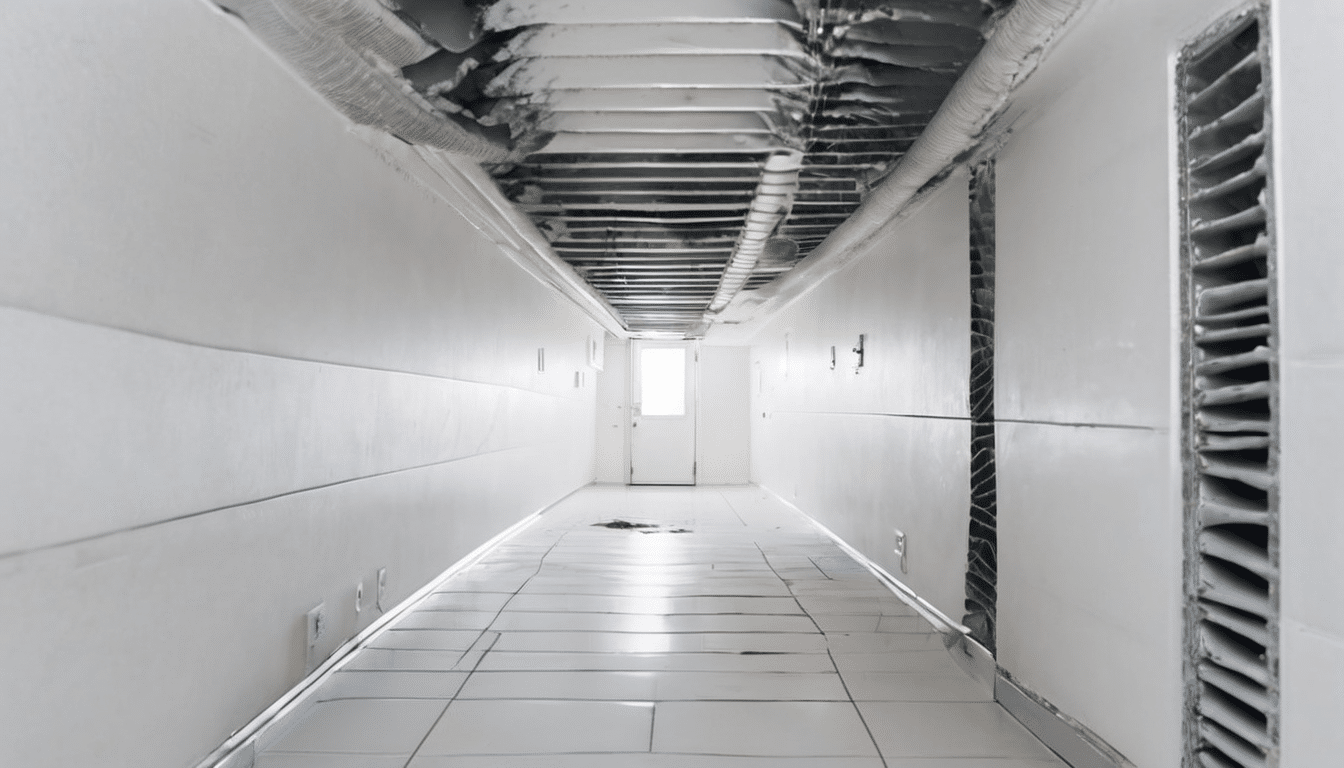
Understanding Mold in AC Ducts Dubai: Signs And Causes is essential. In Dubai’s climate, mould in AC ducts develops predictably — not randomly. Mold in AC Ducts Dubai signs and causes follow a clear pattern: condensation accumulates inside poorly insulated ductwork, humidity levels exceed 60%, and organic dust provides the substrate mould spores need to colonise. Understanding this process allows homeowners and facility managers to intervene at the right stage, before contamination spreads through an entire ventilation system.
As an IAC2 Certified Indoor Air Consultant with over 20 years of building diagnostics experience, I have investigated hundreds of Dubai villas, apartments, and commercial properties where occupants noticed symptoms — headaches, persistent musty odours, unexplained allergic responses — but found nothing visually wrong. In nearly every case, the source was inside the ductwork, invisible and undetected until proper diagnostics were performed. Mold in AC Ducts Dubai signs and causes are rarely obvious. That is precisely what makes them worth understanding. This relates directly to Mold In Ac Ducts Dubai: Signs And Causes.
This guide walks you through the signs, the underlying causes, and a structured step-by-step diagnostic process you can follow to assess whether your AC system may be harbouring mould growth. The process is grounded in building science, not guesswork. When considering Mold In Ac Ducts Dubai: Signs And Causes, this becomes clear.
Mold In Ac Ducts Dubai: Signs And Causes – What Makes Dubai AC Systems Vulnerable to Mould
Dubai’s climate creates conditions that are fundamentally hostile to dry ductwork. Outdoor temperatures regularly exceed 42°C during summer months, while indoor spaces are cooled to 21–24°C. This extreme differential means that any gap, crack, or poorly sealed duct joint becomes a site of condensation — moisture that never fully dries in an air-conditioned environment running continuously for eight to ten months of the year. The importance of Mold In Ac Ducts Dubai: Signs And Causes is evident here.
Relative humidity in Dubai routinely climbs above 80% between June and September. Even when HVAC systems are functioning correctly, the sheer volume of moisture-laden air being processed through ductwork creates ongoing condensation risk. Mold in AC Ducts Dubai signs and causes are therefore directly linked to the thermodynamic behaviour of buildings in a hot-humid climate — this is a building physics problem before it becomes a microbiology one. Understanding Mold In Ac Ducts Dubai: Signs And Causes helps with this aspect.
Field investigations conducted by Saniservice’s Indoor Sciences Division consistently show that Dubai villas built before 2010 — many using older duct insulation standards — are significantly more likely to exhibit internal duct condensation. Based on field investigations across more than 400 Dubai properties, approximately 65% of villas over ten years old showed measurable moisture accumulation inside supply ducts during peak summer months. Mold In Ac Ducts Dubai: Signs And Causes factors into this consideration.
Mold In Ac Ducts Dubai: Signs And Causes – Recognising the Signs of Mold in AC Ducts Dubai
The most reliable indicators of mold in AC ducts Dubai signs and causes present themselves gradually, often mistaken for ordinary seasonal allergies or building dust. Knowing what to look for — and what each sign implies — allows for earlier, less disruptive intervention. This relates directly to Mold In Ac Ducts Dubai: Signs And Causes.
Sensory Indicators
- Musty or earthy odour when the AC is running: This is the most consistent early warning. The smell intensifies when the system first starts because airflow disturbs mould colonies inside ducts, releasing volatile organic compounds (MVOCs) into living spaces.
- Odour disappears when AC is off: This pattern strongly implicates the duct system rather than surface mould in the room itself.
- Visible dark staining around supply vents or grilles: Discolouration around vent openings — particularly grey, green, or black — indicates mould growth at or near the duct outlet.
Occupant Health Indicators
- Symptoms that improve when leaving the property: Persistent nasal congestion, throat irritation, or fatigue that resolves outdoors suggests airborne biological contamination from the ventilation system.
- Symptoms that worsen in specific rooms: If one bedroom or office consistently produces symptoms, the supply duct serving that room warrants investigation.
- Increased frequency of respiratory events in children or elderly occupants: Sensitive groups respond more quickly to elevated spore counts, often before other occupants notice anything.
Visual Indicators
- Condensation on vent covers or ceiling tiles near diffusers: Surface moisture around supply outlets is a direct signal of hygrothermal failure in the duct system above.
- Water staining on ceilings below concealed ductwork: Indicates condensation has exceeded the duct’s capacity to contain moisture.
Mold In Ac Ducts Dubai: Signs And Causes – Root Causes of Mold in AC Ducts Dubai Explained
Understanding the root causes of mold in AC ducts Dubai signs and causes is essential for preventing recurrence after any remediation. Treating mould without addressing the underlying cause produces a temporary result. The cause is almost always one or more of the following: When considering Mold In Ac Ducts Dubai: Signs And Causes, this becomes clear.
Condensation from Hygrothermal Failure
When duct insulation degrades — through age, moisture saturation, or improper installation — the duct surface temperature drops below the dew point of surrounding air. Condensation forms on the exterior, then migrates inward through the duct wall. In Dubai’s climate, where outdoor dew points regularly reach 25–28°C, even brief lapses in insulation integrity create persistent moisture problems. The importance of Mold In Ac Ducts Dubai: Signs And Causes is evident here.
Oversized or Poorly Balanced HVAC Systems
An oversized AC unit cools a space rapidly but does not run long enough to dehumidify it effectively. Short-cycling systems leave relative humidity elevated — often above 65% — creating ideal conditions for mould. This is one of the most commonly overlooked root causes in Dubai villa HVAC installations. Mold in AC Ducts Dubai signs and causes frequently trace back to system sizing errors made at design stage. Understanding Mold In Ac Ducts Dubai: Signs And Causes helps with this aspect.
Blocked or Restricted Condensate Drainage
Every air handling unit produces condensate. When drain pans overflow — due to blocked lines, biological growth in the drain, or incorrect unit levelling — water pools inside the air handler and is distributed through the duct system as aerosol or direct moisture. Laboratory analysis typically shows heavy mould contamination in ducts connected to air handlers with faulty drain pan management. Mold In Ac Ducts Dubai: Signs And Causes factors into this consideration.
Accumulated Organic Debris in Ductwork
Dust, fibres, and skin cells accumulate on duct surfaces over time. In the presence of moisture, this organic layer becomes the growth medium mould requires. Duct systems that have not been professionally cleaned within the past two to three years commonly show significant biological loading, particularly in properties with pets, high occupancy, or older air filtration. This relates directly to Mold In Ac Ducts Dubai: Signs And Causes.
Step-by-Step Diagnostic Process for Duct Mould
This structured process guides you through a systematic investigation of mold in AC ducts Dubai signs and causes, from initial observation to laboratory confirmation. Follow each step in sequence for the most reliable outcome. When considering Mold In Ac Ducts Dubai: Signs And Causes, this becomes clear.
Step 1 — Document Your Observations
Before touching anything, record what you have noticed: which rooms produce odours, whether symptoms correlate with AC operation, any visible staining near vents. Date your observations (DD/MM/YYYY format) and photograph vent grilles and ceiling areas around diffusers. This documentation creates the baseline your investigation needs. The importance of Mold In Ac Ducts Dubai: Signs And Causes is evident here.
Step 2 — Inspect Accessible Vent Grilles and Diffusers
Remove supply and return vent covers. Examine the interior surfaces for visible mould growth — look for dark spotting, fuzzy textures, or biological films on the duct walls immediately behind the grille. Use a torch. Photograph everything. Even 5 cm of visible growth at a supply outlet confirms active colonisation inside the duct system. Understanding Mold In Ac Ducts Dubai: Signs And Causes helps with this aspect.
Step 3 — Measure Humidity at Supply Outlets
Using a calibrated hygrometer, measure relative humidity at each supply vent while the system is running. Readings consistently above 60% RH at the supply outlet indicate the system is not dehumidifying adequately — a primary driver of mold in AC ducts Dubai signs and causes. Record readings per room and per vent. Mold In Ac Ducts Dubai: Signs And Causes factors into this consideration.
Step 4 — Inspect the Air Handler and Drain Pan
Locate your air handling unit — typically in a ceiling void, utility cupboard, or dedicated plant room. Open the access panel carefully. Examine the drain pan for standing water, biological slime, or blockage. Check the drain line for flow by pouring a small amount of water into the pan. A blocked drain is a direct mould risk. This relates directly to Mold In Ac Ducts Dubai: Signs And Causes.
Step 5 — Conduct a Borescope Inspection of Ductwork
A borescope — a flexible inspection camera — allows visual examination of duct interiors without demolition. Insert the camera into accessible duct openings at branch points or near air handler connections. Look for biological growth on duct liners, debris accumulation, and condensation marks (white mineral deposits indicating repeated wetting and drying cycles). When considering Mold In Ac Ducts Dubai: Signs And Causes, this becomes clear.
Step 6 — Collect Surface Samples for Laboratory Analysis
Surface sampling inside ducts uses swabs or tape lifts to capture biological material from duct walls. Samples should be taken from multiple locations — near the air handler, at mid-duct positions, and near supply outlets. Laboratory analysis identifies mould species, concentration, and whether the contamination profile is consistent with active growth or historic residue. The importance of Mold In Ac Ducts Dubai: Signs And Causes is evident here.
Step 7 — Conduct Air Sampling During System Operation
Spore trap air sampling, collected during normal AC operation, measures the airborne fungal load being delivered into occupied spaces through the duct system. Saniservice’s in-house microbiology laboratory analyses these samples against outdoor baseline counts. Elevated indoor-to-outdoor ratios confirm active mould in AC ducts Dubai signs and causes — this is the data that drives remediation decisions. Understanding Mold In Ac Ducts Dubai: Signs And Causes helps with this aspect.
Step 8 — Interpret Results and Define Root Cause
Lab results alone do not resolve the problem. Interpreting the data within the context of building physics — duct condition, humidity levels, drain pan status, insulation integrity — identifies the root cause driving contamination. Without this step, remediation addresses symptoms rather than the system failure producing them. Mold In Ac Ducts Dubai: Signs And Causes factors into this consideration.
What You Need Before Starting Your Investigation
Gathering the right equipment before beginning saves time and improves accuracy. Industry standards require that investigation tools be clean and calibrated before use. This relates directly to Mold In Ac Ducts Dubai: Signs And Causes.
- Calibrated digital hygrometer and thermometer
- Torch (LED, minimum 200 lumens)
- Borescope inspection camera (flexible, minimum 1 m reach)
- Disposable nitrile gloves and N95 respirator
- Surface sampling swabs and tape lift kits (supplied by your laboratory)
- Spore trap cassettes and calibrated air sampling pump (for professional use)
- Smartphone or camera for documentation
- Screwdriver set for vent grille removal
Understanding Mold in AC Ducts Dubai Through Lab Data
Field observation identifies the possibility of mold in AC ducts Dubai signs and causes. Laboratory data confirms it. The difference matters because visual inspection alone cannot distinguish between surface dust and active biological growth, cannot identify species, and cannot quantify the airborne exposure occupants are receiving. When considering Mold In Ac Ducts Dubai: Signs And Causes, this becomes clear.
Saniservice’s indoor microbiology laboratory processes surface and air samples using direct microscopy and culture methods. Species identification informs risk assessment: Cladosporium at low concentrations represents a different risk profile than elevated Aspergillus/Penicillium counts or the presence of Stachybotrys chartarum. The question is never simply whether mould is present — it is what type, at what concentration, and what the lab results indicate about source location and exposure pathway. The importance of Mold In Ac Ducts Dubai: Signs And Causes is evident here.
Based on Saniservice laboratory data from Dubai residential investigations conducted between 2020 and 2024, the three most frequently identified duct mould genera in Dubai properties were Aspergillus/Penicillium group (identified in 74% of positive samples), Cladosporium (61%), and Chaetomium (29% — a reliable marker of water-damaged cellulose materials within or connected to the duct system).
When to Call a Certified Professional
Mold in AC ducts Dubai signs and causes can be partially investigated using the steps above. However, several conditions require certified professional involvement:
- Visible mould coverage exceeding 0.1 m² inside the duct system — at this scale, disturbance during inspection without containment creates cross-contamination risk.
- Occupants with respiratory conditions, immunocompromised status, or young children — professional assessment and clearance testing protects sensitive occupants.
- Recurring mould despite previous cleaning — recurrence indicates an unresolved root cause requiring forensic investigation.
- Suspected water intrusion into air handling units or duct insulation — structural moisture requires building envelope analysis beyond standard HVAC service.
IAC2-certified indoor air consultants follow documented investigation protocols, use calibrated equipment, and interpret laboratory results within a building science framework. This is the standard Saniservice’s Indoor Sciences Division applies to every duct mould investigation in Dubai.
Expert Tips for Dubai Property Owners
- Maintain indoor relative humidity below 55%. This single measure eliminates the primary growth condition for most common duct mould species. Invest in a wall-mounted humidity monitor and review readings weekly during summer months.
- Service your AC system before peak humidity season. Drain pan cleaning, coil inspection, and filter replacement completed before June significantly reduce mould risk during the high-humidity period from July to September.
- Do not seal supply vents to redirect airflow. Blocking vents creates pressure imbalances and condensation points that accelerate mould development inside the duct system.
- Replace fibreglass duct liner if it has been wet. Wet fibreglass insulation does not dry adequately in Dubai’s climate. It retains moisture and biological contamination permanently. Replacement is the only reliable solution.
- Request post-cleaning verification sampling. Duct cleaning without post-remediation air sampling provides no confirmation of effectiveness. Lab-verified clearance is the only measurable proof that the work was successful.
- Document symptoms and their timing. Correlating occupant health observations with system operation data — which vents, which times, which rooms — provides the diagnostic map that guides targeted investigation.
Frequently Asked Questions
How do I know if the musty smell from my Dubai AC is mould or just dust?
Dust produces a flat, dry smell that typically dissipates within minutes. Mould produces a persistent earthy or musty odour with volatile organic compounds (MVOCs) that linger during system operation. If the smell is strongest when the AC first starts and fades once airflow stabilises, biological growth inside the duct system is a likely source. Laboratory air sampling during system operation confirms the distinction.
Can mould inside AC ducts affect my family’s health in Dubai apartments?
Yes. Mould spores and MVOCs distributed through a duct system are delivered directly to breathing zones in every room served by that system. In Dubai apartments with continuous AC operation, occupants receive sustained low-level exposure. Sensitive individuals — children, elderly occupants, those with asthma or allergies — may respond before others notice symptoms. Laboratory-confirmed air sampling quantifies actual exposure levels.
How often should AC ducts be inspected for mould in Dubai?
Based on Dubai’s climate conditions and continuous AC usage patterns, professional duct inspection is recommended annually, ideally before the summer humidity peak in May or June. Properties with a history of water intrusion, drain pan issues, or recurring odours warrant inspection every six months. Visual inspection alone is insufficient — borescope assessment and surface sampling provide the complete picture.
What is the difference between AC duct cleaning and mould remediation?
AC duct cleaning removes accumulated dust, debris, and surface deposits using mechanical agitation and HEPA-filtered vacuum extraction. Mould remediation is a more specific process targeting biological contamination — it includes containment, antimicrobial treatment, source removal, and post-remediation verification sampling. Mould in AC ducts Dubai signs and causes require remediation, not simply cleaning, when active biological growth is laboratory-confirmed.
Does Dubai’s humidity make mould in AC ducts inevitable?
Not inevitable, but predictable without proper system design and maintenance. The combination of high outdoor humidity, continuous cooling, and standard duct construction creates conditions where mould is a consistent risk rather than a rare event. Properties with adequately sized HVAC systems, maintained insulation, functional condensate drainage, and regular professional servicing significantly reduce mould probability — regardless of outdoor humidity levels.
Can I test for mould in my AC ducts myself in Dubai?
Preliminary visual inspection is possible using a torch and basic access to vent grilles. However, accurate diagnosis of mold in AC ducts Dubai signs and causes requires calibrated air sampling equipment, laboratory analysis, and interpretation within a building science framework. DIY swab kits provide limited data and no species identification. For any result you intend to act on — especially remediation decisions — professional laboratory-supported testing is the appropriate standard.
How long does mould grow in Dubai AC ducts before becoming a problem?
Under optimal conditions — moisture, organic substrate, temperatures between 20–30°C — mould colonies can establish and become measurable within 24 to 72 hours. In Dubai ductwork, where conditions may be intermittently favourable during peak humidity months, meaningful colonisation typically develops over two to six weeks of unaddressed moisture presence. Early detection through regular inspection is far less disruptive than addressing established contamination.
Conclusion
Mold in AC ducts Dubai signs and causes follow a logic that building science makes predictable. The climate creates the pressure. Ageing insulation, oversized systems, and blocked drain pans create the failure points. And mould — given moisture, warmth, and organic material — does what biology requires it to do. Understanding this sequence is what separates reactive treatment from informed prevention.
The step-by-step diagnostic process in this guide gives Dubai homeowners and property managers a structured way to move from suspicion to data — from noticing a smell to understanding what the laboratory results mean and what they require. Mold in AC ducts Dubai signs and causes are never resolved by surface-level responses. They are resolved by identifying the root cause, verifying the extent through laboratory analysis, and confirming remediation success through post-clearance sampling.
If your investigation reveals signs consistent with the patterns described above, the next step is not alarm — it is measurement. Invite a certified indoor air consultant to assess what your duct system contains. That assessment is where clarity begins, and clarity is the foundation of a measurably cleaner indoor environment. Understanding Mold In Ac Ducts Dubai: Signs And Causes is key to success in this area.