
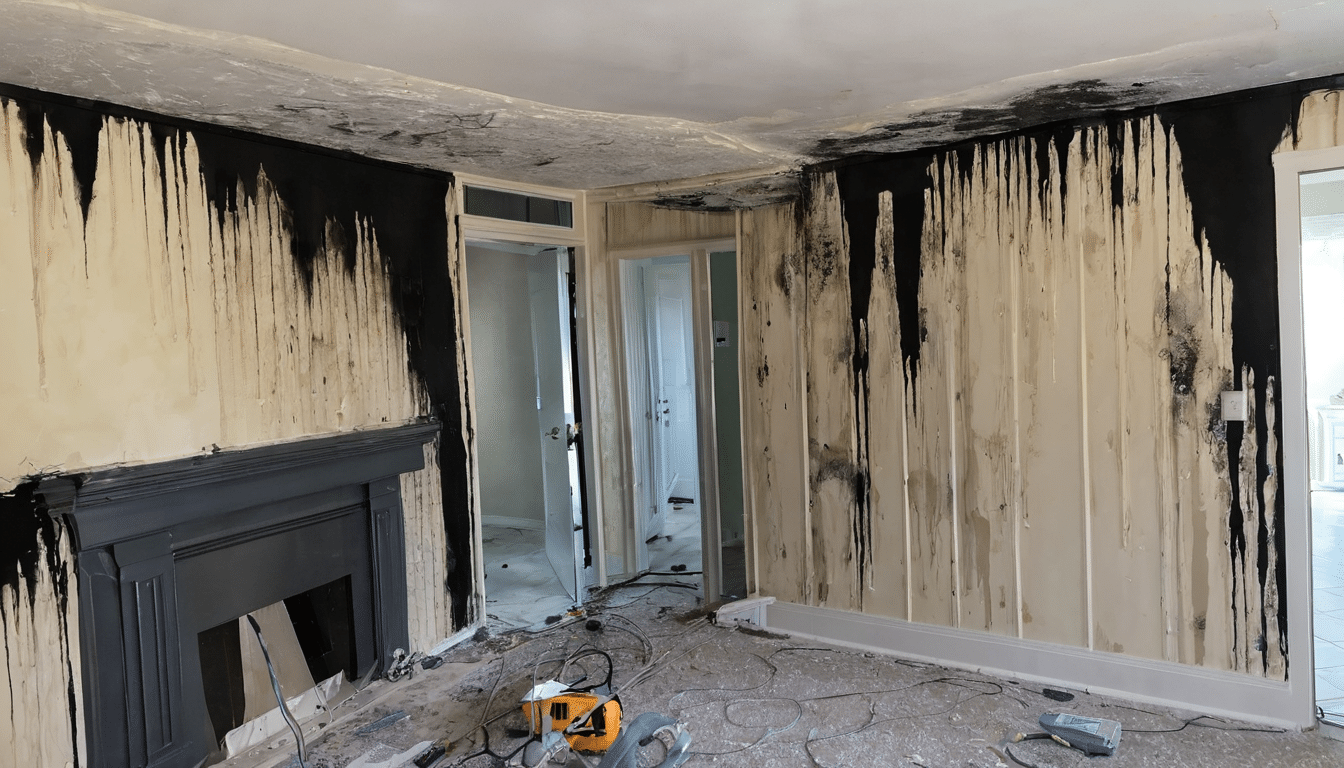
Understanding Black Mold Remediation in Dubai Villas: Verified Methods is essential. Black Mold Remediation in Dubai villas, when conducted to verified standards, follows a defined sequence: assessment and moisture mapping, containment setup, controlled removal, HEPA filtration, surface treatment, and laboratory-confirmed clearance. Each stage depends on the one before it. Skipping steps — or confusing cosmetic cleaning with genuine remediation — is precisely why mould returns in so many Dubai properties. The question is never simply whether mould is visible. The question is what species is present, at what concentration, and what the building conditions are that allowed it to establish in the first place.
Dubai’s climate creates conditions that are genuinely demanding for building envelopes. Outdoor relative humidity regularly exceeds 80% during summer months, ambient temperatures peak above 45°C, and the thermal differential between conditioned interiors and sun-exposed walls generates persistent condensation risk inside wall cavities, behind tiles, and within HVAC systems. In villas — particularly those with complex architectural layouts, multiple AC zones, and high-finish interiors — these variables interact in ways that make mould both predictable and, without root-cause correction, recurring. This relates directly to Black Mold Remediation in Dubai Villas: Verified Methods.
As an IAC2 Certified Indoor Air Consultant with more than 20 years of cross-disciplinary experience, I have investigated mould cases across Dubai, Abu Dhabi, Sharjah, and Ajman where the remediation had been attempted multiple times without success. In almost every case, the failure was not chemical — it was procedural. Verified black mold remediation in Dubai villas requires methodology, not just product. What follows is a precise account of what that methodology looks like. When considering Black Mold Remediation in Dubai Villas: Verified Methods, this becomes clear.
Black Mold Remediation in Dubai Villas: Verified Methods – Why Black Mold Remediation in Dubai Villas Requires a Differ
Dubai villas are not uniform structures. A compound villa in Jumeirah differs significantly from a contemporary villa in Arabian Ranches or a heritage-style property in Al Barsha in terms of building envelope design, insulation strategy, and HVAC configuration. These architectural differences directly affect where mould establishes, how far it spreads, and which remediation methods are appropriate. The importance of Black Mold Remediation in Dubai Villas: Verified Methods is evident here.
In many Dubai villas, the building envelope is under-insulated relative to the thermal and humidity loads placed on it. Condensation forms not on visible surfaces but within wall assemblies — between gypsum board, insulation batts, and the structural substrate beneath. By the time dark staining becomes visible at a skirting board or ceiling junction, the mould colony behind it may have been developing for months. Understanding Black Mold Remediation in Dubai Villas: Verified Methods helps with this aspect.
Standard cleaning services are not designed to reach these concealed growth zones. Verified black mold remediation in Dubai villas requires diagnostics that identify the full extent of contamination before a single square metre of material is touched. Black Mold Remediation in Dubai Villas: Verified Methods factors into this consideration.
Black Mold Remediation in Dubai Villas: Verified Methods – Stage One — Assessment and Diagnostic Investigation
Moisture Mapping and Thermal Imaging
The assessment phase is where verified remediation begins and where unverified approaches fail. Moisture mapping uses calibrated pin and pinless meters to identify elevated moisture content in walls, floors, and ceilings. Thermal imaging provides a broader picture — surface temperature differentials that indicate condensation accumulation, active water ingress, or thermal bridging within the building envelope. This relates directly to Black Mold Remediation in Dubai Villas: Verified Methods.
In Dubai villa investigations, thermal imaging frequently reveals cold spots in external walls that do not appear wet on casual inspection. These zones correspond to areas where insulation has failed, air gaps have formed, or vapour movement has concentrated moisture. Without this data, the true scope of mould growth is unknown, and any remediation plan drawn without it is an estimate rather than a strategy. When considering Black Mold Remediation in Dubai Villas: Verified Methods, this becomes clear.
Borescope Inspection for Hidden Mould
Where moisture readings and thermal anomalies suggest concealed growth, borescope inspection allows visual confirmation without opening large wall sections unnecessarily. A small-diameter camera is inserted through a controlled access point to examine wall cavities, ceiling voids, and subfloor spaces. This reduces unnecessary demolition while providing verified visual evidence of conditions inside the building assembly. The importance of Black Mold Remediation in Dubai Villas: Verified Methods is evident here.
Air and Surface Sampling
Laboratory sampling is not optional in verified black mold remediation in Dubai villas — it is the evidentiary foundation of the entire process. Spore trap air sampling captures airborne fungal particles and delivers them to Saniservice’s in-house microbiology laboratory for species identification and concentration quantification. Surface sampling using tape lifts or swabs confirms mould presence on specific materials and identifies the species involved. Understanding Black Mold Remediation in Dubai Villas: Verified Methods helps with this aspect.
Species identification matters clinically. Stachybotrys chartarum — commonly referred to as black mould — produces mycotoxins that have different health implications than Cladosporium or Penicillium. Knowing what is present allows the remediation plan to be calibrated appropriately and allows occupants to make informed decisions about the property during the remediation period. Black Mold Remediation in Dubai Villas: Verified Methods factors into this consideration.
Black Mold Remediation in Dubai Villas: Verified Methods – Stage Two — Containment Design for Safe Black Mold Remedia
Containment is not simply sheeting off a room. Proper containment in verified black mold remediation in Dubai villas involves engineering negative pressure relative to adjacent spaces, using polyethylene barriers with sealed perimeters, and establishing decontamination airlocks at all work entry points. The purpose is to prevent spore dispersal from the work zone into occupied areas of the villa. This relates directly to Black Mold Remediation in Dubai Villas: Verified Methods.
In occupied Dubai villas — where families may be continuing to use portions of the property during remediation — containment design is directly connected to occupant safety. HEPA air scrubbers are positioned to draw air through the containment and exhaust it outside the building envelope, maintaining directional airflow away from living areas. This setup aligns with IICRC S520 guidelines for professional mould remediation. When considering Black Mold Remediation in Dubai Villas: Verified Methods, this becomes clear.
Containment integrity is verified before remediation work begins, not assumed. Smoke pencil tests or equivalent pressure differential measurements confirm that the negative pressure environment is functioning correctly. The importance of Black Mold Remediation in Dubai Villas: Verified Methods is evident here.
Stage Three — Controlled Removal and Material Assessment
Determining What Can Be Cleaned and What Must Be Removed
Not all materials respond equally to mould remediation. Porous materials — gypsum board, MDF skirting, soft insulation batts, particleboard substrates — cannot be adequately cleaned once mould has penetrated their surface layer. These materials must be removed, bagged within containment, and disposed of in accordance with applicable UAE waste management protocols. Understanding Black Mold Remediation in Dubai Villas: Verified Methods helps with this aspect.
Semi-porous and non-porous materials — concrete masonry, ceramic tiles, aluminium framing, PVC profiles — can typically be cleaned using HEPA vacuum extraction followed by appropriate biocidal treatment. The biocide selection depends on the substrate and the species identified in laboratory analysis. No single product is universally appropriate, and verified black mold remediation in Dubai villas does not default to bleach application as a primary method. Black Mold Remediation in Dubai Villas: Verified Methods factors into this consideration.
HEPA Vacuum and Mechanical Agitation
Before any wet treatment is applied, HEPA vacuuming removes loose spore matter from surfaces and cavities. This step is frequently omitted in non-verified approaches, where chemical spraying is applied directly to dusty or debris-laden surfaces — reducing the biocide’s contact efficiency and leaving residual spore material embedded in surrounding materials. This relates directly to Black Mold Remediation in Dubai Villas: Verified Methods.
Mechanical agitation — wire brushing or sanding of structural timber where mould has surface-colonised without deep penetration — prepares the substrate for biocidal treatment and allows visual confirmation that the underlying material is structurally sound. When considering Black Mold Remediation in Dubai Villas: Verified Methods, this becomes clear.
Stage Four — Moisture Source Correction
Verified black mold remediation in Dubai villas does not proceed to material removal without addressing the moisture source first. This is the point where most repeated remediation failures originate. Mould is a biological outcome of a moisture condition. Remove the mould without correcting the moisture, and regrowth is a building physics inevitability — not a possibility. The importance of Black Mold Remediation in Dubai Villas: Verified Methods is evident here.
Common moisture sources in Dubai villas include: plumbing leaks within wall cavities; HVAC condensate line overflows; vapour diffusion through inadequately insulated external walls; roof membrane failures; and window or door frame seal degradation. Each requires a different corrective action. Plumbing repairs require licensed MEP contractors. Envelope corrections may require insulation upgrades or vapour barrier installation. HVAC deficiencies require system reconfiguration.
The remediation scope document issued by Saniservice specialists includes a root-cause finding and a corresponding corrective recommendation for each identified moisture source. Remediation without this documentation is incomplete by definition.
Stage Five — Post-Remediation Verification
Post-remediation verification is the stage that separates verified black mold remediation in Dubai villas from cosmetic treatment. Once remediation work is complete, containment is still intact, and before any reconstruction begins, clearance testing is conducted.
Clearance testing involves repeat air sampling within the remediated zone and comparison against both pre-remediation baseline samples and outdoor control samples. In Saniservice’s in-house microbiology laboratory, the analysis quantifies total spore concentrations and identifies whether target species have been reduced to levels consistent with normal background conditions.
A clearance certificate is issued only when laboratory results confirm that the remediated environment meets the criteria defined in the pre-remediation scope. This document is the evidentiary record of successful remediation and is meaningful for property transactions, tenancy disputes, and DHA-related documentation requirements in the Dubai context.
HVAC Systems in Black Mold Remediation in Dubai Villas
In Dubai villas, the HVAC system is simultaneously a potential contamination source and a potential distribution pathway. If mould has established within the ductwork, air handler unit, or evaporator coil assembly, normal system operation disperses spores throughout the entire conditioned space — undermining any localised remediation effort conducted in adjacent rooms.
HVAC inspection is therefore a mandatory component of comprehensive black mold remediation in Dubai villas. Saniservice specialists conduct duct surface sampling and visual inspection using borescope equipment calibrated for HVAC applications. Where contamination is confirmed, duct remediation follows NADCA-aligned methodology, including HEPA vacuum extraction, anti-microbial treatment, and coil cleaning where indicated.
Humidity control correction — adjusting thermostat setpoints, improving condensate drainage, or recalibrating fresh air intake proportions — is often the single most impactful long-term preventive measure available in Dubai’s climate.
Expert Takeaways for Dubai Villa Owners
- Visible black mould on a surface is a late indicator — the underlying colonisation typically extends well beyond what is visible to the eye.
- Laboratory species identification changes the remediation and risk profile significantly. Always request documented lab results, not a verbal assessment.
- Moisture source correction is not optional. Remediation without it is temporary by definition.
- HVAC systems must be included in any villa-wide mould assessment — treating rooms while leaving contaminated ductwork active will cause recurrence.
- A clearance certificate backed by post-remediation laboratory sampling is the only verifiable proof of successful remediation.
- British English convention applies in UAE documentation: the word is “mould,” and it matters in formal records and property disclosures.
Frequently Asked Questions
What does verified black mold remediation in Dubai villas actually involve?
Verified black mold remediation in Dubai villas involves a documented sequence: diagnostic investigation with moisture mapping and laboratory sampling, containment setup with negative pressure, controlled material removal or treatment, moisture source correction, and post-remediation clearance testing. Each stage is recorded and confirmed before the next begins. A clearance certificate issued after laboratory analysis is the final deliverable.
How do I know if black mould in my Dubai villa has been fully removed?
The only reliable confirmation is post-remediation air sampling analysed by an accredited microbiology laboratory. Visual inspection alone is insufficient — mould spores are invisible to the naked eye, and treated surfaces can appear clean while residual contamination remains. Saniservice’s in-house laboratory provides analysis that supports clearance certification based on measurable spore concentrations.
Why does black mould keep coming back in Dubai villas after treatment?
Recurrence almost always indicates that the moisture source was not identified and corrected before or during remediation. In Dubai villas, common recurring sources include HVAC condensate overflow, inadequate wall insulation causing vapour diffusion, and undetected plumbing leaks inside wall cavities. Remediation that treats only the visible mould without addressing the underlying building condition will produce repeated growth.
Is black mould in a Dubai villa dangerous for children and sensitive occupants?
The health implications depend on the species present, the spore concentration in the indoor air, and the duration of exposure. Stachybotrys chartarum — a species that produces mycotoxins — requires specific remediation protocols. Laboratory identification allows occupant risk to be assessed accurately rather than assumed. Sensitive occupants, including young children, should ideally be relocated from actively contaminated spaces during remediation work.
What is a DHA mould clearance certificate and when is it needed in Dubai?
A mould clearance certificate documents that post-remediation laboratory results confirm the treated environment meets defined indoor environmental standards. In Dubai, such documentation is increasingly requested during property handovers, tenancy dispute resolution, and in cases involving DHA-registered healthcare or childcare facilities. Saniservice issues clearance certificates supported by in-house laboratory analysis and field documentation.
How long does black mold remediation take in a typical Dubai villa?
Duration varies based on the extent of contamination, the number of affected rooms, and whether HVAC systems require separate treatment. A single-room remediation with straightforward moisture source correction may require two to three working days. Multi-room villa projects with complex building envelope involvement typically require a detailed scope assessment before a timeline can be confirmed accurately.
Can I stay in my Dubai villa during black mold remediation?
This depends on the location and extent of the contamination, the containment configuration, and the occupant’s health profile. In cases where sensitive occupants — including young children or individuals with respiratory conditions — are present, temporary relocation from the affected zone is advisable. Saniservice specialists assess occupancy suitability as part of the pre-remediation consultation and document the recommendation in the project scope.
Black mold remediation in Dubai villas, conducted to verified standards, is ultimately an investment in building integrity and indoor wellbeing — not merely a cosmetic correction. The methodology described here reflects how Saniservice approaches every villa investigation: with diagnostic evidence, documented procedure, and laboratory-confirmed outcomes. If you are observing mould growth, recurrence after previous treatment, or unexplained air quality concerns in your Dubai villa, the starting point is an assessment that measures what is actually present — not an assumption about what the problem might be. Contact Saniservice to arrange a property-specific diagnostic inspection and understand the full scope before any remediation work begins. Understanding Black Mold Remediation in Dubai Villas: Verified Methods is key to success in this area.