
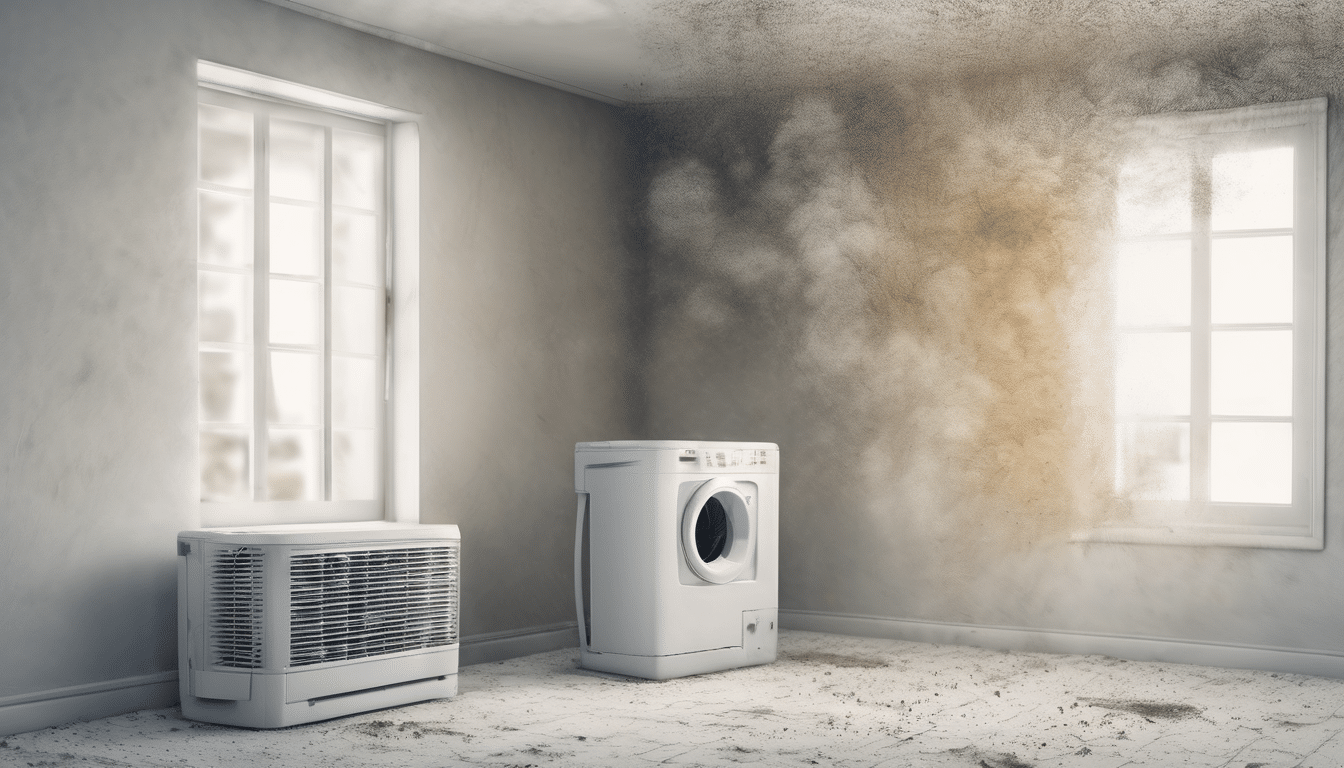
Most homeowners in Dubai, Abu Dhabi, and across the UAE associate mold with damp bathrooms or leaking pipes. Rarely do they consider the appliance running 24 hours a day, circulating air through every room of the home. Understanding How AC Systems spread mold spores in UAE homes requires looking beyond the visible and into the mechanics of airflow, moisture, and microbial biology operating silently inside your ductwork.
The UAE’s climate creates a perfect environment for mold to establish itself within cooling systems. Outdoor humidity regularly exceeds 80% during summer months, and the sharp temperature differential between outside air and cooled interiors produces condensation at every point of entry. When mold spores — which are always present in the outdoor air — enter this environment, the AC system does not simply filter them. In many cases, it amplifies and distributes them. This relates directly to How Ac Systems Spread Mold Spores In Uae Homes.
This is not a surface problem. It is a systems problem. And solving it requires understanding how the contamination actually moves.
How Ac Systems Spread Mold Spores In Uae Homes – Why AC Systems Are Mold Distribution Pathways
Air conditioning systems are designed to move air — and they do so continuously and efficiently. In UAE residential buildings, a centralised or ducted split system may circulate the entire volume of indoor air multiple times per hour. This constant movement means that anything airborne in one area of the home will eventually reach every other area.
When mold establishes a colony anywhere in the AC system — on coils, inside ductwork, within air handling units — it begins releasing spores into that moving airstream. Those spores do not stay localised. They travel the full length of the duct network, settling on surfaces throughout the home and landing in occupied rooms where people breathe.
This is the fundamental mechanism of how AC systems spread mold spores in UAE homes: contamination at one point becomes exposure at many points.
How Ac Systems Spread Mold Spores In Uae Homes – How AC Systems Spread Mold Spores — The Biology
Mold reproduces by releasing microscopic spores into the air. These spores are extraordinarily small — typically between 1 and 100 microns — and remain suspended in air for extended periods. They require only three conditions to establish a new colony: a surface, moisture, and an organic food source.
Inside an AC system, all three conditions are reliably present. Dust accumulates on internal surfaces, providing both a substrate and an organic food source. Condensation from the cooling process provides moisture. The system itself provides surfaces — coil fins, duct walls, drain pans, and filter housings — where spores can settle and begin growing.
Understanding how AC systems spread mold spores in UAE homes at the biological level means recognising that the AC unit is not merely a distribution vector. It is frequently an active growth site where mold colonies produce spores continuously, feeding the contamination cycle.
The Evaporator Coil — Where Contamination Begins
The evaporator coil is the component inside the indoor air handling unit responsible for cooling the air. It operates by maintaining a surface temperature well below the dew point of the incoming air, causing moisture to condense on its surface. This condensation is by design — it is how the system removes humidity from indoor air.
However, this same condensation creates a persistently wet surface in a dark, dusty interior. In our investigations across Dubai villas and apartments, evaporator coils with inadequate maintenance schedules almost always show biological contamination. Common species found include Cladosporium, Aspergillus, and Penicillium — all capable of producing spores that travel readily through airstreams. When considering How Ac Systems Spread Mold Spores In Uae Homes, this becomes clear.
When the blower fan operates, air passes directly across these contaminated coil surfaces before entering the duct system. This means that every cubic metre of conditioned air distributed through the home has passed through a potential spore source.
Coil Fouling and Reduced Efficiency
As mold and biofilm accumulate on coil fins, they reduce heat exchange efficiency. Homeowners often notice the system struggling to cool effectively before they notice any mold-related symptoms. Reduced airflow and increased energy consumption are early signs that coil contamination may already be significant.
How AC Systems Spread Mold Spores Through Ductwork
Ductwork is rarely inspected in UAE residential properties. Concealed within ceilings, walls, and floor voids, these channels carry conditioned air from the air handling unit to every room. They also carry whatever biological material is present in that airstream.
Over time, dust accumulates on duct inner surfaces. In humid conditions — particularly in buildings where outdoor air infiltration is uncontrolled — this dust becomes moist enough to support mold growth. Flexible ductwork, which is commonly used in UAE apartments and villas, is particularly vulnerable because its corrugated interior creates pockets where moisture and organic material accumulate.
This is a critical dimension of how AC systems spread mold spores in UAE homes: duct contamination is self-reinforcing. Spores from the coil settle in the ductwork, establish colonies there, and then release further spores downstream. The contamination cascades through the system rather than remaining at a single point.
Poorly Sealed Duct Joints
In many UAE buildings, duct joints are not adequately sealed. This allows humid unconditioned air from ceiling voids and wall cavities to enter the duct system. Outdoor air in summer may carry humidity levels above 85%, and when this air enters cooled ductwork, condensation forms on the inner surfaces — creating ideal conditions for mold growth even in systems that appear externally clean.
Drain Pans and Condensate Lines — Overlooked Sources
Beneath every evaporator coil sits a drain pan designed to collect condensate water and channel it away through a drain line. When drain lines become partially blocked — through algae growth, dust accumulation, or installation defects — standing water collects in the pan.
Standing water in a drain pan is a textbook mold and bacterial growth environment. The pan is dark, warm when the system is off, and consistently supplied with organic material carried by the airstream. In our laboratory analysis, drain pan samples from poorly maintained systems regularly return high counts of Aspergillus species and bacteria including Pseudomonas.
When the blower operates, air turbulence above the standing water can aerosolise contaminated droplets and particles, adding them directly to the conditioned airstream. This is another underappreciated mechanism in how AC systems spread mold spores in UAE homes.
How AC Systems Spread Mold Spores in UAE Homes With Poor Filtration
Most residential AC systems in the UAE are fitted with basic fibre or mesh filters with a low MERV rating. These filters are designed primarily to protect the mechanical components of the system, not to capture biological particles. Standard filters with a MERV rating below 8 allow spores in the 1–5 micron range to pass through largely unimpeded. The importance of How Ac Systems Spread Mold Spores In Uae Homes is evident here.
Furthermore, filters are frequently poorly maintained in UAE residential properties. A clogged filter increases static pressure and reduces airflow, causing the system to work harder and potentially drawing air around the filter edges rather than through it — bypassing filtration entirely.
When filtration fails, how AC systems spread mold spores in UAE homes becomes a largely unobstructed process. Spores generated anywhere in the system — or drawn in from contaminated spaces — travel freely to every supply vent in the building.
Building-Specific Risk Factors in the UAE
The UAE’s built environment introduces several specific risk factors that amplify the problem. Buildings are tightly sealed against the outdoor heat, meaning indoor air is recirculated constantly with limited fresh air exchange. This concentrates airborne biological particles over time.
Many residential buildings — particularly older apartment blocks in areas like Deira, Al Nahda, and parts of Sharjah — were constructed before modern vapour barrier standards were established. Building envelopes are often not airtight, allowing humid outdoor air to infiltrate ceiling voids where ductwork runs. Thermal bridging through concrete slabs creates cold surfaces where condensation forms independently of the AC system itself.
Luxury villas in communities across Dubai — from Arabian Ranches to Palm Jumeirah — often feature complex ducted systems spanning multiple floors. The greater the duct network length, the more surface area available for contamination and the more rooms potentially affected when spores are introduced at the air handling unit. Understanding How Ac Systems Spread Mold Spores In Uae Homes helps with this aspect.
How AC Systems Spread Mold Spores — Signs to Look For
Recognising the signs of AC-mediated mold distribution requires attention to patterns rather than isolated observations. Musty odours that are strongest when the AC first starts, then dissipate, are consistent with contamination inside the system — the initial blast of air carries the highest spore and VOC load from stagnant ductwork.
Visible mold growth appearing simultaneously in multiple rooms — particularly near supply vents — is a significant indicator. When mold appears in a bedroom, a living room, and a study at roughly the same time, localised moisture sources are unlikely to explain all three simultaneously. Distributed duct contamination is a far more probable explanation.
Occupants experiencing respiratory symptoms — coughing, nasal irritation, eye inflammation — that improve when leaving the building and worsen upon return are reporting a classic pattern associated with elevated indoor airborne spore levels. These symptoms do not confirm mold but they do confirm that the indoor environment warrants scientific investigation.
A Science-Based Approach to AC Mold Investigation
A proper investigation of how AC systems spread mold spores in UAE homes cannot rely on visual inspection alone. The areas of greatest concern — coil surfaces, duct interiors, drain pans — are either inaccessible or visually ambiguous without laboratory confirmation.
Air sampling using spore trap cassettes, collected at supply vents and in occupied spaces, provides a quantifiable picture of airborne spore loads by species. Surface sampling from coil fins, drain pans, and duct interiors using tape lifts or swabs allows laboratory identification of the specific mold genera present. Comparative indoor/outdoor sampling establishes whether indoor levels are elevated relative to the ambient environment. How Ac Systems Spread Mold Spores In Uae Homes factors into this consideration.
Thermal imaging is a valuable complementary tool. Cold surfaces inside ceiling voids and around duct penetrations are identifiable with an infrared camera, revealing condensation-prone zones that may be supporting mold growth upstream of what the air sampling captures.
Borescope inspection — using a flexible camera inserted into ductwork through access points — allows direct visual assessment of interior duct conditions without demolition. In cases where laboratory findings suggest significant contamination but the source is not yet located, borescope investigation frequently resolves the question.
The goal of all of this investigation is not simply to confirm that mold is present. It is to map the contamination pathway precisely — because how AC systems spread mold spores in UAE homes determines both the scope of remediation required and the building modifications needed to prevent recurrence.
Key Takeaways
- AC systems are the primary airborne spore distribution mechanism in tightly sealed UAE homes.
- Evaporator coils, ductwork, and drain pans are the three most common sites of active mold colonisation within an AC system.
- Standard residential filters do not reliably capture mold spores in the relevant size range.
- Mold appearing simultaneously in multiple rooms near supply vents strongly suggests AC-mediated distribution rather than localised moisture sources.
- UAE building characteristics — sealed envelopes, high ambient humidity, complex duct networks — amplify the risk significantly.
- Scientific investigation using air sampling, surface sampling, thermal imaging, and borescope inspection is required to establish the true scope of contamination.
- Remediation that addresses only visible mold without evaluating the AC system will result in recurrence, often within weeks.
Understanding how AC systems spread mold spores in UAE homes reframes the problem fundamentally. Mold in a UAE home is rarely just a wall issue or a bathroom issue. It is an environmental systems issue — and the air conditioning system is the primary distribution network through which that environment is shared with every occupant, in every room, every day the system operates.
A thorough, evidence-based investigation of the AC system itself — not just the surfaces it serves — is the essential starting point for any meaningful response to mold contamination in a UAE residential or commercial property. Understanding How Ac Systems Spread Mold Spores In Uae Homes is key to success in this area.