
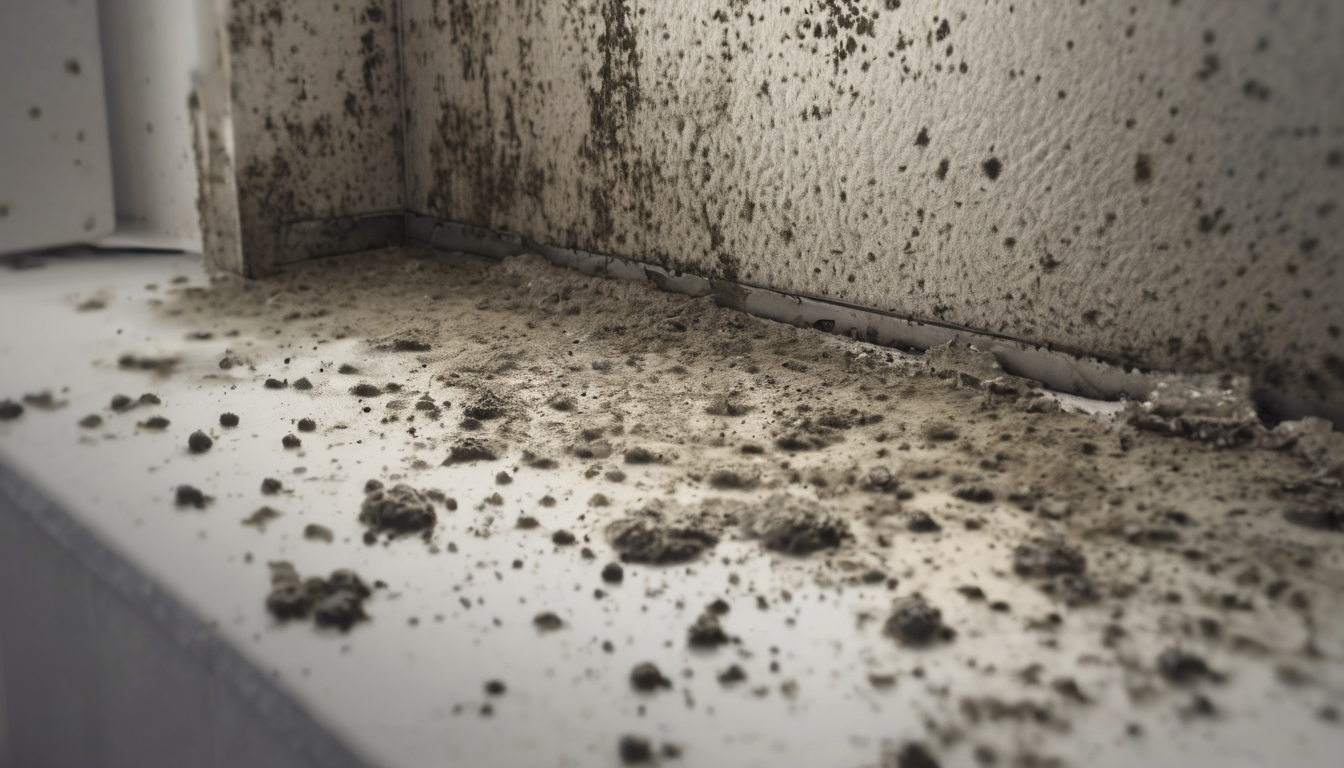
Understanding Mold Inspection Dubai: What Professionals Actually Test For is essential. A mold inspection in Dubai is not simply a walkthrough with a torch and a trained eye. During a structured professional assessment — what IAC2 methodology describes as an Integrated Environmental Investigation — inspectors measure, sample, and interpret data across multiple diagnostic layers. Understanding what professionals actually test for during a mold inspection Dubai assessment helps property owners make informed decisions, understand their results, and protect the people living or working inside the building.
Dubai’s climate creates conditions that make mold inspection genuinely complex. From May through September, outdoor temperatures consistently reach 40°C and above, while indoor air-conditioning systems cycle continuously to compensate. This thermal contrast between cool interior surfaces and warm, humid air — particularly at the building envelope — generates condensation patterns that shift with the season. A mold inspection Dubai professionals conduct during the peak summer months will often reveal moisture accumulation points that are completely dry by November. Seasonality is not background context here. It is a diagnostic variable. This relates directly to Mold Inspection Dubai: What Professionals Actually Test For.
What follows is a structured explanation of every test category that a certified mold inspection in Dubai should include, why each one matters, and what the results actually mean for your property. When considering Mold Inspection Dubai: What Professionals Actually Test For, this becomes clear.
Mold Inspection Dubai: What Professionals Actually Test For – Why Dubai’s Summer Season Defines the Mold Inspection Scope
Before any sampling begins, a competent mold inspection Dubai specialist will account for when the inspection is being conducted. The UAE summer — running roughly from May to September — is the primary mold season for interior environments. Air-conditioning systems operate at maximum load. Ventilation pathways become moisture highways. Building materials that absorbed humidity during the spring transition period begin to show biological activity. The importance of Mold Inspection Dubai: What Professionals Actually Test For is evident here.
In field investigations conducted across Dubai villas and apartments, recurring moisture accumulation is most commonly observed along north-facing walls, inside concealed HVAC ducts, beneath bathroom flooring, and at the junctions between curtain walling and internal partitions. These are the locations where summer inspection protocols focus first. A mold inspection conducted in February, outside the high-humidity window, may underestimate the true scope of contamination simply because the driving moisture conditions are absent. This seasonal variability is why professional assessment timing matters. Understanding Mold Inspection Dubai: What Professionals Actually Test For helps with this aspect.
Mold Inspection Dubai: What Professionals Actually Test For – Visual Assessment — The Starting Point of Every Mold Inspe
Every structured mold inspection Dubai protocol begins with a systematic visual survey. This is not a casual look around. It follows a room-by-room, surface-by-surface methodology that documents visible staining, discolouration, efflorescence, surface texture changes, and building material deterioration. The inspector is looking for evidence of past or current moisture events, not just visible mould growth. Mold Inspection Dubai: What Professionals Actually Test For factors into this consideration.
Visible mould represents only a fraction of what may be present. Laboratory analysis frequently confirms that spore concentrations in air samples are elevated even in spaces where no visible growth is detected. The visual assessment therefore functions as a baseline orientation — it tells the inspector where to prioritise further testing, not where the investigation ends. This relates directly to Mold Inspection Dubai: What Professionals Actually Test For.
What the Inspector Is Documenting Visually
- Water staining on ceilings, walls, or floors
- Surface discolouration consistent with biological growth
- Paint bubbling, peeling, or substrate separation
- Corrosion on metal components near HVAC registers
- Condensation patterns on glazing or cold surfaces
- Odour indicators of microbial volatile organic compound (MVOC) presence
Mold Inspection Dubai: What Professionals Actually Test For – Moisture Mapping — The Most Diagnostic Layer in a Dubai Mo
Moisture measurement is the technical foundation of a professional mold inspection Dubai specialists rely on. Without quantified moisture data, any remediation recommendation is speculative. Certified inspectors use a combination of non-invasive pin-type and radio-frequency moisture metres to map relative moisture content across building materials including plasterboard, timber substrates, screed, and masonry. When considering Mold Inspection Dubai: What Professionals Actually Test For, this becomes clear.
In Dubai properties, moisture mapping during summer inspections commonly reveals elevated readings inside wall cavities adjacent to chilled water pipe runs, beneath bathroom tiles where waterproofing membranes have failed, and at slab junctions in ground-floor villas. These findings guide the sampling strategy — directing air and surface samples toward the areas of highest biological probability rather than relying on random placement. The importance of Mold Inspection Dubai: What Professionals Actually Test For is evident here.
Thermal Imaging as a Moisture Detection Tool
Infrared thermography extends the reach of moisture mapping beyond what contact metres can access. As a thermal imaging certified investigator, I use calibrated thermal cameras to detect temperature differentials that indicate evaporative cooling from moisture — a reliable indicator of elevated moisture content behind non-destructive surfaces. This is particularly valuable in Dubai villas with tiled or marble-clad walls where direct metre contact is not possible without damage. Understanding Mold Inspection Dubai: What Professionals Actually Test For helps with this aspect.
Thermal imaging does not confirm mould. What it confirms is the presence of hygrothermal anomalies that warrant further sampling. It is a localisation tool, not a diagnostic conclusion. Combined with moisture metre data and borescope inspection where access permits, thermal imaging significantly reduces the uncertainty in a mold inspection Dubai investigation. Mold Inspection Dubai: What Professionals Actually Test For factors into this consideration.
Air Sampling — What Spore Counts Actually Tell You
Air sampling is the primary quantitative tool in mold inspection Dubai protocols. Using calibrated pump-and-cassette devices — typically spore trap sampling media — inspectors draw a measured volume of air through a collection cassette over a defined sampling period. The cassette is then submitted to a laboratory for analysis, producing a spore count expressed as spores per cubic metre of air. This relates directly to Mold Inspection Dubai: What Professionals Actually Test For.
Interpretation requires comparison samples. A single indoor air sample means little without a corresponding outdoor baseline. The inspector collects outdoor samples simultaneously to establish what spore genera and concentrations are present in the ambient environment. When indoor spore counts — particularly of genera such as Aspergillus/Penicillium, Cladosporium, or Stachybotrys — significantly exceed outdoor levels, this differential indicates an indoor source. The mold inspection Dubai report documents this differential analysis as its core finding. When considering Mold Inspection Dubai: What Professionals Actually Test For, this becomes clear.
What Species Are Commonly Identified in Dubai Properties
Laboratory analysis in Saniservice’s in-house microbiology laboratory frequently identifies Aspergillus and Penicillium species as the dominant indoor genera in Dubai residential properties. These thrive in the 20–30°C temperature range that most air-conditioned Dubai interiors maintain. Cladosporium is commonly observed where surface condensation occurs seasonally. Stachybotrys chartarum — what is colloquially referred to as black mould — is identified less frequently but is consistently associated with prolonged cellulose substrate saturation, often following undetected water leaks. The importance of Mold Inspection Dubai: What Professionals Actually Test For is evident here.
Species identification matters for remediation planning. Different genera respond differently to remediation methods. It also matters for health risk assessment, particularly for occupants with respiratory conditions or immunocompromised family members. A mold inspection Dubai report that includes laboratory species identification provides a significantly stronger basis for decision-making than one that relies on visual assessment alone. Understanding Mold Inspection Dubai: What Professionals Actually Test For helps with this aspect.
Surface Sampling — Confirming What Is Growing Where
Surface sampling collects biological material directly from suspect surfaces using either tape-lift, swab, or bulk material sampling methods. When interpreted alongside air samples, surface results allow inspectors to confirm whether elevated air counts have an identifiable source within the property. A mold inspection Dubai protocol that includes surface sampling provides the documentation needed for subsequent remediation scoping and post-remediation verification. Mold Inspection Dubai: What Professionals Actually Test For factors into this consideration.
Tape-lift samples are collected from suspect staining on walls, ceilings, or HVAC components. Swab samples are used where the surface is irregular or the contamination layer is thin. Bulk sampling — collecting a small piece of building material — is reserved for situations where the material itself is suspected of being colonised throughout its depth, not just on the surface. This relates directly to Mold Inspection Dubai: What Professionals Actually Test For.
HVAC and Duct Inspection — A Seasonal Priority in the Mold Inspection Dubai Process
In Dubai, the HVAC system is not a comfort feature — it is a life support system. It operates continuously for the majority of the year. This continuous operation creates conditions inside ductwork that are uniquely favourable to mould growth: cooled surfaces, residual condensation, accumulated organic debris, and intermittent airflow. A mold inspection Dubai assessment without a dedicated HVAC component is incomplete by definition. When considering Mold Inspection Dubai: What Professionals Actually Test For, this becomes clear.
Read more: Mold Clearance Certificate
Professional inspectors use borescope cameras to visually examine the interior of supply ducts, return plenums, and air handling unit components. They look for visible mould growth, biofilm accumulation, and debris that could serve as a nutrient substrate. Air samples taken at supply registers — when compared to samples at the return air intake — can indicate whether contamination is being distributed through the system. Per NADCA-aligned methodology, the duct inspection is documented photographically and cross-referenced with air quality findings. The importance of Mold Inspection Dubai: What Professionals Actually Test For is evident here.
What a Professional Mold Inspection Dubai Report Should Contain
A science-based mold inspection Dubai report is not a single-page summary with a recommendation to remediate. It is a structured document that connects environmental data to building performance and provides a basis for action. Based on IAC2 reporting standards, a complete report should include the following elements.
- Property background, inspection date, and environmental conditions at time of sampling
- Visual assessment findings with photographic documentation
- Moisture metre readings mapped by room and surface
- Thermal imaging findings where applicable
- Air sampling results with indoor-to-outdoor comparison and spore identification
- Surface sampling results with species identification
- HVAC inspection findings and duct condition assessment
- Root cause assessment identifying the moisture source driving biological activity
- Remediation scope recommendation proportional to findings
- Post-remediation verification requirements
The report is the deliverable that matters most. It is what protects property owners, guides remediation contractors, and supports any DHA mold clearance certificate application that may follow remediation work.
Key Takeaways for Property Owners Commissioning a Mold Inspection in Dubai
As an IAC2 Certified Indoor Air Consultant with more than 20 years of field investigation experience across Dubai and the wider UAE, the most common gap I observe is the confusion between a surface clean and a verified inspection outcome. A mold inspection Dubai professionals conduct is a diagnostic process — not a treatment. Its value is in the precision of the data it produces.
- Commission inspections during the May–September humidity season for the most diagnostically representative results.
- Confirm that your inspector uses calibrated sampling equipment and a laboratory for analysis — not visual assessment alone.
- Ensure air samples include simultaneous outdoor baseline collection for valid indoor-to-outdoor comparison.
- Request species identification in your laboratory report — genus-level data alone may be insufficient for remediation planning.
- Verify that moisture mapping and HVAC inspection are included, not optional add-ons.
- Understand that the mold inspection scope should inform remediation scope — the two are connected by evidence, not assumption.
Frequently Asked Questions
What does a professional mold inspection in Dubai actually test for?
A professional mold inspection Dubai assessment tests for airborne spore concentrations, surface biological contamination, moisture content within building materials, HVAC duct conditions, and species identity through laboratory analysis. The goal is to quantify what is present, locate its source, and determine the hygrothermal conditions driving growth — not simply to confirm that mould exists.
How does Dubai’s summer climate affect mold inspection findings?
Dubai’s summer season — from May to September — is the primary period when indoor mould risk is highest. Continuous air-conditioning creates cold surfaces that attract condensation from warm, humid incoming air. Mold inspection Dubai specialists conducting assessments during this period frequently identify moisture accumulation inside wall cavities, behind bathroom walls, and within HVAC components that may be absent during cooler months.
Is a visual inspection enough to determine if mould is present in a Dubai property?
No. Visual assessment is the starting point, not the conclusion. Laboratory analysis of air and surface samples consistently reveals elevated spore concentrations in spaces where no visible mould is present. A complete mold inspection in Dubai requires air sampling, surface sampling, moisture mapping, and laboratory analysis to produce actionable findings. Visual-only assessments carry a significant risk of false negatives.
What is the difference between air sampling and surface sampling in mold inspection?
Air sampling measures the concentration and genera of spores suspended in the indoor environment, indicating whether an active or disturbed source is present. Surface sampling confirms what is growing on a specific material or location. In a mold inspection Dubai protocol, both are used together — air sampling detects dispersal, surface sampling identifies the source. Combined results are far more reliable than either method alone.
How long does a professional mold inspection take in a Dubai villa or apartment?
Inspection duration depends on property size and complexity. A typical Dubai apartment may require two to three hours for a thorough mold inspection. A larger villa with multiple levels, a complex HVAC system, or suspected hidden contamination may require four to six hours or more. The sampling and laboratory analysis process adds further time before a final report is issued.
What is a DHA mold clearance certificate and when is it required in Dubai?
A DHA mold clearance certificate is issued following successful remediation and post-remediation verification testing, confirming that the property meets acceptable indoor environmental standards. It is commonly required for commercial properties, healthcare facilities, and childcare settings in Dubai. Some residential landlord-tenant disputes and property handover situations also involve clearance documentation as part of the verification process.
Can HVAC systems spread mould throughout a Dubai property during a mold inspection?
Yes — and this is precisely why HVAC inspection is a core component of mold inspection Dubai protocols. When mould colonises duct interiors, air handling unit components, or drain pans, the distribution system itself becomes a dispersal pathway. Sampling at supply registers and comparing results to return air measurements allows inspectors to determine whether the HVAC system is actively contributing to elevated indoor spore counts.
A mold inspection Dubai professionals conduct is ultimately a data-gathering exercise in service of clarity. It answers the question that matters most to property owners and their families: not whether something might be present, but what is actually present, where it originates, and what the evidence says should happen next. That clarity — built from calibrated measurements, laboratory-confirmed results, and root-cause analysis — is what separates a professional inspection from a surface estimate. Understanding Mold Inspection Dubai: What Professionals Actually Test For is key to success in this area.